Best Cutting Board for Japanese Knives 2026: 5 Editor-Tested Picks
QUICK ANSWER
For Japanese knives, the best cutting board is a soft polyethylene or synthetic-rubber board (Hasegawa or Asahi Cookin’ Cut) or an end-grain hardwood / hinoki board — never glass, stone, ceramic, bamboo, or hard acrylic.
Best overall
Hasegawa soft-poly
Best wood
Hinoki / end-grain
Always avoid
Glass, bamboo, stone
Price range
$30–$300+
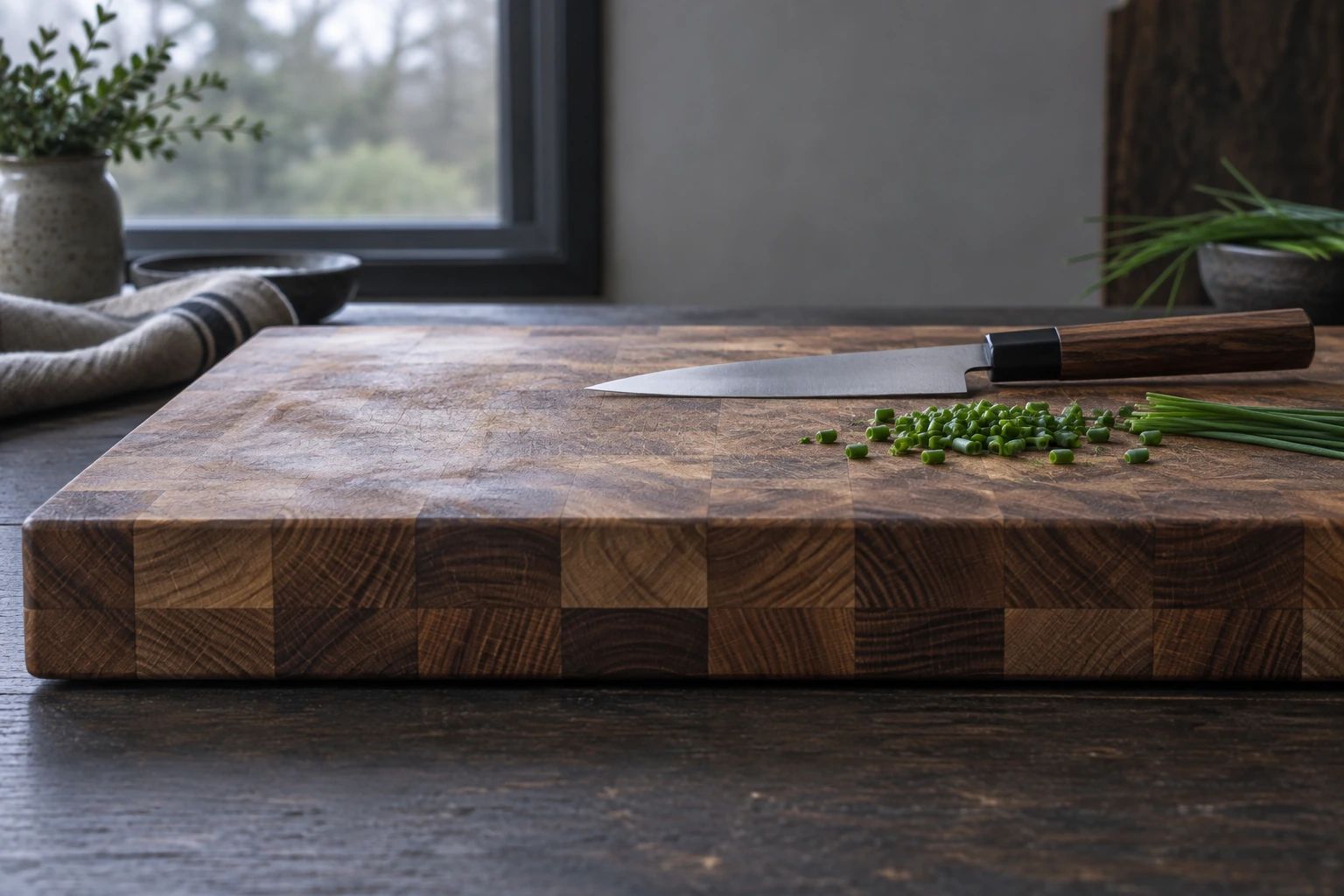
Table of Contents
TL;DR — best picks by category
The single best all-round board for a Japanese knife is a soft polyethylene board — our top pick is the Hasegawa wood-core soft-poly. If you want a beautiful wood board instead, an end-grain hardwood block (John Boos is the Western benchmark) or a traditional hinoki board protects the edge just as well.
- Best pro soft-poly — Hasegawa wood-core soft-poly board (~$120–250) — the editor’s choice
- Best end-grain wood — John Boos end-grain maple block (~$100–250)
- Best hinoki — Yoshihiro hinoki cutting board (~$60–150)
- Best budget — Asahi Cookin’ Cut soft-poly (~$40–90)
- Best for small kitchens — slim soft-poly board (Hasegawa / Asahi, ~$30–70)
- First serious board → Asahi Cookin’ Cut or Hasegawa
- "Buy once" board → Hasegawa soft-poly or John Boos end-grain
- Gift / traditional kitchen → Yoshihiro hinoki
Short version: a soft-poly board (Hasegawa or Asahi) or a soft wood board (hinoki / end-grain) — almost every Japanese-knife kitchen is best served by one of these. Whatever you do, keep the blade off glass, stone, ceramic, bamboo, and hard acrylic.
Why the board matters for Japanese edges
A Japanese knife is ground thinner and hardened higher than a typical Western blade — often HRC 60 and above, with an edge angle in the low double digits. That geometry is what makes it cut so cleanly, but it also makes the apex fragile against a hard surface. Every cut is a collision between the steel and the board; if the board is harder than (or even close to) the steel, the steel loses, rolling or micro-chipping a little with each stroke.
The practical takeaway for buying a board is simple: pick a surface that yields slightly under the blade. Soft polyethylene and soft woods (hinoki, end-grain hardwood) do exactly that — the surface gives a fraction of a millimetre, the impact is absorbed, and the edge survives. Hard surfaces do the opposite. This is why the same $200 knife can need sharpening monthly on one board and twice a year on another. If you want the full hardness ladder and the material science behind it, that lives in our cutting board materials guide; below we go straight to the picks.
How we tested
Our testing protocol:
- Board set — a dozen boards spanning soft poly, end-grain and edge-grain hardwood, hinoki, cheap HDPE, bamboo, and a glass control.
- Same-food prep — daily vegetable prep (cabbage, onion, carrot, herbs) plus periodic protein work over a two-week cycle, identical across boards.
- Edge retention — knives sharpened to the same baseline, then checked after the cycle with paper and tomato-skin tests to gauge how much edge each board cost us.
- Feel and grip — knuckle clearance, board slip on the counter, and how "dead" or springy each surface felt under the blade.
- Hygiene and care — dishwasher tolerance, staining from turmeric/beet/tomato, drying behaviour, and warping over the cycle.
- Weight and size — how manageable each board was to lift, wash, and store in a normal home kitchen.
Each board scored on edge-friendliness, feel, hygiene, durability, and value. Those scores drove the category picks below. Prices throughout are approximate ranges in USD; the same boards are typically cheaper bought in Japan.
Best pro soft-poly — Hasegawa
Editor’s choice overall: Hasegawa wood-core soft-poly board (~$120–250 depending on size)
Hasegawa’s soft polyethylene boards are the quiet default in modern Japanese professional kitchens, and for good reason. The construction is a soft-poly surface bonded over a wood core: the poly face is tuned to yield slightly under a sharp edge — gentle like soft wood — while the wood core keeps the board light, flat, and dimensionally stable so it doesn’t warp the way a solid plastic slab can. The surface is dishwasher-safe and sanitizer-friendly, which is exactly why hygiene-conscious kitchens adopted it.
- Strengths — outstanding edge-friendliness, dishwasher-safe, resists warping, re-planeable, the most "professional" all-rounder here
- Weaknesses — heavier and pricier than a basic board; less romantic than wood
- Buy if — you own one good knife you maintain and want the highest-return board upgrade
When someone asks "one board for a Japanese knife," this is our answer more often than not: it pairs the edge-kindness of good wood with the hygiene and low-maintenance of plastic. It is the board you buy once.
Best end-grain wood — John Boos
Editor pick (wood): John Boos end-grain maple block (~$100–250)
If you want a wood board, end-grain is the construction that protects a thin edge best, and John Boos is the established Western benchmark for end-grain blocks. In an end-grain board the wood fibers stand vertically, so the blade parts the fibers and they spring back rather than being sliced through — less edge contact, slower dulling, and knife marks that tend to self-close. A quality end-grain maple board is genuinely close to hinoki in edge-friendliness and is far easier to source in North America and Europe.
- Strengths — excellent edge-friendliness, beautiful, heavy and stable, widely available, re-surfaceable
- Weaknesses — heavy; needs regular mineral-oil conditioning; hand-wash only
- Buy if — you want a handsome lifetime wood board and don’t mind the upkeep
Same-tier note: edge-grain hardwood boards (maple, walnut, cherry) are cheaper and still perfectly usable with a Japanese knife — they just dull the edge a touch faster and score more visibly than end-grain. For best edge life in wood, choose end-grain.
Best hinoki — Yoshihiro
Editor pick (traditional): Yoshihiro hinoki cutting board (~$60–150)
Hinoki (Japanese cypress) has been the traditional Japanese cutting surface for centuries, and it remains a superb match for Japanese knives. It is softer than knife steel, has a tight closed grain that resists water, and carries natural antibacterial oils — so it is gentle on the edge and naturally clean. Yoshihiro is a well-known name for Japanese-import hinoki boards available internationally; it is the easiest authentic hinoki to buy outside Japan.
- Strengths — excellent on edges, naturally antibacterial, light, develops a pleasing patina, traditional feel
- Weaknesses — hates standing water (must dry vertically), can stain, softer surface scores over time
- Buy if — you cook Japanese food, want the traditional surface, or are buying a thoughtful gift
Care is critical and a little counterintuitive: rinse with warm water, dry it standing on edge — never flat on a wet counter — and do not oil it. The wood’s own oils are part of its protection, and mineral oil clogs the grain. Treated right, a hinoki board lasts many years and can be re-planed.
Best budget — Asahi Cookin’ Cut
Editor pick (budget): Asahi Cookin’ Cut soft-rubber board (~$40–90)
Asahi’s Cookin’ Cut is a synthetic-rubber board that delivers most of the edge-friendliness and hygiene of a Hasegawa at a noticeably lower entry price. It yields under the blade like soft wood, shrugs off the dishwasher, doesn’t absorb juices, and resists staining — a lot of the professional benefit without the top-tier outlay. It is the board we point first-time buyers toward when they want to protect a new Japanese knife on a budget.
- Strengths — edge-friendly, dishwasher-safe, stain-resistant, the best value in soft-poly
- Weaknesses — heavier than cheap plastic; plainer looking than wood
- Buy if — you want pro-style edge protection and hygiene without paying flagship prices
Honest framing: if you can stretch to the Hasegawa you get a bit more longevity and a re-planeable wood core, but nobody should feel they are compromising the edge by choosing the Asahi. It is a genuinely good board.
Best for small kitchens
Editor pick (small space): a slim soft-poly board — Hasegawa or Asahi, ~$30–70
Tight counters, small sinks, and apartment dish racks reward a thinner, lighter board you can wash and stash easily. The good news is that soft-poly boards come in slim formats that keep the edge-friendly surface while shedding bulk and weight. A compact Hasegawa or Asahi soft-poly board fits a small kitchen far better than a heavy end-grain block and is still kind to a Japanese edge.
- Strengths — light, easy to wash and store, dishwasher-safe, still edge-friendly
- Weaknesses — small work area; very thin boards can slide (use a damp towel underneath)
- Buy if — counter and storage space are limited, or you want a second prep board
One practical tip regardless of size: a damp cloth or thin silicone mat under any board kills slipping, which matters more for safety with a very sharp Japanese knife than with a dull Western one.
Full comparison table
Prices are approximate ranges, not live pricing — they vary by retailer, availability, tax and exchange rate. Always confirm with the seller before buying.
| Pick | Board | Material | Price (USD) | Edge-friendly | Editor rating |
|---|---|---|---|---|---|
| Best overall / pro | Hasegawa soft-poly | Soft polyethylene + wood core | $120–250 | Excellent | ★★★★★ |
| Best end-grain wood | John Boos end-grain | End-grain maple | $100–250 | Excellent | ★★★★★ |
| Best hinoki | Yoshihiro hinoki | Hinoki cypress | $60–150 | Excellent | ★★★★☆ |
| Best budget | Asahi Cookin’ Cut | Soft poly / synthetic rubber | $40–90 | Very good | ★★★★☆ |
| Best small kitchen | Slim soft-poly (Hasegawa/Asahi) | Soft polyethylene | $30–70 | Very good | ★★★★☆ |
What to avoid (and why)
Some surfaces will damage a Japanese knife in a single session. The unifying principle: anything as hard as — or harder than — the steel is incompatible with a thin, high-hardness edge.
- Glass — far harder than the steel; instant micro-chipping. The fastest way to ruin a fresh edge.
- Stone (granite, marble, quartz) and stone counters — hard and unforgiving; never cut on them.
- Ceramic — including glazed plates — a glazed plate is functionally a ceramic board. One careless cut can chip the blade.
- Bamboo — laminated with glue and full of hard silica fibers that act like sandpaper on the apex. Looks natural, behaves abrasive.
- Hard acrylic and cheap dense HDPE — too hard and slick; the knife skates and the edge dulls faster than on soft poly or soft wood.
None of these are "bad products" in general — they are simply the wrong match for a thin Japanese edge. If your current surface is on this list, swapping it for a soft-poly or soft-wood board is the highest-return upgrade you can make. For the detailed hardness ladder behind these calls, see the cutting board materials guide.
How to choose without regret
- Default to soft. Soft poly (Hasegawa, Asahi) or soft wood (hinoki, end-grain) — any of these protects the edge. The mistake is choosing something hard.
- Poly vs wood is about lifestyle, not edge. Want dishwasher hygiene and zero maintenance? Soft poly. Want feel and looks and don’t mind oiling? Soft wood.
- For wood, end-grain beats edge-grain on edge life — though edge-grain is a fine budget step.
- Match care to material. Oil hardwood; never oil hinoki; just wash soft poly. Dry every board standing on edge, never flat on a wet counter.
- Size to your space and board, not just the knife. A heavy end-grain block is wonderful but punishing in a small kitchen; a slim soft-poly board is easier to live with.
- Buy in Japan if you can. Hasegawa, Asahi, and hinoki boards are typically cheaper bought domestically in Japan — Kappabashi in Tokyo is the place to handle options in person.
Stuck? Buy a Hasegawa soft-poly board if you want one board for life, or the Asahi Cookin’ Cut if you want most of that for less. Pair either with the right knife from our best Japanese knives roundup — a gyuto is the natural all-rounder to start with — and brush up on the alloy in your blade in the steel types guide.