Best Japanese Knives 2026: 6 Picks & 8 Top Brands, $50–$350
QUICK ANSWER
For most home cooks the right Japanese knife is a 165-180mm santoku in VG-10 stainless steel: the Tojiro DP Santoku 170mm ($50-85) covers vegetables, meat and fish with one blade.
Picks by category, priced from our registry: MAC Professional Gyuto 210mm ($130-160) overall, Miyabi 5000MCD Gyuto 200mm ($230-300) at the premium end. The table below compares published specifications and prices — the only knives we have cut with side by side are the six Kappabashi santoku. Looking for a brand rather than one knife? See the eight brands worth knowing.
- Best overall
- MAC Professional Gyuto 210mm ($130-160)
- Best budget
- Tojiro DP Santoku 170mm ($50-85)
- Best premium
- Miyabi 5000MCD Gyuto 200mm ($230-300)
- First-time buyer
- Santoku 165-180mm
Table of Contents
Japanese knives are the gold standard of kitchen cutlery — thinner, sharper, and harder than their Western counterparts. This guide names one pick per category from the makers we cover in depth: Shun, Miyabi, Tojiro, MAC and Misono, plus the artisan maker Sukenari.
What this page is, and what it is not. The table below is a comparison of published specifications and street prices — not a hands-on cutting test. The only knives we have cut with side by side are the six Kappabashi santoku we bought and used in April 2026. Every price here is read from our product registry, so the same knife carries the same price wherever it appears on this site.
What We Actually Tested: Six Kappabashi Santoku (April 2026)
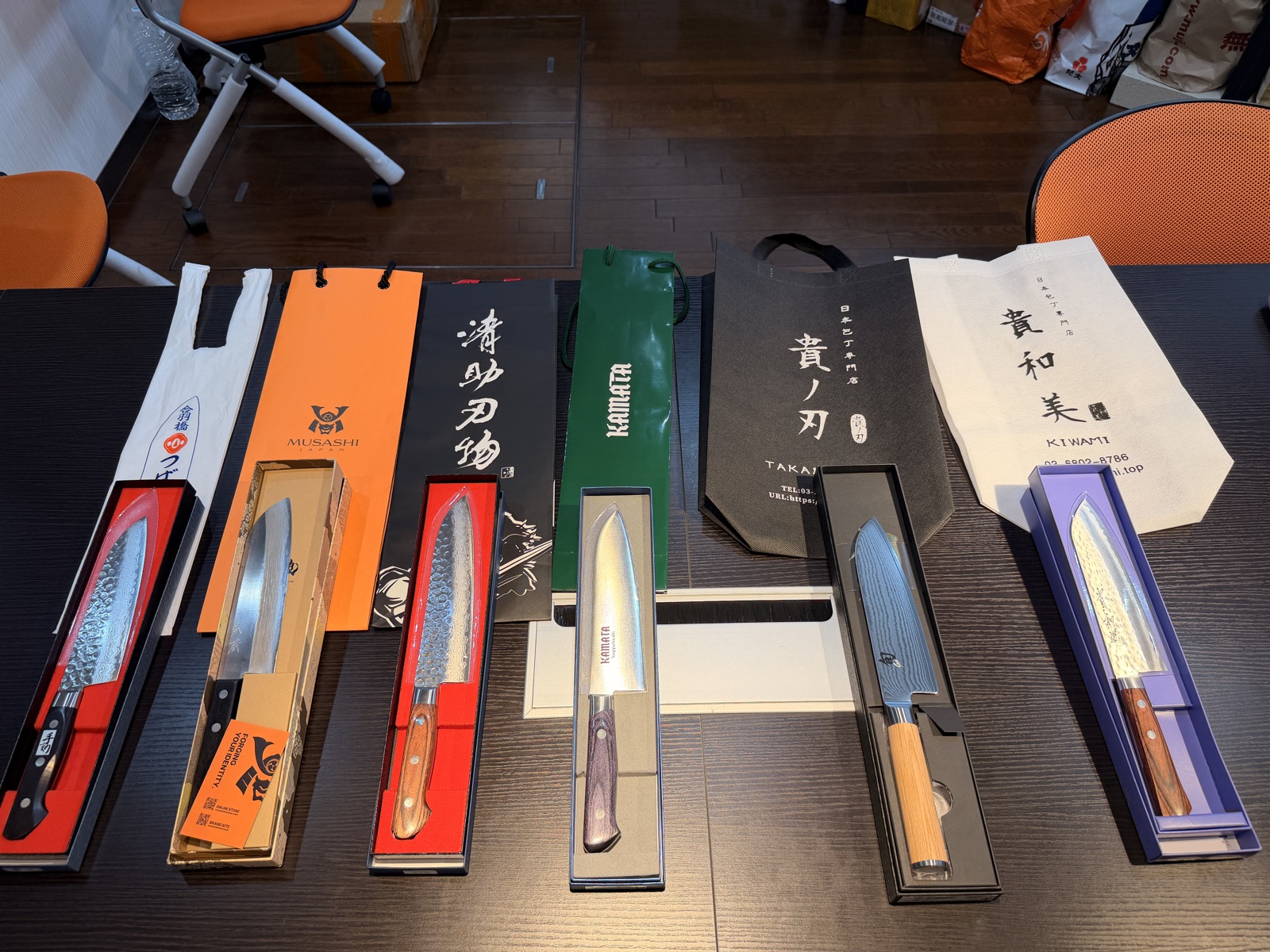
On a single day in April 2026 we walked Kappabashi and bought one santoku from each of six specialist shops, paying full retail as ordinary customers — no samples, no loaners. The budget was around $150 per knife (¥17,800-23,100). That same day, on the same hinoki board, with the same person cutting and every blade still carrying its unmodified factory edge, we cut a tomato, an onion and a daikon — once each, per knife.
Ranking the six knives 1st to 6th on each food and adding the points gave:
- 1st — Kiwami (貴和美), 16 points — 1st on tomato, 1st on onion, 3rd on daikon.
- 2nd — Takanojin (貴ノ刃), 15 points — 1st on daikon, 2nd on tomato, 3rd on onion.
- 3rd — Kamata Hakensha, 14 points — 2nd on onion, 2nd on daikon, 3rd on tomato.
What we did not measure: edge retention, ease of sharpening, and durability. Three cuts in one afternoon tell you how a blade arrives, not how it behaves after a month of service, and we have not yet run a long-term test on any knife. Read the ranking as a snapshot of out-of-the-box cutting — nothing more.
The full write-up, with 29 photos and 18 videos: we bought six Japanese knives around $150 in Kappabashi.
Our Picks by Category (spec comparison — not hands-on)
| Category | Our Pick | Price | Basis | Why |
|---|---|---|---|---|
| Best Overall | MAC Professional Gyuto 210mm | $130-160 | Spec | Best balance of performance, value, and durability |
| Best Budget / first knife | Tojiro DP Santoku 170mm | $50-85 | Spec | VG-10 performance at the lowest sensible price |
| Best Santoku | Shun Classic Santoku 175mm | $130-160 | Spec | Damascus cladding over an excellent VG-MAX core |
| Best Gyuto | Misono UX10 Gyuto 210mm | $160-200 | Spec | Thin grind, long-standing favourite in Japanese kitchens |
| Best Damascus / premium | Miyabi 5000MCD Gyuto 200mm | $230-300 | Spec | 101-layer Damascus over an SG2 powdered-steel core |
| Best Professional | Sukenari SG2 Gyuto 240mm | $250-350 | Spec | Powdered stainless, 240mm for high-volume prep |
Best Japanese Knife Brands 2026
Eight makers cover most of what is worth buying, from a first knife to a professional's yanagiba. Prices are typical US street prices for their kitchen knives.
| Brand · based in | Known for | Typical price |
|---|---|---|
| Tojiro Tsubame, Niigata | The DP series: a VG-10 core at a beginner's price | $40–250 |
| MAC Seki, Gifu (founded 1965) | Thin, Western-handled working knives made at its own factory | $80–280 |
| Misono Seki, Gifu (founded 1935) | The UX10 line in Swedish stainless with Western handles | $120–400 |
| Shun Seki, Gifu (Kai Corporation) | VG-MAX cores, Damascus cladding, D-shaped handles; widely sold outside Japan | $120–400 |
| Miyabi Seki, Gifu (made for Zwilling) | Powdered-steel cores such as SG2 under multi-layer Damascus | $150–500 |
| Global Tsubame, Niigata (Yoshikin) | One-piece stainless knives with a dimpled handle | $60–150 |
| Masamoto Tokyo | Traditional single-bevel knives: yanagiba, deba, usuba | $200–1,000+ |
| Yu Kurosaki Echizen, Fukui | Hand-forged blades with hammered and textured finishes | $200–500 |
Choosing between the two premium Damascus lines? Shun is a little softer and easier to sharpen; Miyabi is harder and holds a fine edge longer. Our Shun vs Miyabi comparison goes through it line by line.
For an in-depth comparison of every major brand, see our Japanese knife brands compared — or browse the individual maker profiles.
Best Overall: MAC Professional Gyuto (210mm)
Price: $130-160 | Steel: MAC proprietary high-carbon stainless | HRC: 59-61 | Weight: 165g
The MAC Professional has been a kitchen workhorse for decades, and for good reason. It is thin, sharp out of the box, and its proprietary steel offers an excellent balance of hardness and toughness. At 210mm, it handles everything from dicing onions to portioning proteins.
Pros: Sharp out of the box, forgiving geometry, comfortable grip, durable
Cons: Plain appearance (no Damascus), handle style may not suit everyone
Best Budget — and Best First Japanese Knife: Tojiro DP Santoku (170mm)
Price: $50-85 | Steel: VG-10 core, stainless clad | HRC: 60-61 | Weight: 145g
The Tojiro DP is legendary in the knife community for punching far above its price. The VG-10 stainless core with soft stainless cladding delivers genuine Japanese cutting performance. It is the knife we point people to most often when they are buying their first Japanese knife.
It doubles as our beginner pick for the same reasons: it is forgiving, it comes back quickly on a basic whetstone, and it is cheap enough that damaging the edge while you learn to sharpen is a lesson rather than a disaster.
Pros: Outstanding value, VG-10 steel, easy to sharpen, widely available
Cons: Handle comfort is average, fit and finish are not premium
Best Santoku: Shun Classic Santoku (175mm)
Price: $130-160 | Steel: VG-MAX core, Damascus clad | HRC: 60-61 | Weight: 170g | Layers: 68
The Shun Classic combines 69-layer Damascus cladding with a VG-MAX core. The D-shaped PakkaWood handle is comfortable for extended use. It is the santoku that looks as good as it cuts.
Pros: Gorgeous Damascus pattern, excellent steel, comfortable handle
Cons: Premium price for a santoku, can be chip-prone on hard foods
Comparing santoku across every budget? See our dedicated best santoku knife guide.
Best Gyuto: Misono UX10 Gyuto (210mm)
Price: $160-200 | Steel: Swedish stainless (Sandvik-type) | HRC: 59-60 | Weight: 155g
The Misono UX10 is the knife you will find in top Japanese restaurant kitchens. Hand-ground in Seki by skilled craftsmen, the blade geometry is exceptional — thin without being fragile, sharp without being delicate. Swedish stainless steel offers excellent corrosion resistance.
Pros: Professional-grade, exceptional blade geometry, great balance, corrosion-resistant
Cons: Plain appearance, stainless handle can be slippery when wet
For the full gyuto line-up by budget, see our best gyuto knife guide.
Best Damascus: Miyabi 5000MCD Gyuto (200mm)
Price: $230-300 | Steel: SG2 powdered core | HRC: 63 | Weight: about 170g | Layers: 101
The Miyabi 5000MCD (sold as Miyabi Birchwood SG2) is arguably the most beautiful production knife available. Zwilling describes a 101-layer "flower" Damascus blade around an SG2 micro-carbide powder steel core, hardened to HRC 63 and hand-honed in Seki.
Pros: Stunning 101-layer Damascus, SG2 powdered steel, Karelian birch handle
Cons: Premium price, powdered steel this hard wants a whetstone, not a honing rod
Best for Professionals: Sukenari SG2 Gyuto (240mm)
Price: $250-350 | Steel: SG2/R2 powdered stainless core | HRC: 63-64 | Weight: 185g
Sukenari is not a person but a company: Sukenari Co., Ltd. (株式会社スケナリ), which forges under the trademark 佑成 in Fuchū-machi, Toyama City, and has been in business since 1933. It is often described as an Echizen maker — it is not; Toyama is a different prefecture entirely. The blade is an SG2/R2 powdered stainless core run at HRC 63-64 — a fine-grained steel taken to a high hardness. At 240mm it assumes a large board and room to work; with less space than that, a 210mm is the sensible length. Available with a Damascus or migaki (polished) finish.
Pros: Powdered stainless core at HRC 63-64, 240mm of blade for long prep sessions, Damascus or migaki finish
Cons: Requires whetstone maintenance, needs a big board, not for beginners
A knife is only half the kit. Keeping one of these sharp needs a whetstone, and a hard board will chip a thin Japanese edge faster than anything else you do to it — see our cutting board guide.
How We Chose These
These picks come from published specifications, prices and reputation — not from a cutting test. What we weigh:
- Core steel and published hardness — what the maker states, and whether the HRC suits the job the knife is bought for
- Blade geometry as specified — length, profile and handle type against the intended use
- Price consistency — every price on this page is read from our product registry, so one knife never carries two prices across the site
- Standing in working kitchens — models that professional cooks keep buying and specialist shops keep restocking
- Availability — knives you can actually find, both in Japan and from abroad
Where we have cut with the knives ourselves, we say so — and that is the six Kappabashi santoku, nothing else. We buy at full retail on the editorial budget, as ordinary customers; no maker or retailer supplies us with knives. The commercial relationships we do have are listed in full on our team page, and our testing tiers are set out in our methodology.
Buying Guide: What to Consider
| Factor | Recommendation |
|---|---|
| First knife | Santoku 165mm or Gyuto 210mm |
| Steel type | Stainless (VG-10, SG2) for easy care; carbon for max sharpness |
| Budget | Start at $50-85 (Tojiro DP Santoku 170mm); $130-160 (MAC Professional Gyuto 210mm) if you want to buy once |
| Handle | Wa-handle (Japanese) for lighter weight; Western for familiar grip |
| Where to buy | In Japan: the Kappabashi shop map, or our full shop guide. From abroad: the specialist shops' own online stores — several Kappabashi shops run English storefronts and ship internationally. |
Prices are approximate ranges, not live pricing — they vary by retailer, availability, tax and exchange rate. Always confirm with the seller before buying.
Frequently Asked Questions
What is the best Japanese knife brand?
Is Shun or Miyabi better?
How much should I spend on a Japanese knife?
What Japanese knife should I buy first?
Are Japanese knives better than German knives?
Sources
- [1] 株式会社スケナリ(商標「佑成」)会社案内 , Sukenari Co., Ltd. (2026)