Best Japanese Knife for Fish: From Filleting to Sashimi (2026)
QUICK ANSWER
Best fish workflow: deba 165mm (head/gut), yanagiba 270mm (filet/slice), small kodeba for plating.
Heading
Deba 165mm
Filleting
Yanagiba 270mm
Small fish
Ko-deba 120mm
Garnish
Petty 120-150mm
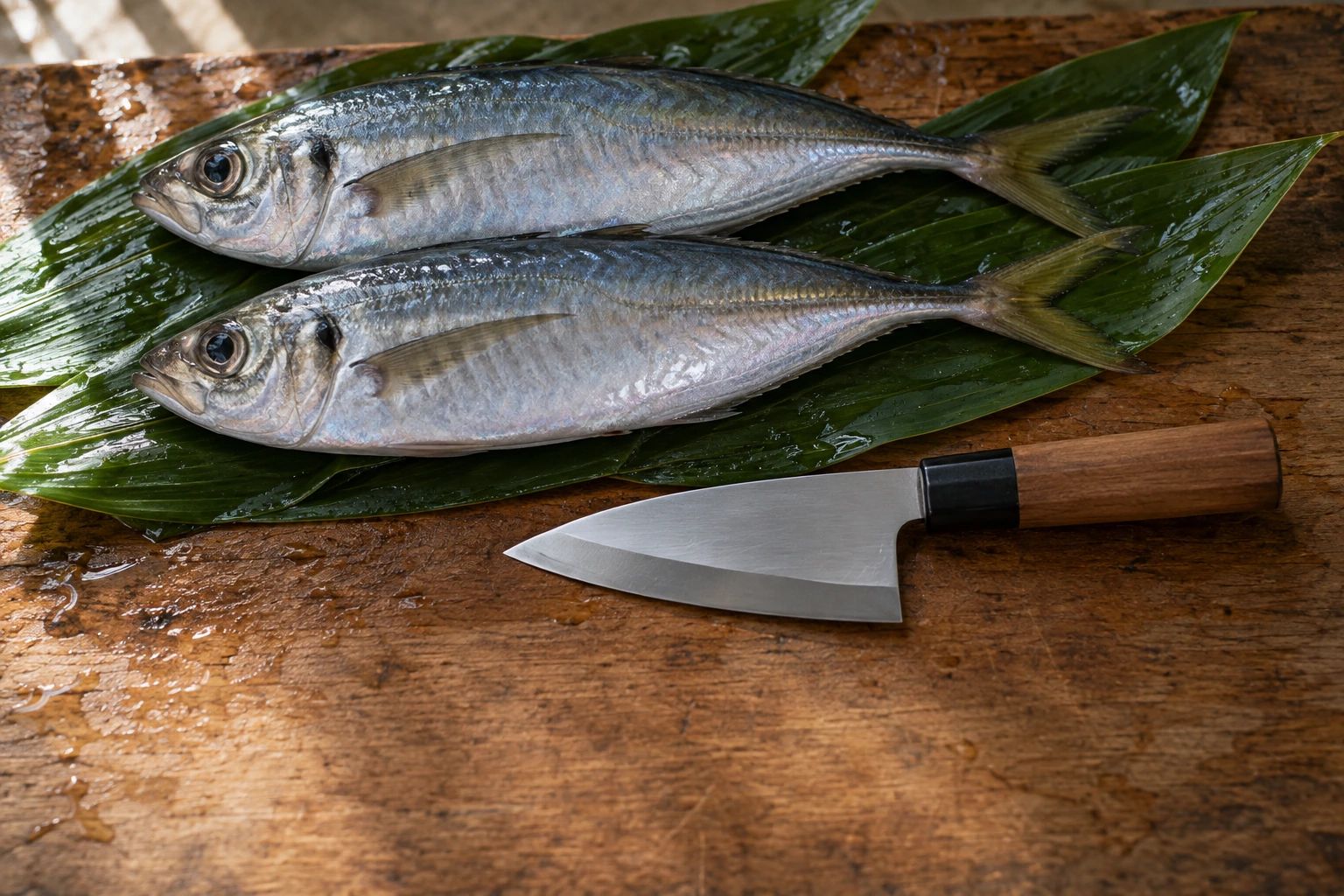
Table of Contents
TL;DR — Three knives for fish work
Fish-focused Japanese knives split into two roles: "break down" and "slice".
- Deba (150mm) — the home workhorse. Aji to tai. First knife to buy.
- Yanagiba (240mm) — slices the block into sashimi after the deba does the rough work.
- Ko-deba (120mm) or garasuki — second knife for small fish or delicate work.
If budget forces one knife, pick a 150mm deba. If you want a real fish kit, the canonical trio is deba + yanagiba + ko-deba or garasuki.
The whole-fish workflow
From a whole fish to sashimi, the standard home process:
- Scale (dedicated scaler or the spine of the deba)
- Head off (deba — behind the pectoral fin)
- Gut and rinse (deba or ko-deba — open the belly)
- Three-piece fillet (deba or garasuki — slide along the spine)
- Trim rib bones (ko-deba or garasuki — flat horizontal cut)
- Skin (yanagiba or deba — press blade against the board)
- Slice into sashimi (yanagiba — one pulling stroke)
Steps 1–3 are deba territory; 4–5 favor garasuki or ko-deba; 6–7 belong to yanagiba. To do the whole workflow you need at minimum a deba and a yanagiba.
Deba — the heavy single-bevel workhorse
The deba is the centerpiece of fish work. Thick spine (5–9mm), single bevel, mass that drops through bone. Full coverage in our deba guide.
- Length by use: 105mm (sardines, baby aji) / 120–135mm (aji, small saba) / 150mm (saba, small tai — home all-rounder) / 165mm (tai, small buri) / 180mm+ (buri and bigger).
- Strong at: bone work, heading, heavy lifting, flat grind that does not deflect against ribs.
- Weak at: wrist fatigue from weight (200–400g), delicate work, left-handed users (custom only).
Most versatile home size: 150mm. Aji through small tai, all covered. Start here for once-or-twice-a-week fish work.
Ko-deba and aji-kiri — small-fish specialists
Ko-deba is a downsized deba for sardines, aji, and small saba. In Kansai the same knife is often sold as "aji-kiri".
- Length: 105–135mm.
- Weight: 100–180g — about half a standard deba.
- Strong at: small-fish maneuverability, fine heel control, rib trimming, careful gutting.
- Weak at: snapping through the spine of a tai or buri.
Ideal as a second knife if you fish or buy small fish often, or if a 150mm deba feels too big in hand. Price is friendly: $55–$120 for solid options.
Garasuki — the triangular all-rounder
The garasuki originated as a poultry boning knife but has crossed over into fish work for its triangular profile, wide heel, and straight edge.
- Bevel: double (left-hand friendly).
- Length: 145–180mm.
- Strong at: chicken and fish both, easy to sharpen, scoops along bones.
- Weak at: snapping through major fish bones (deba still wins there), slicing sashimi.
"Can a garasuki replace a deba?" — yes for aji and saba, no for tai and buri. It is becoming a popular second knife in households that cook both meat and fish.
Honesuki — joint and bone work
The honesuki (kaku-gata) is a single-bevel boning knife with a sharp, pointed tip — designed to separate chicken joints, but useful for fish too.
- Bevel: single, with a pointed tip.
- Length: 150–180mm.
- Strong at: joint separation, intricate bone work.
- Weak at: sharpening (single-bevel) and home-cook approachability.
Fish-first cooks pick garasuki; meat-first cooks pick honesuki. See our honesuki / garasuki guide.
Yanagiba — finishing slices
The yanagiba slices the deba's filleted blocks into sashimi. Full detail in our yanagiba guide and best knife for sushi.
- Length: 240–300mm. Home: 240.
- Role: slicing blocks, skinning, thin sashimi (usu-zukuri).
- Pairs with deba: deba breaks down, yanagiba slices. Together they upgrade home fish cooking to another level.
Seven picks by fish type
| Use / fish | Maker | Length | Steel | Price (USD) | Notes |
|---|---|---|---|---|---|
| Home all-round deba | Tojiro Shirogami #2 | 150mm | Shirogami #2 | ~$65 | Aji to small tai. First-knife default. |
| Stainless deba | Tojiro DP Cobalt Alloy | 150mm | VG-10 core | ~$85 | Rust-resistant for everyday use. |
| Small-fish specialist | Masamoto Ko-deba | 120mm | Shirogami #2 | ~$80 | Aji and sardines. For anglers. |
| Fish-meat dual garasuki | Tojiro Garasuki | 150mm | VG-10 | ~$75 | Double-bevel, lefty friendly. |
| Large-fish o-deba | Sakai Ichimonji Mitsuhide Shirogami #2 | 180mm | Shirogami #2 | ~$160 | Buri and salmon class. |
| Home yanagiba | Tojiro Shirogami #2 Kasumi | 240mm | Shirogami #2 | ~$110 | Sashimi finishing. |
| Stainless yanagiba | Masamoto Ginsanko | 240mm | Ginsanko | ~$160 | Rust-resistant for long-term use. |
Where to buy
Kappabashi is the canonical destination. See our Kappabashi shop map. For fish-specific knives, Kama-Asa and Tsubaya (and Sugimoto, in nearby Tsukiji) have the deepest selection. International shipping: Hocho-Knife, JCK, Korin (NYC).
In Kansai, Sakai Ichimonji Mitsuhide has its shop in Namba, central Osaka, and the Sakai workshops (such as Minamoto Akitada) are worth the trip from Osaka. Around Tsukiji and Toyosu in Tokyo there are also professional knife shops with serious fish-knife inventory.
Prices are approximate ranges, not live pricing — they vary by retailer, availability, tax and exchange rate. Always confirm with the seller before buying.