Best Japanese Knife Under $200: Mid-Tier Picks That Last Decades (2026)
Basis Spec comparison · not hands-on tested
How we chose: makers' published specs, materials and price. We have not used these products ourselves. How we test
Quick answer
Best Japanese knives under $200 (prices checked October 2026): Misono Molybdenum Gyuto 210mm (~$126), Shun Classic Chef 8" (~$190), MAC Professional Santoku MSK-65 (~$140).
- Top pick
- Misono Molybdenum Gyuto ~$126
- Shun option
- Shun Classic Chef 8" ~$190
- MAC Pro
- MSK-65 Santoku ~$140
- Price range
- ~$126-190 (Oct 2026)
Buying from abroad? See how to order a Japanese knife online and what duties to expect
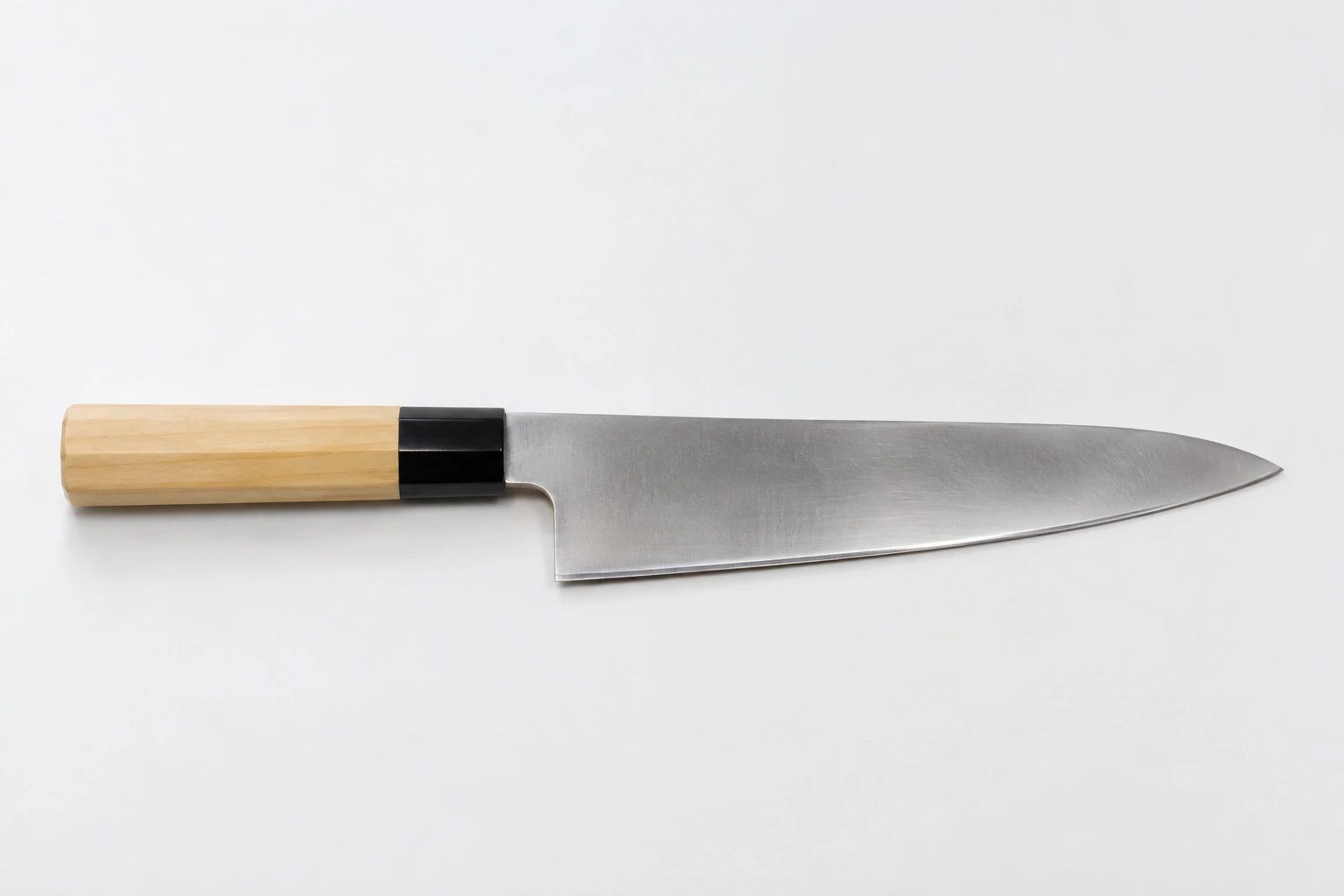
Table of Contents
TL;DR — Why $100-200 Is the Sweet Spot
Seven Japanese knives between $100 and $200. If you want the short list:
- Best pro-kitchen workhorse: Misono Molybdenum Gyuto 210mm — molybdenum stainless, HRC 56-58, ~$126. The in-budget Misono now that the UX10 costs about $258.
- Best for Western cooks: Shun Classic Chef 8" — VG-MAX, HRC 60-61, ~$190. Best brand support, easiest to buy outside Japan.
- Best traditional pick: Hatsukokoro Kurogane Blue #2 Kurouchi Gyuto 210mm — Aogami #2 carbon core, soft-iron clad, HRC 62, ~$139. Traditional iron-clad carbon construction from Tosa, well inside the budget.
The $100-200 tier is where Japanese knives stop being "a step up from a Wüsthof" and start being "a knife you'll never replace." Every pick here has a 30-50 year lifespan with proper care, and the cost-per-year math works out to under $7/year.
What an Extra $100 Actually Gets You
Moving from $100 to $200 buys three concrete improvements:
- Thinner geometry behind the edge. The first 5mm above the cutting edge is hand-thinned at the $200 tier rather than ground to a uniform profile. This reduces "wedging" in dense vegetables (kabocha, sweet potato).
- A wider choice of steels. Below $100 most knives are VG-10 or a softer stainless. In this band you can choose a harder edge — the Takamura Chromax santoku is listed at HRC 62-65 and the Hatsukokoro's Aogami #2 core at HRC 62 — or Damascus-clad VG-MAX (Shun Classic) and VG10 (Yaxell Ran Plus), while easy-to-sharpen stainless such as Misono's Molybdenum line (HRC 56-58) is still there.
- Refined handles. At $100, handles are functional Pakkawood with a small bolster. At $200, handles are polished, hand-fitted, with a balance point that's been deliberately tuned. The difference is felt over a 30-minute prep session, not in single cuts.
What you do not get for an extra $100: a dramatically sharper factory edge (both tiers are sharp), longer warranty, or a fundamentally different look. The improvements are subtle but cumulative — they show up in tool feel over time, not in initial impressions.
Compared to the under-$100 tier covered in our $100 guide, the under-$200 tier is where Japanese knives transition from "best-value tools" to "tools you'll keep for life."
1. Misono Molybdenum Gyuto 210mm
Steel: Molybdenum stainless · HRC: 56-58 · Length: 210mm · Price: ~$126
The pro-kitchen workhorse. The Molybdenum line is the most affordable of the Western-handled series from Misono, a maker in Seki: a stainless monosteel blade, a wood-composite Western handle and a lean 210mm profile. Chubo Knives lists it at 1.8mm thick at the spine and HRC 56-58. When we checked in October 2026, Chubo Knives, which ships from Japan, listed the 210mm at $126 (model No.512). In Japan the lowest kakaku.com listing was ¥9,888, and in Europe Hamono.nl listed it at €129 (out of stock).
Why we put it first: it is the in-budget way into Misono's Western-handled pro gyuto. The trade-off is softer steel — easier to bring back on a stone than the harder picks below, but it will need touching up more often. If you want harder steel with a Western handle, look at the Shun Classic (#2) or the Yaxell Ran Plus (#4). The line also comes in 180mm and 240mm.
Why not the Misono UX10? Earlier versions of this guide put the UX10 Gyuto 210mm in this slot at ~$190. That price is out of date: in October 2026 Chubo Knives listed it at $258 and Korin at $369.50, so it no longer fits this budget.
2. Shun Classic Chef 8" (200mm)
Steel: VG-MAX core, stainless Damascus cladding (34 layers per side) · HRC: 60-61 · Length: 200mm · Price: ~$190 / ¥23,100
The safest mid-tier buy in North America. Shun is Kai's premium Seki-based line, and the Classic Chef is their longest-running model — VG-MAX core (a steel Kai USA describes as proprietary to Shun and built on the VG10 formula) clad in 34 layers of stainless Damascus on each side. The decorative pattern is genuine roll-damascus, not laser-etched. The D-shaped Pakkawood handle is comfortable for both pinch and handle grips.
Why we recommend it: ubiquitous distribution. Available at Sur La Table, Williams-Sonoma, Amazon, and most kitchen retailers in 40+ countries. The warranty is honored through retailers such as Sur La Table and Williams-Sonoma. When we checked in October 2026, Cutlery and More and Abt both listed the 8" at $189.95, and Takashimaya in Japan listed the Japanese-market Shun Classic 200mm chef's knife at ¥23,100. Compared with the Misono Molybdenum (#1) it costs about $64 more, for harder steel (HRC 60-61 vs 56-58) and the Damascus cladding, and you don't have to import it from Japan. Buy the 200mm chef as your main, add the Classic Nakiri 165mm later for the vegetable specialist role.
3. MAC Professional Series Santoku 170mm
Steel: MAC proprietary high-carbon stainless (molybdenum-vanadium) · HRC: 61 · Length: 170mm (sold in the US as 6.5") · Price: ~$140 / ¥18,920
The "I want one knife and I want to never think about steel again" pick. MAC's Professional Series sits above the entry-level Original and Superior lines (see our under-$100 guide) and below the Ultimate. The steel is MAC's proprietary high-carbon stainless, listed by Cutlery and More at HRC 61, with the geometry tuned closer to a Western chef knife than any other knife on this list. The result: an extraordinarily forgiving knife that still cuts at the Japanese level.
We recommend the MAC Pro specifically for the cook who's coming from a Wüsthof Classic or Henckels and wants the smoothest possible transition. The Western handle (no wa learning curve), the slight belly curve (you can still rocking-chop), the moderate hardness (forgiving in the knife block, less brittle around bones). When we checked in October 2026, Cutlery and More listed this hollow-edge (dimpled) santoku, model MSK-65, at $139.95 and in stock, and MAC's own Rakuten shop in Japan listed it at ¥18,920. It is the most "buy it and stop thinking" knife in this guide. The Professional chef's knife is a different story: Cutlery and More lists the 8½" MBK-85 at about $215, outside this budget.
4. Yaxell Ran Plus Chef's Knife 8"
Steel: VG10 core, 69-layer stainless Damascus · HRC: 61 · Length: 8" (203mm) · Price: ~$179
The Damascus value pick. Yaxell is a maker in Seki, and the Ran Plus puts a VG10 core between 34 hard and soft stainless layers on each side (69 in all), on a black canvas-micarta handle with stainless rivets and end cap. Cutlery and More lists HRC 61, a 1.75" blade height and 224 g. When we checked in October 2026, it listed the 8" chef's knife at $179 and in stock. We found no yen price.
Why we recommend it: if you want the look and steel class of the Shun Classic for a little less, this is the closest match in this guide — about $11 cheaper, with a micarta handle instead of Pakkawood. At 224 g it is on the heavy side for a Japanese knife, which suits cooks coming from German knives.
Why not the Tojiro Pro DP3? Earlier versions of this guide put a "Tojiro Pro DP3 Gyuto 210mm" here at ~$150, described as an upgraded DP with a Pakkawood handle. We could not find that knife. Tojiro's "PRO" gyuto 210mm (F-889) has the same VG10 blade with a one-piece stainless handle and was $130 at Chef Knives To Go in October 2026; Tojiro's own Damascus step-up, the Classic Damascus 210mm (F-655), was $225 at Cutlery and More. For the standard Tojiro DP, see our under-$100 guide.
5. Hatsukokoro Kurogane Blue #2 Kurouchi Gyuto 210mm
Steel: Aogami (Blue) #2 carbon core, soft-iron clad, kurouchi finish · HRC: 62 · Length: 210mm · Price: ~$139 / ~€129
The traditional pick. Hatsukokoro's Kurogane line is made in Tosa (Kōchi Prefecture), home of the Tosa forging tradition: an Aogami #2 carbon-steel core between layers of soft iron, left with the black forge scale (kurouchi) on the upper blade, on an octagonal ebony wa handle. The retailer, Tokushu Knife, describes it as hand-forged san-mai and lists HRC 62, a 50/50 double bevel and about 175 g; the smith is not named. When we checked in October 2026, Tokushu Knife listed it at $139 on its US store (stock was low) and €129 including VAT on its EU store. We found no yen retail price.
Caveats: the soft-iron cladding is reactive as well as the carbon edge, so the whole blade patinas within days, must be dried after every use, and demands a basic understanding of whetstone sharpening. The wa-handle is unfamiliar to Western cooks. The Kurogane is the right pick if you've already used Japanese knives for a year or two and are ready to step into traditional construction. Not a first knife. See wa vs yo handle and carbon-steel care.
Why not the Masamoto KS? Earlier versions of this guide put the Masamoto KS Wa-Gyuto 210mm in this slot at ~$190. That price was wrong: Tokushu Knife lists the KS Gyuto 210mm at $429 and the Swedish retailer cleancut.eu at about €500, so it is well outside this budget.
6. Sakai Takayuki VG10 Nashiji Nakiri 160mm
Steel: VG10 core, stainless san-mai, nashiji finish · HRC: 60-61 · Length: 160mm · Price: ~$160 / ~€137
The vegetable specialist. Sakai Takayuki's VG10 nakiri has a VG10 core clad in stainless, a pear-skin (nashiji) finish and a hexagonal ebony wa handle; Cutlery and More lists HRC 60-61 and 167 g (item 14094). The flat, tall blade is shaped for push-cutting vegetables. When we checked in October 2026, Cutlery and More listed it at $159.95 and in stock, and Knivesandtools in the Netherlands listed it at €137.49 from its own stock. We found no yen price.
Why we recommend it: if your cooking is vegetable-heavy (Japanese, Korean, Middle Eastern, vegetarian/vegan), a nakiri suits cabbage chiffonade, daikon, sweet potato, and onion mince better than a gyuto. VG10 is a forgiving stainless, so there is no carbon-steel routine. Pair it with the Misono Molybdenum gyuto for a two-knife setup at about $286 in total.
Why not the Ginsanko nakiri? Earlier versions of this guide listed Sakai Takayuki's Ginsan (silver #3) nakiri here at $150-180. Cutlery and More has since removed its Takayuki Ginsan Nashiji nakiri listing, and in October 2026 the Dutch retailer Hamono.nl listed a Gin #3 nashiji nakiri 165mm at €249 (out of stock), well above this budget.
7. Takamura Chromax Tsuchime Santoku 170mm
Steel: Chromax semi-stainless core, stainless san-mai, hammered (tsuchime) finish · HRC: 62-65 (retailers differ) · Length: 170mm · Price: ~$149-170
The hardness pick. Takamura Hamono is a maker in Echizen (Fukui Prefecture), and its Chromax santoku puts a hard semi-stainless core between stainless cladding, with a hammered finish and a Pakkawood Western handle. Retailers list the hardness anywhere from HRC 62-63 (Cutlery and More) to 64-65 (Chef Knives To Go) — either way, harder than the VG10 picks. The hammered (tsuchime) finish is meant to help slices come off the blade. When we checked in October 2026, Cutlery and More listed it at $169.95 and in stock, and Tokushu Knife at $149, also in stock. In Europe, Sharp Edge Shop listed the brown-handle version at €165 in stock (the €130 black-handle version was sold out). In Japan, the Echizen knife cooperative store listed it at ¥12,320 including tax, out of stock.
Why we put it last: the higher hardness means more careful handling — keep it away from bones and twisting cuts that can chip the edge — and the semi-stainless core can discolor if it's left wet, so dry it after use. We recommend it to cooks who already own a forgiving VG-10 knife and want a harder edge. Not a first knife — start with the Misono Molybdenum or Shun Classic.
Why not a Kanetsune SG2 santoku? Earlier versions of this guide put a "Kanetsune Hammered SG2 Santoku 170mm" here at $170-200. We could not find that knife listed. Kanetsune's SG2 santoku (KC-133 from the KC-130 series, 165mm, not hammered) was $231.99 at Hocho Knife ($193.99 on sale) and out of stock, and the other SG2 santokus we checked ran from $199.95 (Miyabi Mizu SG2, on sale from $234.95) to $299.95 (Enso SG2) — so this slot now uses Takamura's Chromax instead.
Full Comparison Table
Seven mid-tier picks side by side (prices checked October 2026):
| Knife | Type | Steel | HRC | Length | USD | JPY |
|---|---|---|---|---|---|---|
| Misono Molybdenum | Gyuto | Molybdenum stainless | 56-58 | 210mm | ~$126 | ¥9,888 |
| Shun Classic Chef | Gyuto | VG-MAX, Damascus-clad | 60-61 | 200mm | ~$190 | ¥23,100 |
| MAC Professional MSK-65 | Santoku | MAC high-carbon SS | 61 | 170mm | ~$140 | ¥18,920 |
| Yaxell Ran Plus | Chef's (gyuto) | VG10, 69-layer Damascus | 61 | 203mm | ~$179 | — |
| Hatsukokoro Kurogane | Wa-Gyuto | Aogami #2 carbon, iron-clad | 62 | 210mm | ~$139 | — |
| Sakai Takayuki VG10 Nashiji | Nakiri | VG10 san-mai | 60-61 | 160mm | ~$160 | — |
| Takamura Chromax Tsuchime | Santoku | Chromax semi-stainless, san-mai | 62-65 | 170mm | ~$149-170 | ¥12,320 |
Why This Tier Has the Best Long-Term ROI
The math on a $200 Japanese knife is unusual among kitchen tools. Run a comparison:
| Tool | Typical Lifespan | Cost | Cost/Year |
|---|---|---|---|
| $50 Western chef knife | 5-10 years | $50 | $7 |
| $200 Japanese knife | 30-50 years | $200 | $5 |
| $400 stand mixer | 10-15 years | $400 | $35 |
| $300 espresso machine | 5-8 years | $300 | $50 |
| $30 nonstick pan | 2-3 years | $30 | $13 |
The $200 Japanese knife actually has the lowest cost-per-year of any common kitchen tool, often beating $50 Western chef knives over a 30-year horizon. This is the under-recognized argument for the $100-200 tier: you are buying a knife that costs less per year than your cheapest tool, while being the sharpest and most-used item in the drawer.
For the next tier — hand-forged master-cutler knives in the $300-700 range — see our yearly best-of. For shopping in Tokyo, our Kappabashi map shows where each of these is sold in person; for the under-$100 starter tier, see our budget guide.
Prices are approximate ranges, not live pricing — they vary by retailer, availability, tax and exchange rate. Always confirm with the seller before buying.