Best Japanese Knife Storage 2026: Magnetic Strips, Saya, In-Drawer & Blocks Ranked
QUICK ANSWER
A hardwood-faced magnetic strip (spine on first, never the edge) for display, plus a wooden saya for your single prized knife, is the safest, edge-friendliest way to store Japanese knives.
Best for display
Hardwood-faced magnetic strip
Best for one prized knife
Wooden saya (blade guard)
Best hidden option
In-drawer slotted tray
Avoid
Universal slot blocks; loose in a drawer
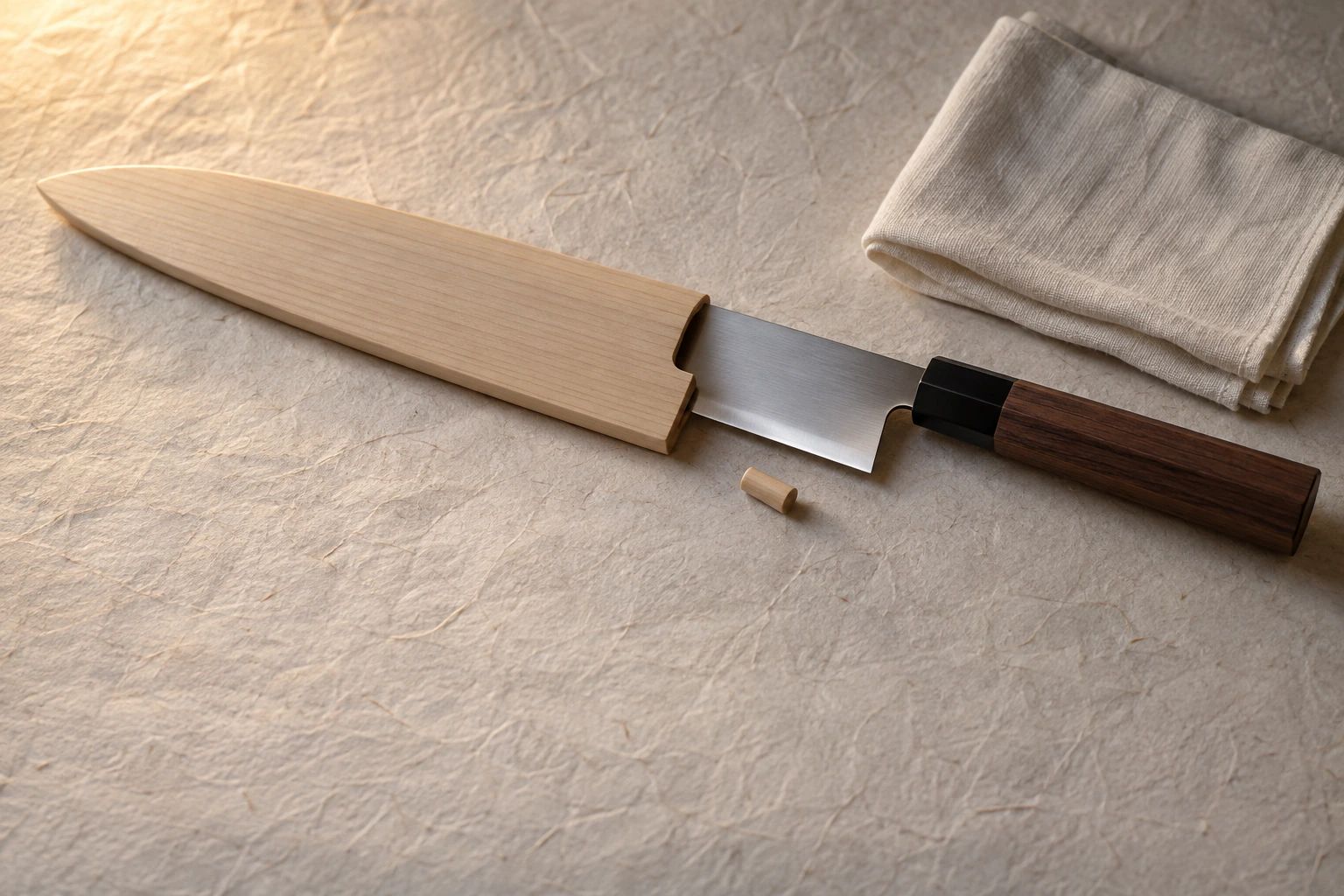
Table of Contents
TL;DR — what to store knives in
For most people the answer is a hardwood-faced magnetic strip for the knives you use daily, and a wooden saya for any single prized or carbon-steel blade. If you would rather keep knives out of sight, a slotted in-drawer tray is just as kind to the edge.
- Best for display & daily access — a hardwood-faced magnetic strip (mount spine-first, never edge-first)
- Best for one prized knife or travel — a wooden saya (magnolia blade guard)
- Best hidden / child-safe — a slotted in-drawer tray or in-drawer docking insert
- Use with care — countertop blocks, but only spine-supported or wide-channel designs
- Avoid — universal tight-slot blocks and (worst of all) loose in a drawer
Short version: a magnetic strip plus a saya covers nearly every home kitchen. The rest of this guide is about getting the details right so you never chip an edge.
Why storage matters for Japanese knives
A Western chef's knife is forgiving — thick, softer steel, a robust edge. A Japanese knife is the opposite by design: a thin blade road, a hard steel core (often HRC 60+), and an acute edge that slices effortlessly precisely because there is so little metal at the apex. That same thinness is fragile. Three things ruin it in storage:
- Edge-on-hard-surface contact. Dragging or resting the cutting edge against wood, plastic or metal rolls the apex over. This is the slow killer in tight-slot blocks and loose drawers.
- Impact. Blades knocking together or against utensils chip the brittle hard steel. One careless drawer rummage can leave a permanent notch.
- Moisture. Trapped water rusts carbon steel within days and can pit even some stainless. Storage that breathes matters.
Good storage simply avoids all three: it supports the blade on its spine or back, keeps blades separated, and lets air move. Every ranking below is judged against exactly that.
How we ranked storage
We scored each storage type on five things:
- Edge protection — does anything touch or drag across the cutting edge in normal use?
- Impact protection — are blades kept apart and shielded from knocks?
- Moisture / airflow — does it let a blade dry, or trap water against the steel?
- Human safety — how likely is a reaching hand to meet a bare edge?
- Access & display — how easy and pleasant is everyday use?
A storage method only earns a top rating if it protects the edge and the cook. Looks and convenience break ties; they never override safety.
Magnetic strips — best for display
Our top pick for daily-use knives. A wall-mounted magnetic strip holds blades by the flat of the steel, so nothing presses on the edge, air circulates freely (great for carbon steel), and your best knives are one reach away. Done correctly, it is among the gentlest storage there is.
The honest caveat — technique is everything. The single mistake people make is slapping the cutting edge onto the bar. Always lower the spine onto the magnet first, then roll the blade flat against it; to remove, lift from the spine. Treat the edge as if it must never touch the bar, because it shouldn't.
Choose a hardwood-faced strip over bare metal. Strips that sandwich the magnets behind a strip of hardwood (walnut, oak, cherry are common) are gentler on both the edge and the blade's finish than a bare stainless or painted bar, and they grip without metal-on-metal scraping. Bare stainless strips work and look clean, but they are less forgiving of a careless mount and can micro-scratch a polished blade.
- Strengths — no edge contact, excellent airflow for carbon steel, fast access, attractive display, scales to many knives
- Weaknesses — blades exposed to dust and splatter, requires correct spine-first technique, needs solid wall mounting, not ideal around small children
- Buy if — you want your daily knives visible and accessible, or you own carbon steel that benefits from airflow
Brands we are confident exist in this category include hardwood magnetic strips from makers such as Benchcrafted (the well-regarded "Mag-Blok" hardwood bars) and a range of Japanese and Western hardwood strips sold through specialist knife shops. Either way, the rule that matters is hardwood face + spine-first mounting. Typical price range: roughly $30–90 for a quality hardwood strip; bare stainless strips can be cheaper.
Saya & blade guards — best for one knife
The best protection for a single treasured blade. A saya (鞘) is a traditional wooden sheath, usually carved from magnolia (ho-wood), that slides snugly over the blade and is often held by a small wooden pin. It is the answer to "how do I keep this one knife perfect."
A saya shields the edge completely, so the knife can live in a drawer, a knife roll or a bag without ever contacting another surface. Because magnolia is light and breathes, it does not trap moisture against the steel — which makes a saya especially good for carbon blades. For travel, a saya plus a knife roll is the standard way chefs carry their gear.
- Strengths — total edge protection, ideal for carbon steel and for transport, traditional and beautiful, makes any drawer safe for one knife
- Weaknesses — one per knife (cost adds up across a set), must be sized to the blade, you must dry the knife before sheathing it
- Buy if — you own a prized gyuto, yanagiba, deba or any carbon knife, or you ever carry a knife outside the kitchen
Saya are widely sold by Japanese knife makers and by Kappabashi shops, generally listed by blade type and length, so you match the cover to the knife. Magnolia (ho-wood) is the classic material to look for. Typical price range: roughly $15–50 depending on length and finish. If you buy a knife and a matching saya together, many shops will fit it for you. See our best gyuto picks for blades worth this level of care.
In-drawer trays & docks — best hidden
The best option if you want knives out of sight. A slotted in-drawer tray gives each blade its own channel, keeping edges apart and supported so they never touch each other or roll onto the cutting edge. In-drawer docking inserts (where the knife sits in a wide groove or stands on its spine) work on the same principle. Knives are hidden, protected from knocks and out of reach of children.
The key is that each blade is separated and edge-protected. A bamboo or hardwood drawer organizer with knife-width slots, or a bed of slotted inserts, both qualify. Pair it with a saya on your best knife and even a busy drawer is safe.
- Strengths — knives hidden and child-safe, blades separated, no countertop footprint, protects against impact
- Weaknesses — uses a whole drawer, less airflow than a strip (dry carbon knives fully first), slower to scan at a glance
- Buy if — you prefer a clean countertop, have small children, or want a safe home for the knives you don't use daily
Bamboo and hardwood in-drawer knife trays are sold widely by general kitchen-organizer brands; the only spec that matters is that slots are sized so the edge never bears weight against the slot wall. Typical price range: roughly $20–60.
Knife blocks — proceed with care
Countertop blocks are popular, and the look is undeniable — but the common universal tight-slot block (horizontal slots that take any knife) is the design we are most cautious about, because the edge drags against the slot every time you insert or withdraw the blade, and the knife often rests on its edge.
The better block designs do exist. Look for blocks where the blade is supported on its spine rather than wedged on the edge, blocks with channels wide enough that the cutting edge never touches a wall, or in-drawer docking blocks that hold the knife by its spine. If you want a block on the counter, choose one of these — not a tight universal slot.
- Strengths — convenient countertop access, tidy, keeps blades separated by slot
- Weaknesses — many designs drag the edge or rest the knife on it; slots are hard to clean; takes counter space
- Buy if — you want a block and can find a spine-supported or wide-channel design
Typical price range: roughly $30–120 depending on material and size. If your only block is a tight universal-slot model, consider switching those Japanese knives to a magnetic strip or saya and keeping the block for softer Western knives.
What to avoid
- Loose in a drawer with other tools. The worst option on every axis — blades chip against utensils and each other, and a bare edge waits for a reaching hand. Never do this with a good knife.
- Tight universal-slot blocks for thin Japanese edges. The edge drags against the slot on every insert and withdrawal, slowly rounding the apex.
- Sealing a damp blade in plastic. A snug plastic sleeve over a wet carbon knife traps moisture and invites rust — dry fully first, and prefer a breathing wooden saya for long storage.
- Slapping the edge onto a magnetic strip. The strip is fine; the technique is the problem. Spine first, always.
None of this is about brand-shaming — plenty of well-made blocks and sleeves are sold. It is about geometry: a thin, hard Japanese edge simply cannot take edge-on contact or impact the way a thick Western knife can.
Full comparison table
| Storage type | Best for | Edge safety | Airflow | Price (USD) | Editor rating |
|---|---|---|---|---|---|
| Hardwood-faced magnetic strip | Daily-use display | High (spine-first) | Excellent | $30–90 | ★★★★★ |
| Wooden saya (magnolia) | One prized knife / travel | Very high | Good | $15–50 | ★★★★★ |
| Slotted in-drawer tray | Hidden / child-safe | High | Moderate | $20–60 | ★★★★☆ |
| Bare stainless magnetic strip | Minimal display | Good (spine-first) | Excellent | $20–60 | ★★★★☆ |
| Spine-supported / wide-channel block | Countertop access | Good | Moderate | $30–120 | ★★★☆☆ |
| Universal tight-slot block | — | Low (edge drag) | Poor | $30–80 | ★★☆☆☆ |
| Loose in a drawer | — | Very low | Poor | $0 | ★☆☆☆☆ |
Prices are approximate ranges, not live pricing — they vary by retailer, availability, tax and exchange rate. Always confirm with the seller before buying.
How to choose without regret
- Start with how many knives you use daily. Two or three? A magnetic strip is perfect. A full set? Combine a strip for the daily blades with an in-drawer tray for the rest.
- Protect your one best knife with a saya. Whatever else you do, a treasured or carbon blade deserves its own wooden guard. It is the cheapest insurance in the kitchen.
- If you choose a strip, choose hardwood and learn the spine-first mount. Both decisions protect the edge and the finish.
- If you choose a block, inspect the slot geometry. Buy only spine-supported or wide-channel designs; skip tight universal slots for Japanese knives.
- Carbon steel needs airflow. Dry fully, then favor a magnetic strip or a breathing magnolia saya over a sealed sleeve or a damp drawer. See our steel types guide.
- Buying in Japan? Saya and hardwood strips are abundant and well-priced at Tokyo's Kappabashi, where shops will size a saya to your blade in person.
Still unsure? Put a hardwood magnetic strip on the wall and a saya on your best knife. That pairing protects edges, suits carbon steel, and looks the part. For the knives worth storing this well, see our best Japanese knives and best gyuto picks, and keep them sharp with our best whetstone guide.