Best Nakiri Knife 2026: 6 Picks for Every Budget
Basis Spec comparison · not hands-on tested
How we chose: makers' published specs, materials and price. We have not used these products ourselves. How we test
QUICK ANSWER
Best value nakiri: Tojiro DP 165mm (~$70). Buy-once pick: MAC Japanese Series (~$110). Both are double-bevel, low-maintenance, and beginner-friendly.
- Best overall
- Tojiro DP 165mm
- Best buy-once
- MAC Japanese Series
- Best traditional
- Sakai Takayuki
- Length range
- 160-180mm
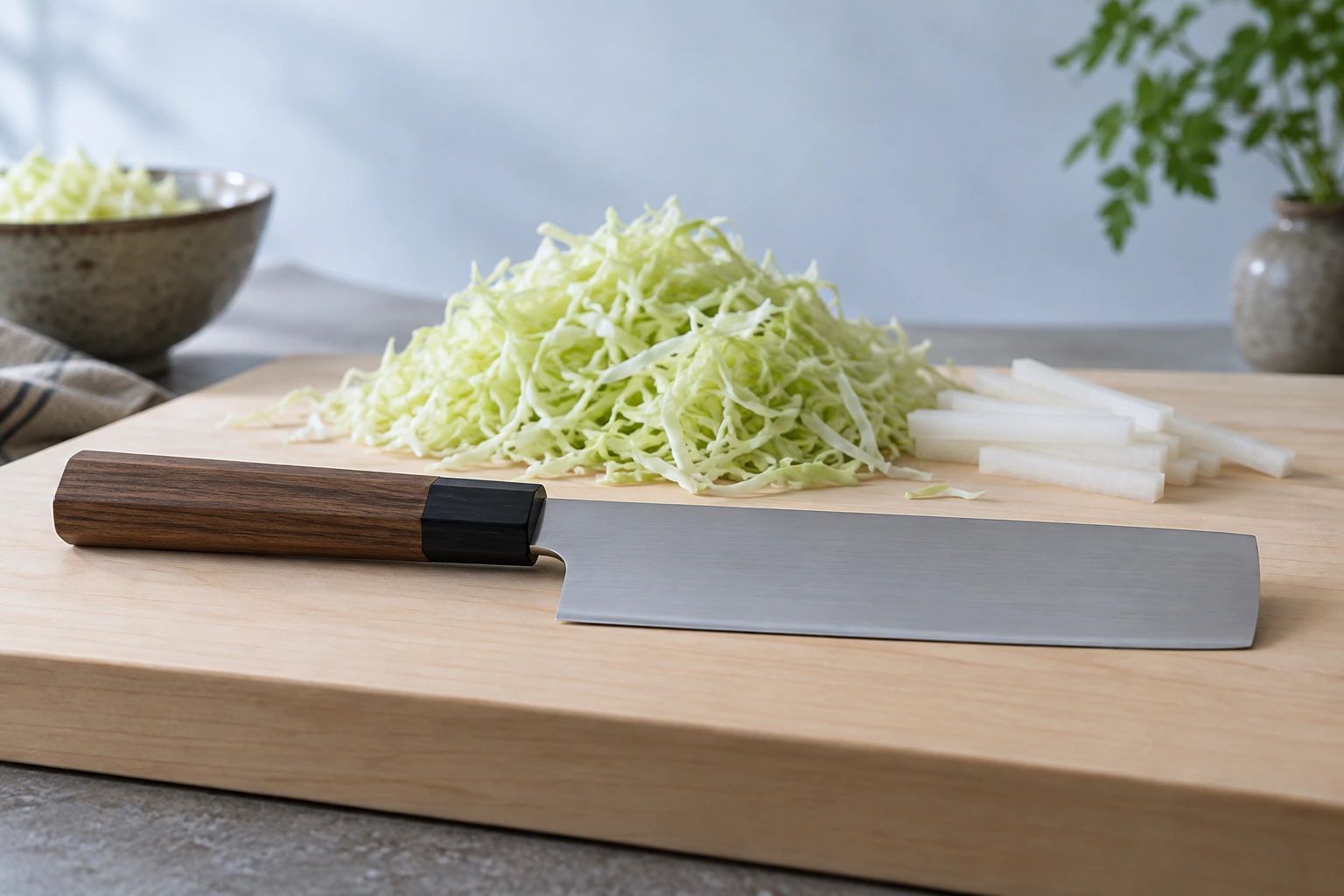
Table of Contents
TL;DR — best picks by budget
The single best-value nakiri is the Tojiro DP 165mm (~$70). If you want a "buy once" knife, the MAC Japanese Series nakiri (~$110) is our pick. Prices below are approximate ranges and move with the yen, retailer, and where you buy — treat them as bands, not quotes.
- $40-80 — value tier — Tojiro DP Nakiri 165mm (~$70) — the editor's choice
- $80-180 — lifetime tier — MAC Japanese Series Nakiri (~$110) / Sakai Takayuki Ginsan (~$130) / Shun Classic (~$170)
- $180+ — pro / artisan tier — Masakage carbon nakiri (~$200+) / Echizen forged nakiri ($250+)
- First nakiri → Tojiro DP 165mm
- "Last nakiri" → MAC Japanese Series
- Gift → Shun Classic or Sakai Takayuki
Short version: the ~$70 Tojiro DP or the ~$110 MAC covers the vast majority of home kitchens. Everything above that buys craft, edge feel, or looks — not a fundamentally better cut on a cabbage.
What a nakiri does best
A nakiri is a vegetable specialist, and three pieces of geometry explain why it beats an all-rounder at produce:
- Push-cut straight down. The edge is flat, with no curved belly. You lift the whole blade and set it straight down through the vegetable — a clean push cut — rather than rocking. A curved knife that doesn't fully reach the board leaves slices half-attached (the "accordion" effect); the nakiri's flat edge makes full board contact, so every cut releases.
- Flat profile = full contact. Because the entire edge meets the board at once, long cuts across a cabbage quarter or a length of daikon come off the blade clean and even. This is what makes fast, uniform julienne and dice feel effortless.
- Tall blade for knuckle clearance. The 50-60mm blade height keeps your guiding knuckles well above the board, which lets you choke down on big vegetables confidently — and the wide face doubles as a bench scraper to sweep prep into the pan.
What it is not: a meat or fish knife, and not a rocking knife. If you want a single do-everything blade, you want a santoku or gyuto, not a nakiri.
How we chose
We compared, for each nakiri:
- Steel and hardness — the makers' published core steel and HRC.
- Blade length and weight — as listed by the maker.
- Bevel and handle — double-bevel (nakiri) versus single-bevel (usuba), Western (yo) or Japanese (wa) handle.
- Care needs — stainless versus carbon steel.
- Price — typical price ranges at the time of writing.
We have not cut with these knives. The only knives we have cut with are the six santoku in our Kappabashi test.
Value tier — $40-80
Editor's choice: Tojiro DP Nakiri 165mm (~$70)
The benchmark home nakiri, and the easiest knife in this article to recommend without caveats. VG-10 core with stainless cladding, made in Tsubame-Sanjo (Niigata), with a riveted yo-style handle that shrugs off water. Double-bevel, so it cuts straight and is friendly to right- and left-handers alike. It is widely regarded as sharp out of the box, and VG-10 is quick to bring back on a stone.
- Strengths — best-in-class sharpness for the money, low maintenance, easy to sharpen, widely available worldwide
- Weaknesses — plain styling, polarizing logo
- Buy if — it's your first nakiri, you're value-focused, or you need overseas availability
Getting VG-10 — a pro-tier stainless — in a clean-cutting nakiri at this price is genuinely hard to beat. Below roughly $40 you mostly find soft-steel knives that dull within days; if your budget is tight, save a little and start here rather than below it.
Same-tier note: Tojiro's own cheaper cobalt-alloy lines and various brand-name "starter" nakiri sit just under this; they cut acceptably but give up edge retention and sharpening feel. The DP is the floor we'd recommend.
Lifetime tier — $80-180
Our pick: MAC Japanese Series Nakiri (~$110)
If you want one nakiri for the next decade, this is it. MAC's proprietary high-carbon stainless has a reputation for taking a keen edge and holding it well, the grind is thin, and North American support is strong. Double-bevel, low fuss.
- Strengths — excellent edge retention, thin clean grind, great balance, strong support
- Weaknesses — more Western in feel than a traditional wa-handled nakiri; limited distribution in some regions
- Buy if — you want a "last nakiri," you cook seriously, you've outgrown an entry knife
Alternative 1: Sakai Takayuki Ginsan Nakiri (~$130) — forged in Sakai with Ginsanko (Silver-3) stainless and a ho-wood octagonal wa handle. The most traditional Japanese feel in this tier, and the pick if you cook Japanese food and want the authentic in-hand experience. Stays low-maintenance despite the traditional look.
Alternative 2: Shun Classic Nakiri (~$170) — VG-MAX core under a Damascus-clad body, a D-shaped pakkawood handle, and the most recognizable Japanese nakiri in North America. Beautiful and a fine cutter; the Damascus is cosmetic (more on that below). Often a strong gift choice, and usually cheaper in Japan than abroad.
Pro / artisan tier — $180+
This tier is more "hobby and craft" than "better cut." On a cutting board, the difference between a $110 MAC and a $250 hand-forged nakiri is small; what you pay for is artisan provenance, rare steels, edge feel, and ownership pleasure.
Our pick: Masakage carbon nakiri (~$200+)
Masakage knives are forged in Takefu (Echizen, Fukui) by named smiths across several lines, with carbon-core options (such as Aogami / blue steel) that deliver an exceptional, "scary-sharp" edge feel devotees love. The trade-off is maintenance: carbon needs a full dry and care or it patinas and can rust. A second knife for someone who enjoys the upkeep, not a first nakiri.
- Strengths — hand-forged character, superb edge feel, named-smith provenance
- Weaknesses — carbon care required, price, availability varies by line
- Buy if — you already own a stainless nakiri, you sharpen your own knives, you enjoy the ritual
Alternative: Echizen forged nakiri ($250+) — hand-forged in Fukui's Echizen workshops, with steels and finishes that vary by smith (carbon Aogami/Shirogami or premium stainless such as SG2). Each blade carries the maker's mark, and many workshops include sharpening support. Expect a wait if ordering, and limited availability outside Japan. For the steel trade-offs, see our steel types guide.
Double-bevel nakiri vs single-bevel usuba
Beginners sometimes confuse the nakiri with the usuba, the other flat-edged Japanese vegetable knife. The difference is the bevel, and it matters:
- Nakiri — double-bevel. Sharpened on both sides, it tracks straight, works for either hand, and is simple to sharpen. This is the home cook's vegetable knife and the only one we'd recommend as a first purchase.
- Usuba — single-bevel. Sharpened on one side only, it produces thinner, cleaner cuts and enables katsuramuki (paper-thin rotary peeling), but it's handed (right or left), steers in the cut until you've learned it, and is harder to sharpen. It's a professional tool — a deliberate upgrade, never a starter knife.
In short: buy a nakiri now; consider an usuba later if you pursue Japanese-style precision work.
On Damascus: pretty, not sharper
A lot of nakiri sell on a rippling Damascus pattern. Be clear-eyed about it: Damascus is the laminated cladding wrapped around the hard cutting core; the pattern does nothing for sharpness. A Shun Classic with its Damascus body and a plain-clad knife sharing the same VG-MAX/VG-10 core cut essentially the same. You're paying a design premium, often 30-50%, for the look.
That's not a reason to avoid Damascus — if you love how it looks on your board, buy it. Just don't expect the pattern to cut better, and don't let it be the deciding factor over the actual core steel, grind, and edge.
Full comparison table
| Model | Approx. price (USD) | Length | Core steel | Bevel |
|---|---|---|---|---|
| Tojiro DP Nakiri | ~$70 | 165mm | VG-10 | Double |
| MAC Japanese Series | ~$110 | 165mm | Proprietary HC stainless | Double |
| Sakai Takayuki Ginsan | ~$130 | 165mm | Ginsanko | Double |
| Shun Classic Nakiri | ~$170 | 165mm | VG-MAX core | Double |
| Masakage carbon nakiri | ~$200+ | 165-180mm | Carbon (e.g. Aogami) | Double |
| Echizen forged nakiri | $250+ | 165-180mm | Carbon / SG2 | Double |
Prices are approximate ranges, not quotes. Nakiri pricing swings with the yen, the retailer, Damascus/handle upgrades, and especially whether you buy in Japan or abroad — overseas listings for "Made in Japan" nakiri often run well above Japanese domestic prices. Use these bands to compare tiers, then check current pricing before you buy.
How to choose without regret
- First nakiri → $70-130. Tojiro DP or MAC Japanese Series. Cheaper steel underperforms; pricier is over-investment for a beginner.
- Confirm it's a nakiri, not an usuba. Buy double-bevel unless you specifically want the single-bevel pro tool and the skill it demands.
- Don't buy on Damascus alone. The pattern is cosmetic; the core steel, grind, and edge do the cutting.
- Size by your board. 165mm is the default; 180mm only if you regularly break down big cabbage or daikon and have a large board.
- Carbon is a second knife. Stainless for your first nakiri; carbon (Masakage, Echizen) rewards owners who enjoy the upkeep.
- Watch where you buy. Overseas "Made in Japan" nakiri often cost well above domestic Japanese prices. Visiting Japan? Kappabashi is the cheapest place to shop.
Stuck? Buy the Tojiro DP 165mm — there isn't a better default. For what a nakiri is and how to use it, see our nakiri knife guide; to compare against the all-rounders, see our best santoku and best gyuto picks, or the wider best Japanese knives roundup.