Best Petty Knife 2026: 6 Editor-Tested Japanese Utility Knives
QUICK ANSWER
Best petty knife overall: Tojiro DP 120mm (~$35-45). Best mid-tier: MAC Professional 135mm (~$60-80). Premium: Misono UX10 150mm (~$90-120).
A petty is a 120-150mm Japanese utility knife for peeling, small produce, garlic, citrus and detail work — the ideal companion to a gyuto or santoku, not a replacement for one.
Best overall
Tojiro DP 120mm
Best mid-range
MAC Professional 135mm
Premium
Misono UX10 150mm
Length range
120-150mm
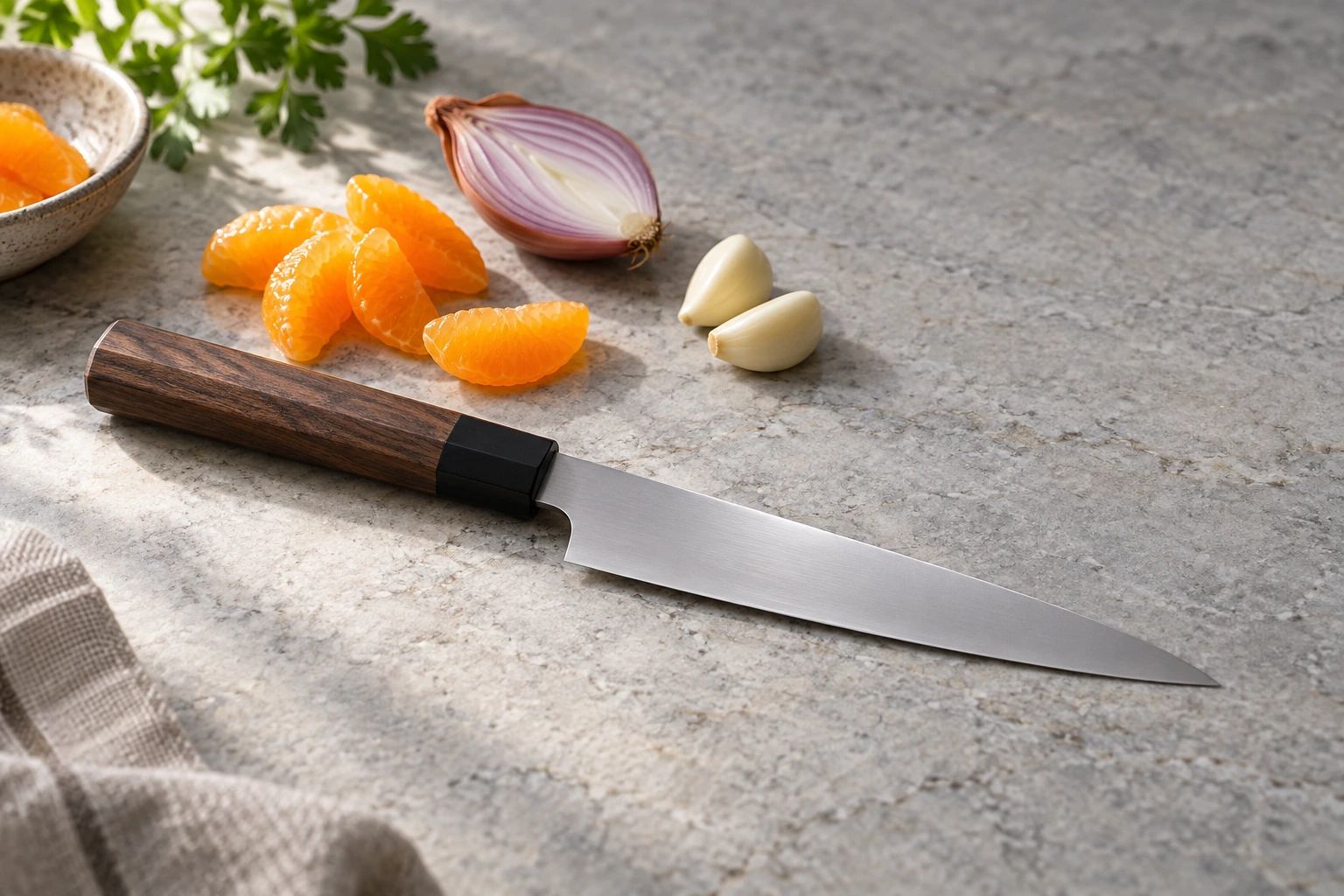
Table of Contents
TL;DR — best picks by budget
The single best-value petty knife is the Tojiro DP 120mm (~$35-45). If you want a daily detail knife that feels a tier above, the MAC Professional 135mm (~$60-80) is our pick. A petty is the Japanese small utility knife — a 120-150mm precision blade for peeling, small produce, garlic, citrus and fine work. It is the ideal second knife to a gyuto or santoku, not a replacement for one.
- Best value — Tojiro DP Petty 120mm (~$35-45) — the editor's choice
- Mid tier — MAC Professional Petty 135mm (~$60-80) / Tojiro DP 150mm (~$45-60)
- Premium — Misono UX10 Petty 150mm (~$90-120) / Shun Classic 6" (~$90-120)
- Ultimate — Shibata / Sukenari SG2 Petty (~$160-220)
- First petty → Tojiro DP 120mm
- Already own good knives → MAC or Misono petty
- Gift → Shun Classic or Misono UX10
Short version: the ~$40 Tojiro DP or the ~$70 MAC Professional — most home kitchens are perfectly served by one of these two as their detail knife.
What a petty knife is (and is not)
The petty knife (ペティナイフ, from the French petit) is Japan's compact utility blade — bigger than a paring knife, smaller than a santoku, and built for the precision tasks a large chef's knife handles clumsily. A typical petty is 120-150mm long with a thin, pointed blade and a hard, finely ground edge. It is the second most-reached-for knife in many professional Japanese kitchens, right after the gyuto.
What it is built for: peeling fruit and vegetables, segmenting citrus, hulling strawberries, mincing a shallot or a few garlic cloves, deveining shrimp, trimming silver skin, slicing small or delicate produce, and detail garnish work. Anywhere you need more control than a long blade gives you, the petty wins.
What it is not: a primary chef's knife. A petty is too short to dice onions, slice cabbage or break down a squash efficiently. It complements a gyuto or santoku rather than replacing it. If you only own one knife, buy a chef's knife first and add a petty as your second. For the full type overview, see our petty knife guide — this page is the "which one to buy" companion to it.
How we tested
Our testing protocol:
- Sample set — a dozen petty knives spanning roughly $30 to $250, covering major Japanese domestic brands plus North American favorites, in both 120mm and 150mm where available.
- Detail-work prep — peeling apples and pears in the hand, supremeing oranges and grapefruit, mincing shallots and garlic, deveining shrimp, trimming silver skin, slicing strawberries and cherry tomatoes.
- Tip-precision test — following citrus membranes and lifting silver skin to judge how fine and controllable the tip is.
- Edge-retention test — two weeks of daily detail use, no honing, then a paper-edge and tomato-skin check.
- Sharpening test — a short session on a #1000 stone, measuring how quickly the apex returned and how cleanly the burr broke off.
- In-hand test — extended peeling sessions to judge balance, fatigue and control for choke-grip work.
Each knife scored 1-5 on sharpness, retention, sharpening ease, in-hand control and value. Total score determined our picks below.
120mm or 150mm?
This is the only sizing decision that really matters for a petty, and it comes down to how you intend to use it.
- 120mm (4.7") — the most versatile and our default. Light and nimble in the hand, ideal for peeling, garlic, citrus, shrimp and detail garnish. If you already own a gyuto or santoku and want a pure precision knife, this is the size.
- 150mm (6") — more cutting-board reach and doubles as a small gyuto stand-in for a sandwich or a single tomato. Slightly less precise for in-hand work, but a better "only small knife in a tiny kitchen" choice.
A smaller 80mm option exists, but it is really a paring knife — fine for pure in-hand peeling, too short for anything on a board. For the distinctions between petty, paring and Western utility knives, see our petty vs paring guide. Our recommendation for almost everyone: a 120mm. Step to 150mm only if board work matters more to you than in-hand finesse.
Best value — Tojiro DP petty
Editor #1: Tojiro DP Petty 120mm (~$35-45)
The benchmark value petty, and the same VG-10 core that makes the Tojiro DP santoku and gyuto such standouts — here in a compact, agile body. Three-layer stainless construction, made in Tsubame-Sanjo (Niigata) with tight quality control, and a riveted yo-style handle that shrugs off water. Light in the hand, it takes a keen edge and is easy to bring back on a stone.
- Strengths — best-in-class sharpness for the price, easy to sharpen, low maintenance, widely available worldwide
- Weaknesses — plain styling; the 120mm is short for board work (step up to the 150mm if that matters)
- Buy if — it's your first petty, you're value-focused, or you want the same DNA as your Tojiro chef's knife
When someone asks "what should my first petty be," we say Tojiro DP almost every time. Getting a genuine VG-10 stainless core in a petty for around $40 is remarkable, and it pairs naturally with the Tojiro DP gyuto if you're building a two-knife kit. A 150mm version (~$45-60) is the natural pick if you want more cutting-board capability.
Mid tier — daily detail work
Editor #1: MAC Professional Petty 135mm (~$60-80)
MAC's petty is a long-running professional favorite for one reason: it is thin. The proprietary high-carbon stainless blade is laser-light and glides through delicate skins, which makes long sessions of fine work genuinely comfortable. The 135mm length splits the difference between in-hand agility and board reach, and edge retention is excellent for the class.
- Strengths — exceptionally thin and sharp, light for extended detail work, strong North American support
- Weaknesses — Western styling rather than a traditional Japanese look; the thin tip rewards careful handling
- Buy if — you already cook seriously and want a daily detail knife a clear tier above the entry pick
If you've outgrown the Tojiro DP petty, this is the natural next step. It is the petty many line cooks keep next to their gyuto for prep and plating.
Premium — the petty pros reach for
Editor #1: Misono UX10 Petty 150mm (~$90-120)
The premium line forged from Swedish Sandvik stainless, the same family of knives sushi and kaiseki cooks keep as trusted all-rounders. Misono's signature thin grind gives a slicing feel many professionals describe as gliding, and the 150mm length makes this petty equally happy doing light board work and fine in-hand tasks. Comfortable Western handle, beautiful finish, and edge retention that earns its keep.
- Strengths — refined edge feel, thin geometry, excellent fit and finish, trusted by pros
- Weaknesses — price, the thin blade is less forgiving of lateral force, narrower distribution
- Buy if — you treasure sharpness, cook a lot, or are buying a knife as a gift
Alternative: Shun Classic 6" Utility (~$90-120) — VG-MAX core in a 32-layer Damascus body, HRC around 60-61. The most visible Japanese small knife in the West and a near-perfect gift: striking pattern, comfortable D-shaped handle and solid performance. Often noticeably cheaper bought in Japan than abroad.
Going further (~$160-220) — laser-thin SG2/R2 petties from makers like Shibata Kotetsu or Sukenari sit at the top of the field. Powder-steel cores deliver outstanding sharpness and edge life with excellent rust resistance, and the thin grinds are a joy for long prep sessions. This tier is for cooks who already own several good knives and want the finest cutting feel — the home-use gap over the Misono is small, but the ownership pleasure is real.
Full comparison table
Prices vary by retailer, availability, tax and exchange rate — approximate ranges, not live pricing.
| Model | Price (USD) | Length | Steel | HRC | Editor rating |
|---|---|---|---|---|---|
| Tojiro DP Petty | $35-45 | 120mm | VG-10 core | 60 | ★★★★★ |
| Tojiro DP Petty (longer) | $45-60 | 150mm | VG-10 core | 60 | ★★★★☆ |
| MAC Professional Petty | $60-80 | 135mm | Proprietary HC stainless | 59-61 | ★★★★★ |
| Misono UX10 Petty | $90-120 | 150mm | Sandvik stainless | 59-60 | ★★★★★ |
| Shun Classic Utility | $90-120 | 152mm | VG-MAX core | 60-61 | ★★★★☆ |
| Shibata / Sukenari SG2 | $160-220 | 135-150mm | SG2 / R2 powder | 62-64 | ★★★★★ |
Ranges reflect typical retail at the time of writing. Buying in Japan — particularly Tokyo's Kappabashi — is usually cheaper than overseas marketplaces.
How to choose without regret
- First petty → Tojiro DP 120mm. There isn't a better value answer. Anything cheaper uses soft steel that dulls in days; anything pricier is over-investment for a first detail knife.
- Pick size by use, not by spec. 120mm for in-hand peeling and detail; 150mm if cutting-board reach matters more. When in doubt, 120mm.
- Buy it as a second knife. A petty complements a gyuto or santoku — it doesn't replace one. If you don't yet own a chef's knife, see best gyuto knife first.
- Choose stainless. A petty lives on acidic, wet ingredients, so VG-10, Ginsanko or SG2 makes far more sense than carbon for most cooks.
- Don't pay for Damascus alone. The pattern is cosmetic; the core steel is what cuts. Same core, no Damascus = same edge.
- Watch foreign-market pricing. "Made in Japan" petties sold abroad typically run well above domestic price. Visiting Japan? Kappabashi is cheapest, and our under-$150 Kappabashi field test shows what's worth carrying home.
Stuck? Buy the Tojiro DP 120mm and pair it with a good chef's knife. For the full type overview, see our petty knife guide; for the wider category, see best Japanese knives 2026.