Flying With Japanese Knives: How to Get Your Knife Home (2026)
QUICK ANSWER
A kitchen knife must travel in your checked baggage — never in hand luggage or on your person. Keep the shop box, cover the edge, pad it in the middle of your suitcase, keep the receipt, and check your airline and your own country's import rules before you fly.
- Hand luggage
- Never
- Checked baggage
- Yes — the only way
- How to pack
- Boxed, edge covered, padded
- No checked bag?
- Have the shop ship it
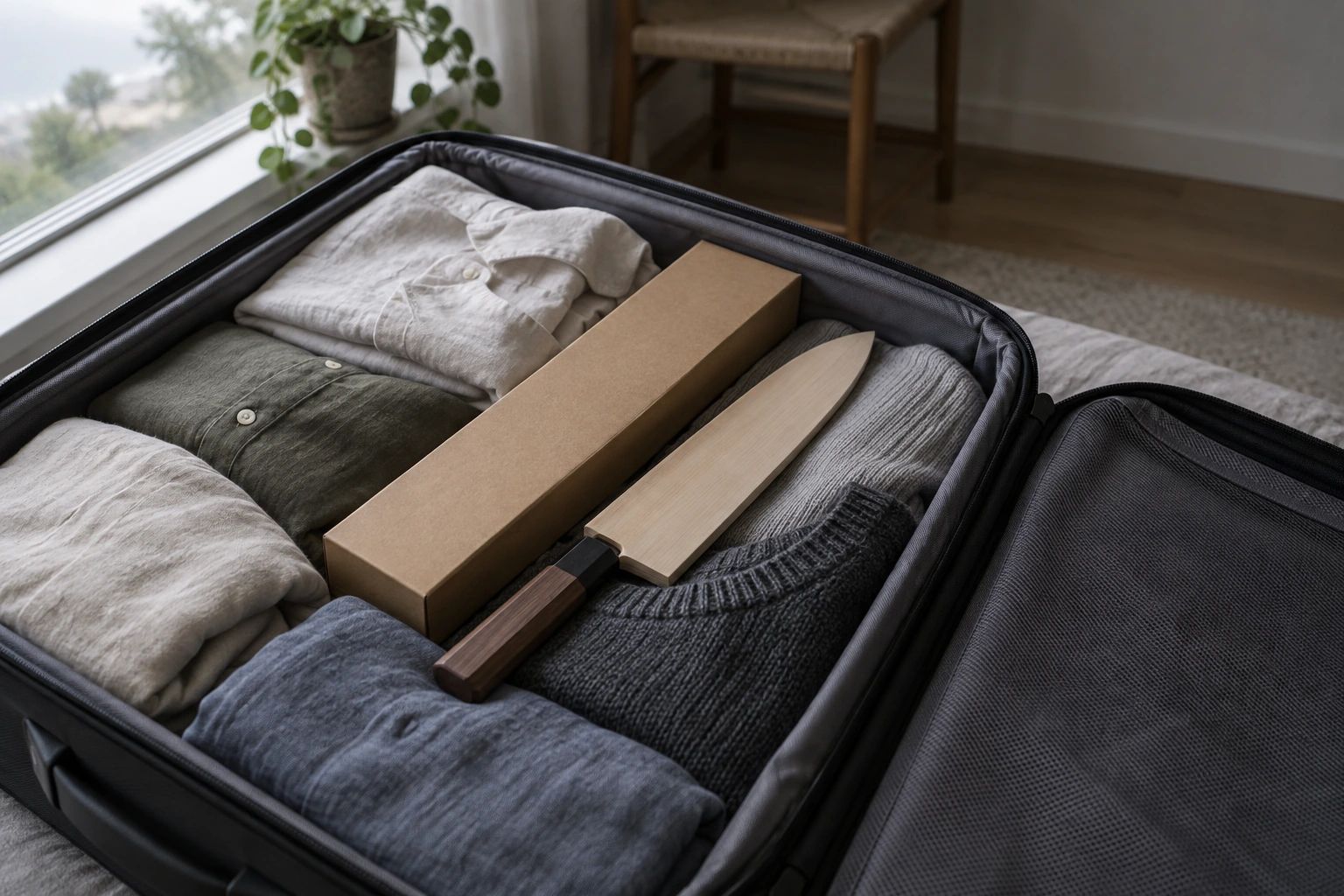
Table of Contents
TL;DR — the short version
Knives fly in checked baggage. Never in hand luggage. Pack the edge, keep the receipt, and check your airline and your own customs rules before you go.
- Checked baggage only. This is standard across essentially every airline and airport in the world. A blade in your cabin bag will be confiscated at screening.
- Keep the shop box. Japanese knife shops pack blades for flights constantly — that box and wrapping is already the right answer.
- Cover the edge. A cardboard sheath, a saya, or taped card. Then wrap in clothing, flat, in the middle of the case.
- Keep the receipt. It proves what you bought and what you paid, which is what customs cares about.
- Tax-free? Keep the paperwork. Tax-free goods are for export — keep documentation and any sealed packaging, and be ready to show the item on departure.
- Check, don't assume. Airline conditions and national import rules vary and change. Five minutes on your airline's and your customs authority's own pages settles it.
- Carry-on only? Ship it. Most shops that sell to travellers will post it, and many ship internationally.
Still deciding what to buy before the flight home? Start with our best Japanese knives overview, or the city guides for Tokyo and Kyoto.
Flying with a knife at a glance
| Question | The answer |
|---|---|
| Hand luggage / carry-on | Never — prohibited, and it will be confiscated |
| Checked baggage | Yes — the only lawful way to fly with a knife |
| How to wrap it | Shop box if possible; edge sheathed or securely wrapped |
| Where in the case | Flat, mid-suitcase, padded in clothing on all sides |
| What to keep | Receipt, tax-free paperwork, original packaging |
| Buying at the airport | Only before bag drop — it still has to be checked in |
| Import rules at home | Vary by country — check your own customs authority |
| No checked bag | Have the shop ship it instead |
Everything above is unpacked below — starting with the one rule that has no exceptions.
The one rule: checked baggage only
A kitchen knife goes in the hold. It does not go in the cabin, in your day bag, in your coat pocket, or in a "clearly it's obviously a cooking tool" carrier bag. Aviation security rules differ on plenty of things — liquids, batteries, tools — but on knives they are about as close to universal as air travel gets. Sharp blades are prohibited in cabin baggage essentially everywhere.
Two well-documented examples make the pattern clear. The US Transportation Security Administration lists knives as not permitted in carry-on but permitted in checked bags, and asks that sharp objects in checked bags be sheathed or securely wrapped so they cannot injure baggage handlers or inspectors. The UK Civil Aviation Authority likewise treats sharp knives as banned from the cabin while allowing them in hold luggage. Other national regulators land in the same place.
Three practical consequences follow, and they trip people up more often than the rule itself:
- You need a checked bag at all. If you are flying on a hand-luggage-only fare, you have no lawful way to carry a knife. Add a checked bag, or ship the knife.
- Buy before bag drop. A knife bought at the airport still has to go in the hold, so buy it before you check your suitcase — not after, and certainly not airside.
- Mind connecting flights. If an itinerary makes you collect and re-check your bag at a transit point, the knife stays in that bag the whole time. Never move it into your cabin bag "just for the transfer."
Beyond the baseline, individual airlines and airports can be stricter, and screening officers everywhere have discretion to refuse an item they consider dangerous. That is why the honest advice is not a number or a loophole but a habit: check your airline's restricted-items page before you fly.
How to pack a knife for a flight
The goal is simple: the edge cannot reach anything, and nothing can reach the edge. A knife packed properly survives baggage handling untouched — the ones that arrive chipped are the ones that rattled around loose.
- Start with the shop's box. If the shop boxed and wrapped it for travel, you are already done with this step. Japanese knife shops do this every day for visiting customers, and their packing is better than anything you will improvise in a hotel room. Ask them to pack it for a flight and they will.
- Cover the edge. No box? Sheath the blade. A saya (traditional wooden blade guard) is ideal and shops often sell one to fit. A plastic blade guard works. Failing that, fold stiff cardboard over the edge along the full length of the blade and tape it closed so it cannot slide off.
- Wrap the whole knife. Roll the sheathed knife in a tea towel, a T-shirt, or bubble wrap, and tape the bundle. This stops the handle knocking and keeps the package obviously deliberate rather than something loose and alarming.
- Bury it in the middle of the case. Lay it flat in the centre of your checked suitcase with clothing above, below and around it. Away from the shell, away from wheels and hinges, away from anything hard.
- Do not pack it against fragile things. Nothing breakable directly against the blade. A knife plus a ceramic souvenir in the same pocket is how both get damaged.
- Keep the paperwork accessible. Receipt and any tax-free documentation in your day bag or passport wallet — not sealed inside the taped bundle at the bottom of your suitcase.
- Assume the bag may be opened. Security may hand-search checked baggage. Pack so that someone opening your case finds a clearly wrapped, safe package — that is both courteous and the point of the sheathing rule.
If you bought a whetstone too, it is heavy and hard — pad it separately rather than letting it travel pressed against the blade. Once you are home, our knife care guide covers drying, rust prevention and storage from day one, which matters more than usual after a long flight in a humid suitcase.
Three ways to get a knife home
Flying it back yourself is the default, but it is not the only route — and for some travellers it is not the best one.
| Route | Best for | Watch out for |
|---|---|---|
| In your checked bag | Anyone already checking a suitcase; no extra cost, knife in hand on arrival | Must be wrapped properly; useless if you have no hold bag |
| Shop ships it | Carry-on-only trips, fragile or expensive blades, buying more than you can carry | Shipping cost and time; duty or import tax at your end is yours to pay |
| Buy online from home | Not travelling at all, or deciding after the trip | You cannot hold the knife first; check the retailer ships to your country |
There is no wrong answer here. The mistake is only ever the fourth option — trying to carry it into the cabin.
Not travelling to Japan at all, or already home and regretting the knife you did not buy? Some Japanese shops ship internationally — including Kiwami, a Tokyo (Kappabashi) shop and one of the six shops in our Kappabashi santoku test, whose online store ships overseas. In the interest of full disclosure, Kiwami is an affiliate partner of ours. If you would rather buy in person, our Kappabashi shop directory maps out the street shop by shop.
What to sort out before you leave the shop
Five minutes at the counter saves an hour of anxiety at the airport. While you are still in the shop:
- Ask them to pack it for a flight. Say the words. Shops that sell to visitors understand exactly what you mean and will wrap the edge and box it so it is obviously not for cabin use.
- Take the receipt and keep it. It is your proof of purchase, your proof of value, and the document customs may want to see. Photograph it too.
- Settle tax-free before engraving. An engraved or used knife may not qualify for tax-free at some shops, and a personalised blade generally cannot be returned. Decide on the knife, handle the tax-free formalities, then ask about engraving.
- Ask about a saya. A wooden blade guard costs little, makes the flight safer, and then becomes your storage solution at home — see our knife storage guide.
- Ask whether they ship. Even if you plan to carry it, knowing the answer is useful — plans and baggage allowances change.
City-specific advice on all of this lives in our Tokyo and Kyoto buying guides.
Tax-free purchases and your paperwork
Tax-free shopping in Japan exists on one core premise: the goods are being exported. Everything else follows from that. Whatever the mechanics look like on the day you buy, the traveller's side of the bargain stays the same.
- Bring your physical passport when you buy. A photo or a copy is not enough.
- Keep the receipt and any tax-free documentation together, somewhere you can reach at the airport.
- Leave sealed packaging sealed where sealing applies, and do not use the knife during your trip. A knife that has clearly been used is no longer an exported good.
- Be ready to show the item on departure. Customs may ask to see the goods along with your passport and receipts, so do not bury a tax-free purchase at the very bottom of a bag you have already checked.
One important caveat on timing: Japan's tax-free system is being reformed, with a refund-at-departure model scheduled to take effect from 1 November 2026 — meaning travellers pay the tax at the till and claim it back after a customs check on the way out. Thresholds, sealing requirements and the refund process are all part of that revision. Treat the principles above as durable and confirm the current procedure in-store and at the airport rather than trusting any article, this one included.
Customs and import rules at home
This is the part where we will deliberately refuse to give you a number, because the honest answer is that it depends on your passport and your destination — and getting it wrong is expensive.
Two different sets of rules can apply when you land:
- Duty and import tax. Most countries give returning travellers a personal allowance and charge duty or tax on goods above it. Thresholds vary widely, change with policy, and sometimes differ depending on where you are flying from. Your receipt is what establishes the value, which is the single best reason to keep it.
- Restricted blade types. Some countries restrict specific categories of knife on import — automatic or switchblade knives, gravity knives and certain locking knives are the ones that come up repeatedly in national weapon-import rules. Ordinary double-bevel kitchen knives are generally treated as household goods rather than weapons, and travellers bring them home from Japan routinely, but the categories and definitions genuinely differ country to country.
So: look up your own customs authority's guidance before you buy, not after you land. Search for your country plus "customs" plus "importing knives" and read the official page, not a forum. If you are buying something unusual — a folding knife, anything with a locking mechanism, anything that could be described as a weapon rather than a cooking tool — that check moves from sensible to essential. For a plain gyuto, santoku or nakiri in a shop box, you are on the well-trodden path.
Declare when in doubt. Declaring something that turns out to be allowance-free costs you two minutes; not declaring something dutiable can cost you the knife and a penalty.
Mistakes that get knives confiscated
- Putting it in the cabin bag "just this once." The single most common way to lose a knife. There is no discretion at the checkpoint in your favour.
- Buying airside, after security. Anything bought past the checkpoint travels with you into the cabin — which a knife cannot do. Buy before bag drop.
- Booking a hand-luggage-only fare and improvising later. Decide before you buy: hold bag, or shipping.
- Moving it to the cabin bag during a transfer. If you re-check your bag mid-journey, the knife stays in the checked bag throughout.
- Packing it loose and unwrapped. Even in the hold, an unsheathed blade risks a chipped edge, a cut hand, and a bag flagged at inspection.
- Throwing away the receipt. It is your value proof at customs and your tax-free evidence on departure.
- Throwing away the box before you fly. From 1 November 2026 customs checks tax-free goods against the receipt as you leave Japan. A knife can be used during the trip, but one separated from the box or tag that carries its model number may not be identifiable — and if one item on a receipt is missing, nothing on that receipt is refunded.
- Assuming your country's rules match someone else's. Import rules for blades are national, not global. Check yours.
Get those eight right and the rest is easy. The knife is in the hold, the edge is covered, the paperwork is in your pocket, and the only thing left to do is unpack it, dry it properly, and start cooking. Our care guide is the natural next read.