How to Hold a Japanese Knife: Pinch Grip, Handle Grip, and Why It Matters
QUICK ANSWER
Pinch grip the blade between thumb and index finger; the other three fingers wrap the handle for control.
Grip
Pinch grip
Pressure
Front fingers
Other hand
Claw guide
Avoid
Handle-choke grip
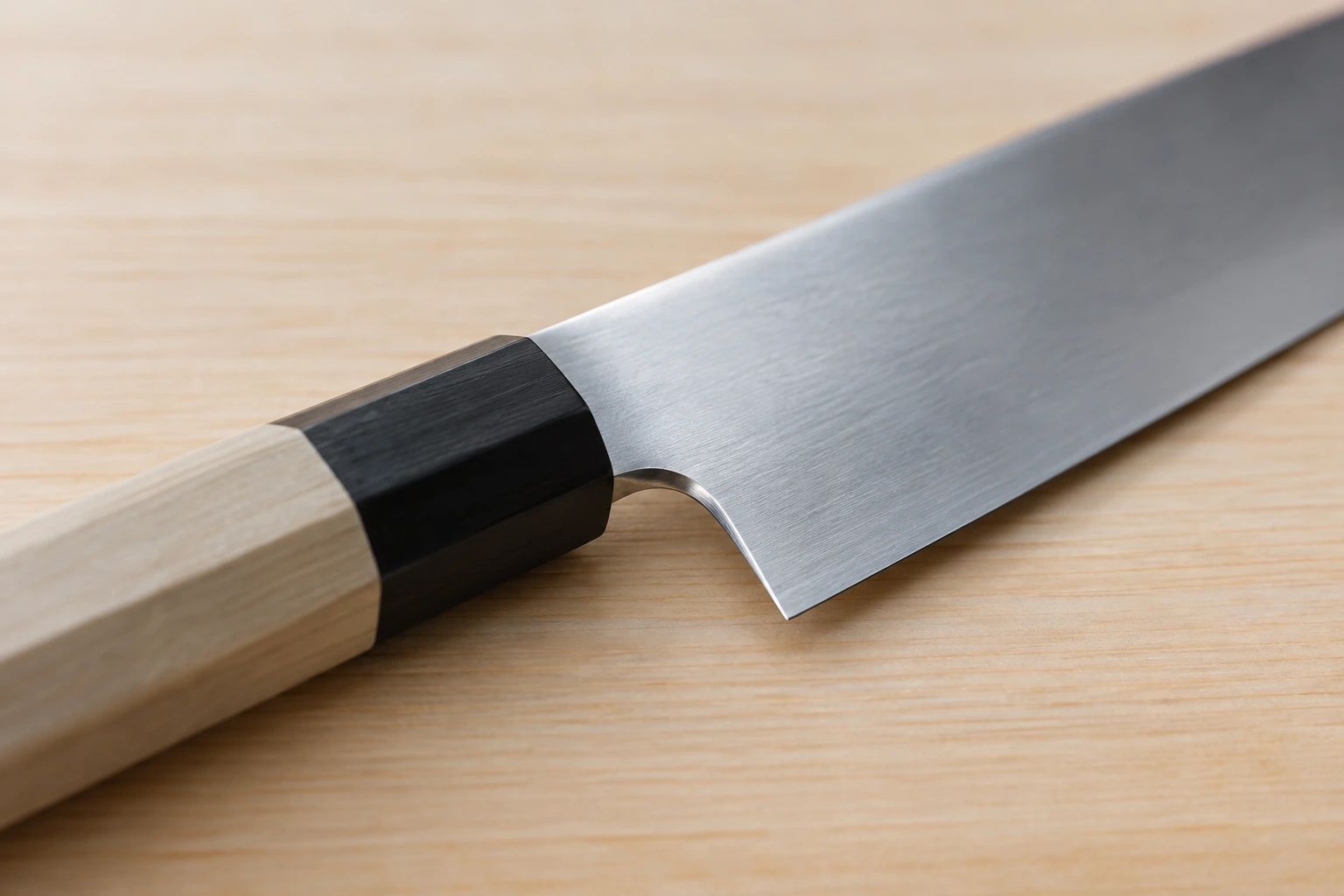
Table of Contents
TL;DR — One Grip Does 95% of the Work
Five grips exist for kitchen knives. Three matter for a Japanese knife:
- Pinch grip — Thumb and index finger pinch the blade just forward of the bolster, remaining fingers wrap the handle. The default for everything: gyuto, santoku, nakiri, petty, sujihiki, even yanagiba. 95% of professional cuts use this grip.
- Handle grip — All four fingers and thumb wrap the handle, blade extends forward. Acceptable for occasional light tasks (chopping a single onion). Not recommended as a default — less control and more wrist strain.
- Claw grip — Your guiding (non-knife) hand. Fingers curled under, knuckles forward, thumb tucked behind. The knife's flat side rides against your knuckles as a guide.
Two grips to avoid: dagger grip (overhand stabbing, ruins the blade and risks injury) and death grip (squeezing too hard, the most common cause of wrist fatigue). The rest of this article shows you each in detail.
Why Grip Matters More with a Japanese Knife
A typical $50 Western chef knife is forgiving — soft steel at HRC 56-58, thick spine, blunt edge geometry. You can grip it poorly and it still cuts onions reasonably. A Japanese knife at HRC 60-65 with a 15° edge has none of that forgiveness. Three reasons grip technique matters more:
- Forward-balanced blade. Japanese knives are deliberately tip-heavy compared to Western knives. The pinch grip moves your control point forward onto the blade itself, matching the balance and giving you precise tip-down control. Handle grip leaves the blade flopping around.
- Thin geometry. A Japanese knife's edge is meant to slide through food, not crush. Pinch grip lets you control the angle of the edge to within 1-2 degrees; handle grip introduces wrist-driven wobble that smashes tomato flesh and bruises herbs.
- Hard steel. A wobbly, side-loaded Japanese edge chips. The pinch grip locks your wrist into a straight forward-push position that minimizes side load — the position the knife was designed for. Handle grip combined with rocking is how chips happen.
Put differently: a Western knife is a hammer, and any grip works. A Japanese knife is a scalpel, and only specific grips align with its design intent.
The Pinch Grip — The Default Pro Grip
The pinch grip is your default for a gyuto, santoku, nakiri, sujihiki, and petty. Step by step:
- Hold the knife with all four fingers wrapping the handle (handle grip starting position).
- Slide your thumb forward off the handle until it rests on the flat (left side for right-handers) of the blade, just forward of the bolster — about 1-2 cm onto the blade.
- Curl your index finger forward and pinch the opposite side of the blade with the side of the finger (not the pad). Your index fingertip rests against the blade, the second knuckle of the index finger sits behind it.
- The remaining three fingers (middle, ring, pinky) wrap the handle loosely. Just enough grip to keep the knife from rotating, not a clench.
- Relax your shoulder and elbow. The knife should feel like an extension of your forearm. If your shoulder is up by your ear, you're squeezing too hard.
The blade is now controlled by your forefinger and thumb — the two strongest, most articulate digits — while the handle merely steadies the back of the knife. This is why pro chefs cut for 8 hours without wrist pain: 80% of the grip force is in the two strongest fingers, and the wrist stays straight.
Common adjustment: if your thumb feels uncomfortable on the blade, try sliding it back so it rests on the spine (top edge) of the blade rather than the flat side. This is a slight variation but valid — many professional chefs use the "thumb on spine" version. The key is that the thumb is forward, controlling the blade, not curled around the handle.
The Handle Grip — Casual and Safe
Handle grip is the default for most untrained cooks: all five fingers wrap the handle, the blade extends forward, and the knife is steered from the back. It works fine for casual light tasks — chopping a single shallot, slicing one tomato, sectioning citrus. Why it's not the pro default:
- No fine blade control. The pivot point is at the bolster, far from the cutting edge. Small wrist movements translate into large blade movements at the tip. You cannot make a clean shallot brunoise from a handle grip.
- Wrist strain over time. Handle grip puts the load on your wrist's flexor tendons — the same tendons that get carpal tunnel syndrome. After 30-60 minutes of continuous cutting, the strain becomes obvious.
- Higher accident rate. If the knife slips or skips off a hard surface (frozen carrot, a melon rind), the back of the blade comes back toward your index finger. Pinch grip places your index finger forward of the bolster, where the blade slip can't reach it.
When handle grip is acceptable: heavy chopping with a cleaver or deba (where you need maximum power for a single downward stroke); occasional one-shot cuts where speed doesn't matter; first 2-3 cuts with a new knife while you adjust to its weight before settling into pinch grip. Otherwise, default to pinch.
The Dagger Grip — Never Do This
Dagger grip (overhand stab) is what people instinctively use to break open hard winter squash, watermelon, or to portion a roast. Hand wrapped around the handle with the thumb on top of the spine, blade pointing down, and a downward stabbing motion. Do not use this with any Japanese knife.
- The blade comes down vertically into the cutting board. A Japanese edge geometry (15° per side, HRC 60+) is meant to slide through food, not impact it. The first time the tip hits the board hard, it chips.
- Your wrist is locked at an inefficient angle that recruits the rotator cuff for power. Long-term repetitive use causes shoulder strain.
- The blade angle is impossible to control mid-stroke. If the squash is harder on one side, the blade twists and the edge takes a side load — the worst possible load for thin Japanese steel.
What to use instead for hard cuts: a Western cleaver (deliberately thick, durable steel) or a Japanese deba (still a Japanese knife, but specifically designed with thicker geometry for poultry and small fish bones). For winter squash specifically, the safest method is to microwave the squash for 60 seconds to soften it, then slice with normal pinch-grip technique.
The Claw Grip — Your Guiding Hand
The other half of cutting that nobody talks about: your non-knife hand. The claw grip is your guiding hand's job, and it determines both safety and cut precision. Step by step:
- Place your non-knife hand on the food with fingertips curled inward toward your palm. Knuckles point forward.
- Tuck your thumb behind your fingers — out of the path of the blade entirely. The thumb is the most-cut digit in home kitchens; the claw grip protects it.
- The flat side of the blade rests against your knuckles as a guide. Your knuckles are the rail; the blade slides up and down along them.
- Move your knuckles backward incrementally as you cut, controlling cut thickness. The knife itself moves forward and down; your hand moves backward.
Why this matters: in claw grip, the closest part of your hand to the blade is your knuckle (a hard, rounded surface), not your fingertip (soft, pointed). If the knife slips, it bounces off the knuckle. If your fingertip were forward instead, the knife would catch it. The claw grip is the single most-effective accident-prevention technique in any kitchen.
The first 2-3 weeks of claw grip feel awkward — your wrist is bent at an unfamiliar angle, and you'll feel slower. Push through it. After 20-30 hours of prep time, the claw becomes automatic and you'll cut both faster and safer than you ever did with a flat-palm grip.
Specialty Grips for Specialty Knives
Three knife-specific grip notes:
| Knife | Recommended Grip | Key Adjustment |
|---|---|---|
| Gyuto 210-240mm | Pinch grip | Standard pinch position |
| Santoku 165-180mm | Pinch grip | Thumb slightly more forward (lighter blade) |
| Nakiri 165mm | Pinch grip | Pinch closer to spine; flat blade rocks less |
| Petty 120-150mm | Pinch or thumb-rest grip | Thumb rests on spine for delicate work (peeling) |
| Yanagiba 240-300mm | Pinch grip, light | Slicing pull only — minimal force, max precision |
| Usuba 195-225mm | Pinch grip, thumb high | Thumb braces blade angle for katsuramuki |
| Deba 165-180mm | Handle grip with thumb on spine | Higher force needed for fish bones; thumb adds power |
| Sujihiki 240-300mm | Pinch grip | Long stroke — relaxed grip, no death grip |
For petty and paring work specifically, see our petty vs paring guide — the smaller knives sometimes benefit from a modified grip with the thumb on the spine for delicate peeling motions.
Common Grip Mistakes to Fix
- Death grip. Most common mistake. A Japanese knife doesn't need force; the edge does the work. If your fingers are white from squeezing, relax. Light grip = better control + less fatigue.
- Index finger on the spine of the blade. Some old chef school books teach this — index finger extended onto the top of the blade. Don't. It puts your finger directly above the cutting edge and is genuinely dangerous if the knife rolls.
- Thumb wrapped around the handle in pinch grip. If your thumb is still on the handle, you're not pinching — you're just resting your other fingers on the blade. The thumb must be on the blade.
- Wrist bent forward. The wrist should be in line with the forearm. Bent wrist puts the cutting force through wrist tendons rather than forearm muscles. Long-term, this causes injury.
- Flat-palm guiding hand. The most dangerous mistake. A flat palm puts fingertips in the path of the blade. Curl into the claw grip.
- Holding food in the air instead of on the board. Always cut against the board with the claw grip guiding the food. Cutting toward your palm (apple in hand, slicing toward thumb) is how people sever finger tendons.
How to Practice Your New Grip
A two-week practice plan to switch from handle grip to pinch grip:
- Week 1, days 1-3: Slice one onion per day using pinch grip. Don't worry about speed. Notice where your thumb and index finger want to slip back to the handle and consciously hold them forward.
- Week 1, days 4-7: Add cucumber, bell pepper, and carrot prep. Maintain pinch grip throughout. You'll feel slower than handle grip — that's normal and temporary.
- Week 2, days 1-3: Practice the claw grip alongside pinch grip. Slice a cabbage in half, then chiffonade. The claw grip protects your fingertips as you work close to the blade.
- Week 2, days 4-7: Real meal prep with both grips. Most cooks find by end of week 2, pinch grip is reflexive and handle grip feels weird.
- Week 3 onwards: Forget about grip. It's now automatic.
One additional aid: cut soft fruits and vegetables (overripe peaches, soft tomatoes, ripe avocado) early in your practice. These force light grip — death-grip on a soft tomato turns it into pulp, and you'll feel the feedback immediately.
For more on basic Japanese knife technique, see our first knife guide and Japanese vs German knives for the design philosophy that makes grip matter.