Left-Handed Japanese Knives: What Lefties Actually Need to Know (2026)
QUICK ANSWER
Double-bevel Japanese knives (gyuto, santoku, nakiri, most petty) are symmetric and work fine left-handed; only single-bevel knives (yanagiba, usuba, deba) need a special-order left-handed version.
- Work fine left-handed
- Gyuto, santoku, nakiri, petty
- Need a left-hand version
- Yanagiba, usuba, deba
- Most ambidextrous handle
- Octagonal wa-handle
- Left single-bevel premium
- Usually special order, +20-50%
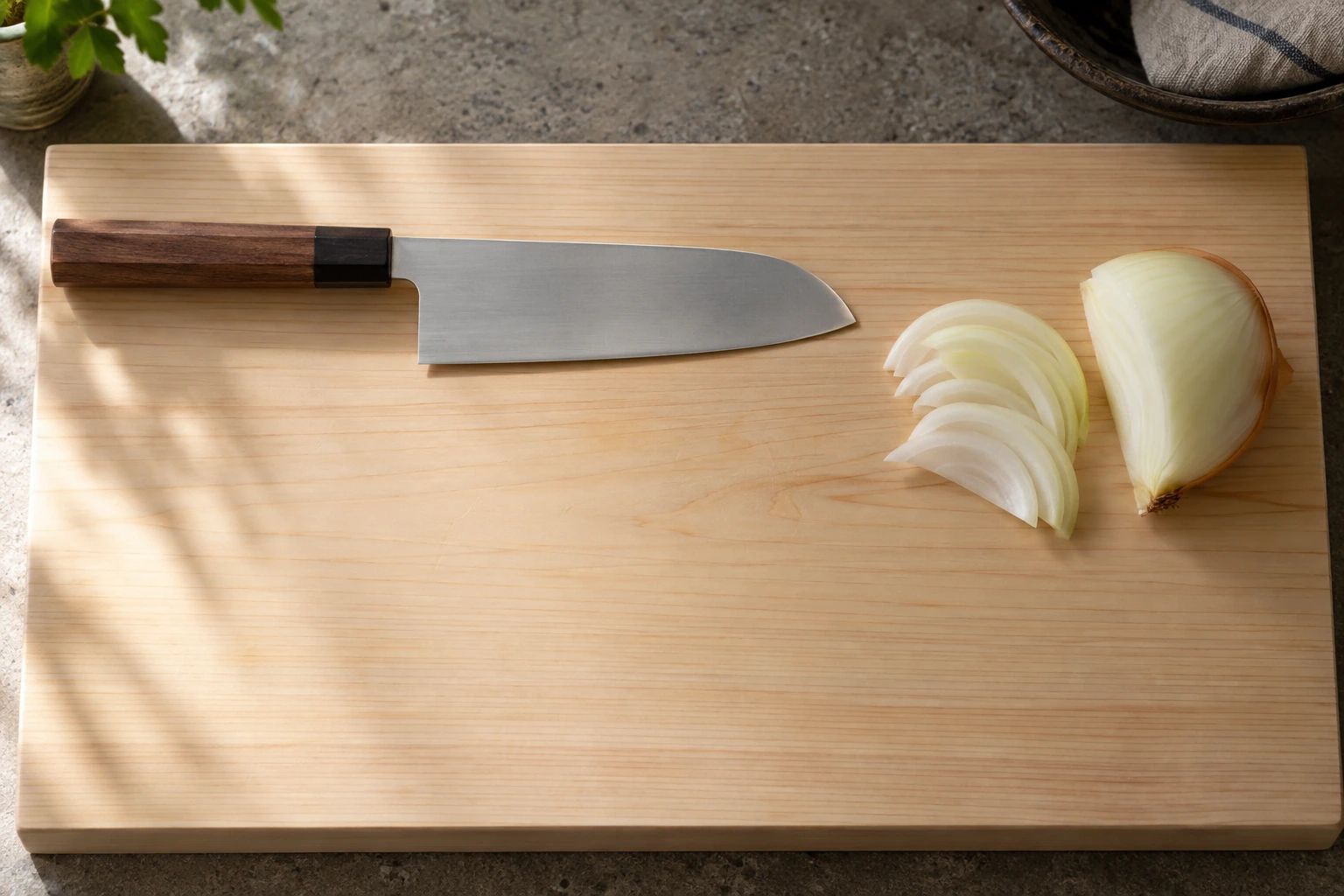
Table of Contents
TL;DR — the one thing to remember
Double-bevel = ambidextrous. Single-bevel = handed. That single distinction answers almost every left-handed knife question.
- Work fine as-is — gyuto, santoku, nakiri, bunka, most petty knives, and double-bevel kiritsuke. These are ground symmetrically; lefties use them exactly like everyone else.
- Need a left-handed version — yanagiba, usuba, deba, and single-bevel kiritsuke. A standard right-handed one is genuinely worse in a left hand.
- Handle — octagonal and oval wa-handles are ambidextrous; D-shaped wa-handles are slightly right-biased but still usable. Western (yo) handles are symmetric.
- Cost & supply — double-bevel left-handed knives cost nothing extra (they don't exist as a separate product). Left-handed single-bevel knives are usually special order, carry a premium, and have thin stock.
- If you buy one Japanese knife and you're left-handed — buy a double-bevel gyuto or santoku and forget handedness entirely.
In short: most lefties never need a "left-handed knife" at all. The exception is single-bevel slicers — and for those, the left version is real, worth it, and worth planning ahead for.
Why handedness matters for some knives
A knife is "handed" only when its edge is ground asymmetrically. That happens with single-bevel knives, where the blade is sharpened almost entirely on one face (the front), while the back is flat or gently hollowed (the urasuki). The geometry is deliberately one-sided — it's what lets a yanagiba peel a translucent sashimi slice or a usuba take a paper-thin sheet off a daikon.
That asymmetry has a direction. A right-handed single-bevel is ground on the right face, so when a right-hander cuts straight down, the bevel steers the blade gently away from the finished slice and the flat back hugs the food. Put that same knife in a left hand and every force reverses: the blade wanders into your cut, the back faces the wrong way, and food release suffers. The knife isn't broken — it's just mirrored relative to your hand.
Double-bevel knives have none of this. They're ground on both faces, so the edge sits on the centerline and pushes evenly to both sides regardless of which hand holds it. That symmetry is exactly why double-bevel knives dominate global kitchens — and why they're a non-issue for left-handed cooks. We cover the full physics in the single-bevel vs double-bevel guide; for handedness, the takeaway is simple: only the single-bevel family carries a "side."
Knives that work fine for lefties as-is
These are double-bevel, symmetric, and require no special left-handed version. If you're left-handed, buy them off the shelf like anyone else:
- Gyuto — the Japanese chef's knife and the best single all-rounder. Fully ambidextrous. Our best gyuto picks apply to lefties unchanged.
- Santoku — the compact home all-rounder. Symmetric; no handedness concern.
- Nakiri — the straight-edged vegetable knife. Double-bevel and ambidextrous.
- Bunka — santoku's reverse-tanto cousin. Double-bevel.
- Petty — the small utility knife. Almost always double-bevel and ambidextrous.
- Double-bevel kiritsuke — the modern, symmetric kiritsuke (distinct from the traditional single-bevel one) cuts fine in either hand.
One nuance: a small number of double-bevel Japanese knives are ground with an asymmetric ratio — for example 70/30 or 80/20 front-to-back rather than a true 50/50 — usually biased for right-handers to improve food release. This is far subtler than a single-bevel; most cooks never notice it, and many makers offer a 50/50 grind on request. It's worth knowing about, not worth worrying about. For a first or only Japanese knife, a symmetric gyuto or santoku removes any question entirely.
Knives that need a left-handed version
These are the genuinely handed knives. A standard right-handed model is awkward and measurably worse for a left-hander, and a true left-handed version (mirrored grind) is the right answer if you use these regularly:
- Yanagiba — the long sashimi slicer. The single most common knife lefties ask about. A right-handed yanagiba steers into the slice in a left hand and ruins the clean pull-cut it exists for. Left-handed yanagiba are made by request from established makers. See the yanagiba guide.
- Usuba — the single-bevel vegetable knife for katsuramuki (rotary peeling) and precision work. Heavily dependent on bevel direction; a right-handed usuba is a real handicap for a lefty.
- Deba — the heavy fish-breaking knife. Single-bevel, used to cut down along the bone; the wrong handedness makes filleting and head removal noticeably harder.
- Single-bevel kiritsuke — the traditional kiritsuke (a yanagiba/usuba hybrid used by senior chefs) is single-bevel and equally handed.
Honest caveat: "needs a left-handed version" is about how good you can get, not whether the knife functions. A casual home cook who slices fish a few times a year can muddle through with a right-handed yanagiba. But if single-bevel work is part of your routine — or you're learning proper technique — a right-handed blade puts a ceiling on you. For those knives, buy left-handed and never think about it again.
Handle shape: D-shape vs octagonal
Edge geometry is the big story; handle shape is the footnote. Traditional Japanese (wa) handles come in a few cross-sections, and only one of them has any handedness at all:
- Octagonal — eight flat facets, symmetric. Fully ambidextrous. The safest pick for a lefty who wants zero compromise, and a popular choice on quality knives regardless of hand.
- Oval / round — also symmetric, also ambidextrous.
- D-shaped — one face is flattened into a subtle ridge designed to sit under the right thumb for a consistent grip. This is the only mildly right-biased handle. Left-handed, the ridge rotates to the underside of your grip.
- Western (yo) handle — the riveted, contoured handle on knives like the Tojiro DP or MAC. Symmetric and ambidextrous.
If you're choosing a wa-handled double-bevel knife and want it to feel perfect in a left hand, pick octagonal. If you've already got a D-handle, it's still usable — read on for how much the bias actually matters.
How right-biased is a D-handle, really?
Less than the name suggests. A "right-handed D-handle" simply has its flat ridge oriented for a right hand; held left-handed, the ridge sits where your fingers curl rather than under your thumb. For most cooks this is a mild ergonomic note, not a performance problem — the blade still cuts identically because the edge is symmetric on a double-bevel knife.
Your options if a D-handle bothers you:
- Just use it — many left-handed cooks report the D-handle becomes invisible within a few sessions.
- Choose octagonal instead — sidesteps the question entirely; widely available.
- Order a left-handed D-handle — some makers and shops will mount a mirrored D (ridge for the left thumb) on request, sometimes for a small fee.
- Rehandle later — wa-handles are designed to be replaceable. A left-biased or octagonal handle can be fitted down the line.
Bottom line: a D-handle is a preference issue, not a dealbreaker. The genuinely consequential left-handed decision is always the bevel, never the handle.
The cost and wait-time premium
Here's where left-handedness does cost something — but only for single-bevel knives.
- Double-bevel knives: no premium whatsoever. There is no separate "left-handed gyuto," because the knife is already symmetric. You pay the normal price and buy off the shelf.
- Single-bevel knives (left-handed): expect a premium and limited availability. Left-handed yanagiba, usuba, and deba are produced in far smaller numbers than right-handed ones — many are forged or finished to order rather than stocked. A reasonable expectation is roughly a 20-50% price uplift over the equivalent right-handed model, driven by lower volume and the extra grinding/finishing for the mirrored geometry. Some shops keep a thin selection; for specific steels or sizes you'll often special-order.
- Wait time: off-the-shelf right-handed single-bevels ship immediately; left-handed equivalents can mean a wait, sometimes several weeks, when the knife is made to order.
The practical lesson: if you know you'll want a left-handed single-bevel knife, plan ahead rather than expecting to grab one the day you need it. And don't let the premium push you toward a right-handed blade "to save money" — a single-bevel you fight is a poor investment at any price.
Where to find left-handed knives
Because double-bevel knives aren't handed, "where to buy left-handed" only really applies to single-bevel slicers. Your best avenues:
- Specialist knife shops in Japan — Tokyo's Kappabashi kitchenware street has dedicated knife retailers, some of which keep a small left-handed single-bevel selection or will take an order. Buying in person lets you confirm the grind and feel the handle.
- Direct from established makers (special order) — traditional forging regions, Sakai above all, produce left-handed yanagiba, usuba, and deba on request. This is the most reliable route for a specific steel, length, or finish, and the maker can mirror both the grind and (if you want) the handle.
- Reputable online retailers with international shipping — a number of Japan-based shops list left-handed single-bevels online and ship worldwide. Selection is thinner than right-handed, so search specifically for "left-handed" or "左利き" and confirm before ordering.
For the double-bevel knives that make up most kitchens, you don't need any of this — buy from wherever you'd normally shop. Our best Japanese knives roundup and the best gyuto picks are all ambidextrous and available off the shelf.
A lefty buying checklist
- Is it double-bevel? (gyuto, santoku, nakiri, bunka, petty) → buy normally. Handedness doesn't apply.
- Is it single-bevel? (yanagiba, usuba, deba, single-bevel kiritsuke) → buy the left-handed version if you'll use it regularly.
- Wa-handled and want zero bias? → choose octagonal over D-shaped.
- Buying a single-bevel left-handed knife? → budget a premium and allow for a possible wait or special order.
- Only buying one Japanese knife? → a double-bevel gyuto or santoku. You're a lefty and it genuinely doesn't matter.
- Tempted by a cheap right-handed single-bevel? → don't. The grind, not the price, is what you'll live with.
The headline, one more time: being left-handed barely affects Japanese knife buying. Get the double-bevel all-rounder you'd buy anyway, and only sweat handedness when you step into the single-bevel world of yanagiba, usuba, and deba.