Nakiri vs Usuba: Which Japanese Vegetable Knife Should You Buy?
QUICK ANSWER
For almost every home cook the answer is the nakiri: it is double-bevel, ambidextrous, low-maintenance, and cuts vegetables beautifully. The usuba is a single-bevel professional tool for Japanese cuisine and katsuramuki rotary peeling — choose it only if you want to commit to single-bevel technique and sharpening.
Nakiri bevel
Double (V-edge)
Usuba bevel
Single (one side)
Easier to use
Nakiri
Most people pick
Nakiri
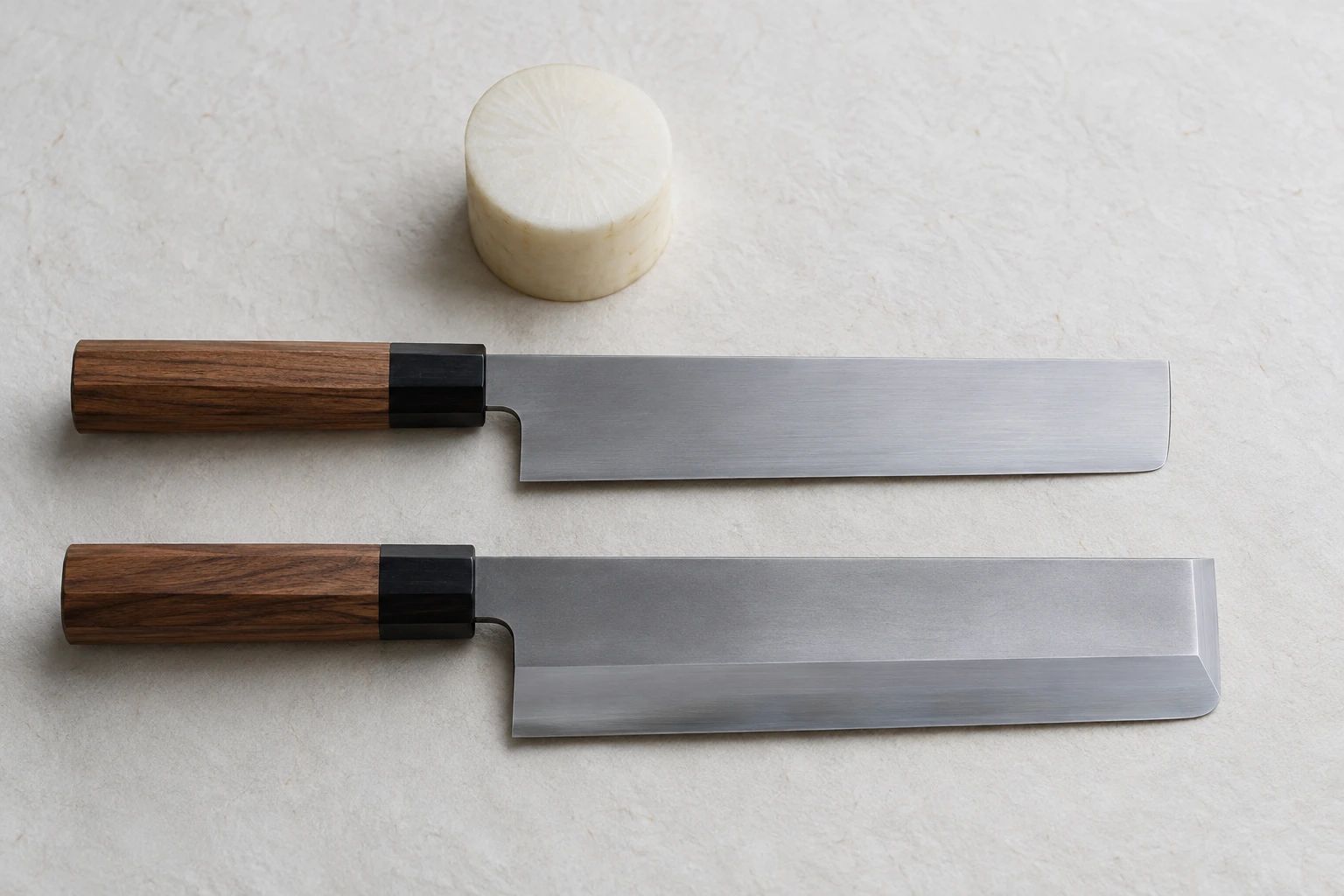
Table of Contents
Quick verdict
If you just want a great vegetable knife, buy a nakiri. It is double-bevel, ambidextrous, forgiving, low-maintenance, and cuts vegetables cleanly with no learning curve. It is the right answer for the overwhelming majority of home cooks.
Choose an usuba only if you are committed to traditional Japanese technique. It is a single-bevel professional knife that produces the thinnest, most delicate cuts and the paper-thin katsuramuki sheets used for sashimi garnish — but only in hands that have learned single-bevel cutting and sharpening.
- Home cook, any cuisine → nakiri
- First Japanese vegetable knife → nakiri
- Left-handed cook → nakiri (single-bevel usuba is handed and must be ordered for lefties)
- Training in Japanese cuisine / katsuramuki → usuba
- You already own a nakiri and want to go deeper → usuba
Neither knife is "better." They sit in the same slot — the dedicated vegetable knife — but ask very different things of the cook. Below is exactly how they differ.
The core difference: double vs single bevel
Everything else about these two knives flows from one fact: the nakiri is double-bevel and the usuba is single-bevel. If you understand that, you understand the whole comparison. For the full theory, see our single vs double bevel guide.
Nakiri — double bevel (V-edge)
The nakiri is ground on both sides to a symmetric V, exactly like a Western chef's knife or a santoku. That symmetry means the blade tracks straight down through a vegetable on its own — it does not steer left or right. It also means the knife is ambidextrous: left- and right-handed cooks use the same knife with no penalty. The double bevel is slightly more robust at the edge, more forgiving of imperfect technique, and easy to sharpen on a standard whetstone.
Usuba — single bevel (one side ground)
The usuba is ground on the front face only; the back (ura) is flat, with a subtle hollow (urasuki). That single bevel can be made extraordinarily keen, which is why a skilled user gets thinner, more delicate cuts than a double-bevel knife. But the asymmetry has consequences. The blade naturally wants to drift toward its flat side, so cutting straight is a learned skill. And because the grind is handed, a standard usuba is built for right-handers; left-handed cooks must order a mirror-image left-handed usuba, usually at extra cost and lead time.
In short: the double bevel buys you ease and ambidexterity; the single bevel buys you ultimate keenness and traditional capability, at the cost of a learning curve and handedness.
Kanto and Kamagata: two usuba shapes
Usuba come in two regional profiles, and the difference matters at the point of purchase. The Kanto (Tokyo) usuba is the square-tipped rectangle most people picture. The Kamagata (Kansai) usuba has a pointed tip that sweeps up toward the spine, giving the tip more dexterity for fine decorative work. Kansai kitchens tend to favour the kamagata, and some chefs keep both.
On a shelf, a nakiri and a Kanto usuba can look almost identical. Two things separate them: the usuba is usually thicker at the spine (roughly 3-4mm) and tapers harder toward the edge, and only one of its faces is ground. If you are unsure which you are holding, turn the blade over — a flat, faintly hollowed back means usuba.
Who each knife is for
The nakiri is for almost everyone
- Home cooks of any cuisine — it chops, dices, and slices vegetables of every kind with a clean straight-down motion and no rocking.
- First-time Japanese-knife buyers — nothing to learn, nothing fussy to maintain; it behaves like the Western knives you already know but cuts better.
- Left-handed cooks — the symmetric edge works identically in either hand, off the shelf.
- Anyone who wants one vegetable knife and no homework — buy it, keep it sharp, use it for years.
The usuba is for the dedicated and the professional
- Japanese-cuisine professionals — it is a standard tool of the traditional Japanese kitchen alongside the deba and yanagiba.
- Cooks learning katsuramuki — the single bevel and flat back are purpose-built for rotary peeling daikon and cucumber into paper-thin sheets.
- Enthusiasts ready to learn single-bevel skills — people who already own a nakiri, enjoy whetstone work, and want to go deeper into Japanese technique.
Notice the overlap: both are vegetable knives, so you do not need both. The question is simply which one matches your cooking and how much technique you want to invest.
Skill, maintenance & sharpening
This is where the two knives separate most sharply.
Skill curve
The nakiri has essentially no learning curve. Lift, push straight down, repeat — its flat edge and double bevel do the work. The usuba has a real one. You must learn to keep the flat back true against the food, control the blade's tendency to wander toward its flat side, and master rotary techniques like katsuramuki. Expect weeks of practice before an usuba feels natural, and longer before it outperforms a nakiri for you.
Maintenance
Both knives should be hand-washed and dried immediately, never put in a dishwasher, and stored so the edge does not knock against other tools. Many nakiri are stainless and very low-maintenance; many traditional usuba are carbon steel, which demands a thorough dry and a wipe of camellia oil to prevent rust. Carbon usuba also develop a patina that is normal and protective. Net: a stainless nakiri is the more forgiving knife to own day to day.
Sharpening
A nakiri sharpens like any double-bevel knife: alternate sides on a whetstone, raise and remove a burr, done. A beginner can learn it from our knife sharpening guide. An usuba is a different discipline. You sharpen the front bevel and then carefully deburr the flat back without rounding it — keeping that ura truly flat is the whole skill, and getting it wrong ruins the knife's signature performance. Single-bevel sharpening is genuinely an acquired craft, not a weekend project.
Price reality
Prices below are approximate ranges and vary widely by brand, steel, length, region, and exchange rate — treat them as ballpark, not quotes.
- Nakiri — a good stainless home nakiri runs roughly $60-150, with premium forged and carbon models reaching $200+.
- Usuba — a genuine single-bevel usuba typically starts around $120-150 and climbs to $300-600+ for traditional forged carbon-steel pieces; a left-handed usuba costs more and takes longer to obtain.
The usuba is the pricier knife at almost every tier, and that is before the hidden cost: single-bevel sharpening is a skill. Maintaining an usuba's flat back correctly takes practice, and a poorly sharpened single bevel performs worse than a well-kept nakiri. Factor in that learning time as part of the true cost of ownership.
Wherever you buy, you will find the widest selection — and the chance to hold both styles in hand before deciding — at a specialist shop. If you visit Tokyo, the knife street in Kappabashi is the place to compare nakiri and usuba side by side.
Side-by-side comparison
| Nakiri | Usuba | |
|---|---|---|
| Bevel | Double (symmetric V) | Single (front ground, flat back) |
| Handedness | Ambidextrous | Right-handed (left made to order) |
| Primary user | Home cook, any cuisine | Japanese-cuisine pro / dedicated learner |
| Skill curve | Minimal | Significant |
| Signature task | Everyday vegetable chop & dice | Katsuramuki, ultra-thin precision cuts |
| Common steel | Often stainless (low-maintenance) | Often carbon (more upkeep) |
| Sharpening | Standard double-bevel | Single-bevel craft (flat back) |
| Approx. price | ~$60-150 (premium $200+) | ~$120-150 to $300-600+ |
Prices are approximate ranges and fluctuate with brand, steel, size, and exchange rate. Always confirm current pricing with the retailer.
Final recommendation
For most people, the answer is the nakiri. It delivers the clean, satisfying vegetable cutting that draws people to Japanese knives in the first place, works in either hand, forgives imperfect technique, and asks little in maintenance if you choose a stainless model. As a first — and often only — dedicated vegetable knife, it is hard to beat.
Reach for the usuba when you are ready to invest in technique. If you cook Japanese cuisine seriously, want to master katsuramuki, and enjoy single-bevel sharpening, the usuba rewards that commitment with cuts a double-bevel knife cannot quite match. It is a destination knife, not a starting point — and the natural path is to learn on a nakiri, then graduate to the usuba.
Still deciding between a dedicated vegetable knife and a do-everything blade? Compare both against the all-rounder in our best santoku knife guide, then dig into the type pages for the nakiri and the usuba.