Best Sujihiki Knife 2026: Double-Bevel Slicers by Budget
Basis Spec comparison · not hands-on tested
How we chose: makers' published specs, materials and price. We have not used these products ourselves. How we test
QUICK ANSWER
For most cooks the Tojiro DP Sujihiki 240mm (~$90-130) is the best first double-bevel slicer; step up to a Misono UX10 or MAC Professional 270mm (~$200-280) for a lifetime carving knife, or a Sakai Takayuki for a more traditional Japanese feel.
A sujihiki is a long, thin, double-bevel slicing knife — the Japanese take on a Western carver. It cuts cooked proteins and fish cleanly in one stroke, is ambidextrous, and sharpens like any normal knife, making it the lower-maintenance alternative to a single-bevel yanagiba.
- Best first sujihiki
- Tojiro DP 240mm
- Best lifetime
- Misono UX10 / MAC Pro
- Bevel
- Double-bevel (ambidextrous)
- Typical length
- 240-270mm
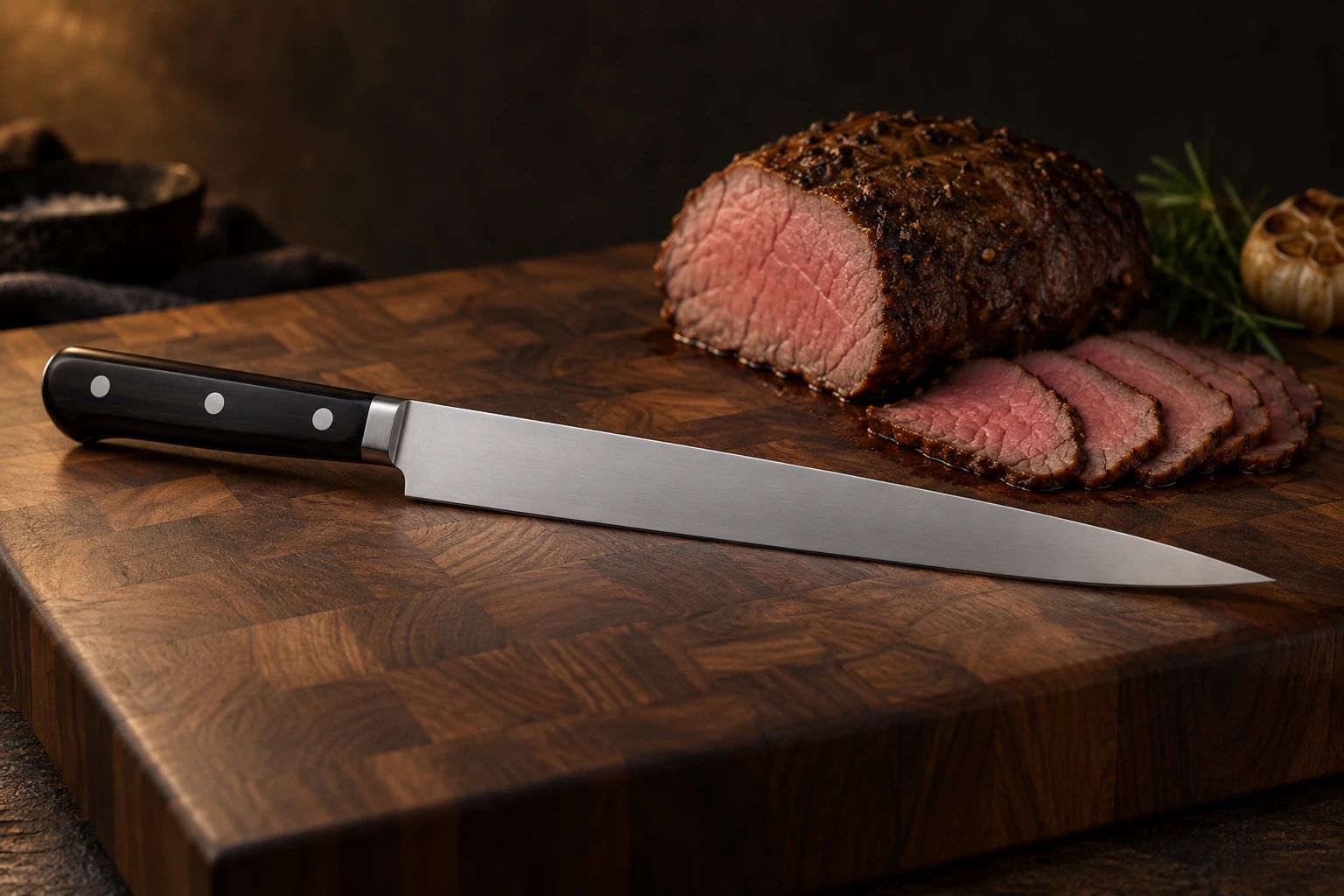
Table of Contents
TL;DR — best picks by use-case
The single best-value first sujihiki is the Tojiro DP Sujihiki 240mm (~$90-130). If you want a "buy once" carving and slicing knife, step up to a Misono UX10 or MAC Professional sujihiki 240-270mm (~$200-280).
- Value / first sujihiki — Tojiro DP Sujihiki 240mm (~$90-130) — the editor's choice on-ramp, VG-10 stainless
- Value, traditional feel — Sakai Takayuki sujihiki 240-270mm (~$120-200) — Sakai-forged, wa-handle option
- Lifetime — Misono UX10 Sujihiki 240-270mm (~$200-280) — thin Swedish-stainless grind, pro favourite
- Lifetime, Western-pro — MAC Professional Slicer 240-270mm (~$170-260) — superb edge retention, ambidextrous
- Step-up Japanese — Sakai Takayuki Grand Chef / Damascus sujihiki (~$200-350) — refined finish, gift-grade
- Left-handed — any sujihiki works as-is; double-bevel means no special order, no premium
Short version: the ~$90-130 Tojiro DP sujihiki or a ~$200-280 Misono UX10 / MAC Professional slicer — most cooks who carve and slice are well served by one of these.
Before you buy: what a sujihiki is (and is not)
A sujihiki (筋引包丁, roughly "muscle/sinew slicer") is a long, narrow, double-bevel slicing knife — the Japanese answer to a Western carving or slicing knife. Its job is to draw long, clean slices through cooked proteins and fish in a single pulling stroke: a rested roast, brisket, prime rib, ham, turkey, smoked salmon, and boneless fish fillets. The length lets you slice in one pull rather than sawing, and the thin, flat profile produces a smooth cut face that does not tear or compress the food. Because it is double-bevel, it is ambidextrous and sharpens like any normal knife.
The hard rules that shaped every pick below:
- Slicing and carving — not chopping. A sujihiki is for clean pull-stroke slicing of cooked proteins and boneless fish. It is a poor choice for general prep, hard vegetables, or rock-chopping.
- Never on bone. The thin edge is built for flesh, not joints. Carve around bones; do not lever or hack through them.
- Double-bevel means ambidextrous. Unlike a single-bevel yanagiba, a sujihiki works in either hand with no special build — a real advantage for left-handed cooks.
- Low-maintenance by design. Most quality sujihikis are stainless, so they tolerate the wet, lightly fatty work of carving far better than a carbon single-bevel slicer.
In short, the sujihiki is the versatile finishing slicer: the knife you reach for to carve the roast cleanly at the table or portion a fish side without dragging. Many cooks own a gyuto first and add a sujihiki when slicing and carving become a regular part of how they cook.
Sujihiki vs yanagiba: double-bevel vs single-bevel
This is the comparison that decides which long Japanese slicer is right for you, so we are putting it up front. The two knives share a silhouette — long, narrow, built to slice in one pull — but they are ground completely differently, and that changes everything.
- Sujihiki — double-bevel. Edge ground on both faces, like a Western knife. It is ambidextrous, sharpens on a standard whetstone with no special technique, tolerates wet protein work well (usually stainless), and slices both cooked meats and raw fish. The trade-off: on pure sashimi it cannot quite match the mirror-clean release of a single bevel.
- Yanagiba — single-bevel. Bevel on one face, flat ura on the other. It gives the cleanest sashimi cut and the smoothest slice release, but it is handed (left-handed cooks need a priced special order), demands single-bevel sharpening, and is usually carbon, so it needs more care.
The honest verdict: buy a sujihiki if you want one versatile, ambidextrous, low-maintenance slicer for everything from roasts to fish; buy a yanagiba if pure sashimi quality is the whole point and you accept the handedness and upkeep. Our full best yanagiba knife guide covers the single-bevel side, and our single vs double bevel guide explains exactly why the geometry behaves so differently. There is no winner here — only the right tool for how you cook.
Sujihiki vs gyuto: slicer vs all-rounder
The other common mix-up is the sujihiki and the gyuto, because both are long double-bevel knives. The difference is purpose, and it shows in the blade shape.
- Gyuto — the all-rounder. Taller blade with a curved belly for rocking and chopping, built to do everything: vegetables, meat, general prep. It is the one knife most kitchens should own first.
- Sujihiki — the slicer. Longer, narrower, and flatter, optimised to draw a single long slice cleanly rather than to chop. It excels at carving and portioning and is poor at general prep.
Practical advice: if you only buy one knife, make it a gyuto; add a sujihiki when carving and clean slicing become frequent enough to want a dedicated blade. A tall, curved gyuto can carve in a pinch, but its height and belly drag on long slices and its tip can catch — the sujihiki's flat, narrow profile glides where the gyuto fights. See our best gyuto knife picks if you do not yet own an all-rounder, and our broader best Japanese knives roundup for how the two fit a full set.
How we chose
- Specs — the makers' published steel, blade length, weight, bevel, profile and handle.
- Care needs — stainless vs carbon for a slicer that spends its time on wet proteins.
- Price — approximate street ranges from the value tier to pro.
We do not invent hardness numbers or specs. Where a maker documents a steel we name it; where details vary by batch or length we keep it conservative and say so. All prices are approximate street ranges, not quotes — slicers swing a lot by length, finish, and seller. We have not cut with these knives; the only knives we have cut with are the six santoku in our Kappabashi under-$150 test.
Value tier — your first double-bevel slicer
Editor pick: Tojiro DP Sujihiki 240mm (~$90-130)
The most sensible on-ramp to a real Japanese slicer. The Tojiro DP line pairs a VG-10 stainless core with stainless cladding, made in Tsubame-Sanjo (Niigata) with Tojiro's consistent quality control and broad international availability. It takes a keen edge, holds it well, sharpens easily on a whetstone, and gives you authentic sujihiki length and a thin slicing profile without a craft-knife price. Because it is stainless and double-bevel, it is genuinely low-fuss — wipe and go — and works in either hand.
- Strengths — VG-10 keenness and edge retention, easy to sharpen, low maintenance, ambidextrous, widely available, honest value
- Weaknesses — plain styling; riveted Western handle rather than a traditional wa handle; not a sashimi specialist
- Buy if — first sujihiki, you carve and slice regularly, you want one versatile low-maintenance slicer
Traditional-feel alternative: Sakai Takayuki sujihiki 240-270mm (~$120-200) — a Sakai-forged slicer, often available with a comfortable ho-wood octagonal wa handle and stainless or Ginsan steel. You pay a little more than the Tojiro for a more traditional Japanese feel and finish, which is the right call if you cook Japanese food and prefer a wa handle in the hand.
Lifetime tier — the carving knife for keeps
Editor pick: Misono UX10 Sujihiki 240-270mm (~$200-280)
Misono's premium UX10 line, forged with Swedish Sandvik stainless and finished with the maker's signature thin grind, makes one of the finest production slicers you can buy. On a long sujihiki that thin geometry pays off directly: the blade glides through a roast with very little drag, the slice release is clean, and the edge is keen and easy to bring back on a stone. It is a knife many professionals keep for carving and portioning, and it will reward decades of proper sharpening. Available in 240mm and 270mm.
- Strengths — refined thin grind, excellent slice glide and release, keen long-lasting stainless edge, beautiful finish, ambidextrous
- Weaknesses — premium price; the thin blade is less forgiving of lateral force; more knife than a casual carver needs
- Buy if — you carve and slice often, want a "buy once" blade, and value edge feel
Western-pro alternative: MAC Professional Slicer 240-270mm (~$170-260) — the default professional slicer in many North American and European kitchens. MAC's proprietary high-carbon stainless holds an edge exceptionally well, the geometry is excellent for long clean slices, and the balance is superb. It is fully ambidextrous and very low maintenance — a tremendous "last slicer" if you prefer a Western handle and proven durability over a more Japanese aesthetic.
Pro tier — refined and hand-finished slicers
This tier is finish, steel, and provenance more than raw everyday performance. The differences in ordinary carving narrow, but premium steels, hand-finishing, Damascus cladding, and refined wa handles carry the price. These are the slicers that look as good on the table as they cut.
Editor pick: Sakai Takayuki Grand Chef or Damascus sujihiki 240-270mm (~$200-350)
Sakai Takayuki's higher lines pair Sakai forging with premium stainless cores (such as Swedish stainless or VG-10) and, in the Damascus versions, beautiful laminated cladding over a hard core. You get a refined grind, clean slice release, and a gift-grade finish, often with a comfortable wa handle. Worth being clear: the Damascus pattern is cosmetic — it is the core steel that cuts — so buy the look if you love it, but do not expect the pattern itself to improve performance.
- Strengths — Sakai forging and finish, premium core steel, gift-grade looks, refined handle, clean slicing
- Weaknesses — Damascus carries a design premium; more about pride and finish than extra cutting ability; price
- Buy if — you want a beautiful lifetime slicer, a gift-grade knife, or a more traditional Japanese build
Alternative: a step-up Tojiro or comparable Damascus sujihiki (~$150-280) — several established makers offer VG-10 or SG2-core Damascus sujihikis in this range. They give you a clear step up in finish and a striking look over the value tier, with the same honest caveat: the pattern is decoration, the core does the cutting. A strong pick if you want presentation as well as performance.
What length sujihiki should you buy?
Length is the spec people get wrong most often, because a sujihiki is meant to slice in one pull — the blade should comfortably exceed the width of whatever you are carving so you never saw.
- 240mm (9.4") — the friendliest home size. Easier to control and store, smaller hands welcome, and long enough for most roasts, hams, and fish sides. A great first sujihiki.
- 270mm (10.6") — the standard all-rounder and our default recommendation for serious carving. Extra reach for wider roasts and salmon sides in a single clean draw.
- 300mm (11.8") and up — for whole briskets, prime rib, and pro slicing. Maximum reach, but it needs board space, storage, and a confident stroke.
If you are unsure, buy 240mm for a home kitchen or 270mm if you carve large roasts often. Both are long enough for nearly all home carving without becoming unwieldy. For how the sujihiki fits alongside a gyuto and other knives, see our best Japanese knives roundup.
Full comparison table
Prices are approximate street ranges in USD, not fixed quotes. Sujihikis vary widely by length, finish, handle, and seller, and currency and import costs shift them further — treat these as ballpark bands for comparison, not exact figures.
| Pick | Tier | Price (USD, approx.) | Typical length | Steel |
|---|---|---|---|---|
| Tojiro DP Sujihiki | Value / first | ~$90-130 | 240mm | VG-10 core, stainless |
| Sakai Takayuki Sujihiki | Value, traditional feel | ~$120-200 | 240-270mm | Stainless / Ginsan |
| Misono UX10 Sujihiki | Lifetime | ~$200-280 | 240-270mm | Swedish Sandvik stainless |
| MAC Professional Slicer | Lifetime, Western-pro | ~$170-260 | 240-270mm | Proprietary high-carbon stainless |
| Sakai Takayuki Grand Chef / Damascus | Pro / gift-grade | ~$200-350 | 240-270mm | Premium stainless / VG-10 (Damascus) |
| Any sujihiki, left-handed use | Ambidextrous — no special build | same as base | 240-270mm | Double-bevel |
How to choose without regret
- First sujihiki → value tier. Tojiro DP 240mm, or a Sakai Takayuki if you want a more traditional wa-handle feel. Learn the single-pull slice here before spending more.
- Want it for life → Misono UX10 or MAC Professional. A thin-ground Misono for the finest edge feel, or a MAC for proven retention and a Western handle. Both are ambidextrous and low maintenance.
- Left-handed? Just buy any sujihiki. Double-bevel means no special order and no premium — this is the slicer's biggest edge over a single-bevel yanagiba.
- Prefer stainless. A slicer meets wet protein constantly; VG-10, Sandvik, and Ginsan give a keen edge with far less rust worry than carbon.
- Default to 240mm at home, 270mm for big roasts. Long enough to slice in one pull, not unwieldy. Go 300mm+ only for whole briskets and pro work.
- Don't pay for Damascus expecting sharper cuts. The pattern is cosmetic; the core steel does the cutting. Buy it for looks, not performance.
Stuck? For most cooks the answer is the Tojiro DP Sujihiki 240mm to start, stepping up to a Misono UX10 or MAC Professional slicer when carving becomes a regular habit. For how it compares to its cousins, see our best yanagiba knife and best gyuto knife guides, plus single vs double bevel.
Buying a sujihiki in Japan
Japan is usually cheaper for the same maker, and a long, length-sensitive slicer is exactly the kind of knife worth holding in hand before you commit. Tokyo's Kappabashi kitchenware street and the forges of Sakai carry the widest selection of double-bevel slicers, from value Tojiro up to refined Damascus and pro Misono. Domestic prices often sit below overseas retail, and good shops will discuss steel, length, and handle honestly — and because a sujihiki is ambidextrous, there is no handedness to special-order for.
If you cannot travel, reputable makers and shops ship internationally. For broader category context, see our best Japanese knives roundup, and to understand the steels behind these picks, our steel types guide.