Aogami vs Shirogami: Blue vs White Steel Japanese Knife — Performance Compared
Quick answer
Aogami (blue) holds an edge longer thanks to tungsten + chromium additives; Shirogami (white) is plain carbon steel, prized for a keener edge. Both rust without care.
- Aogami
- Edge retention
- Shirogami
- Sharpness
- Both
- Carbon steel
- Beginner-friendly
- Neither (use VG10)
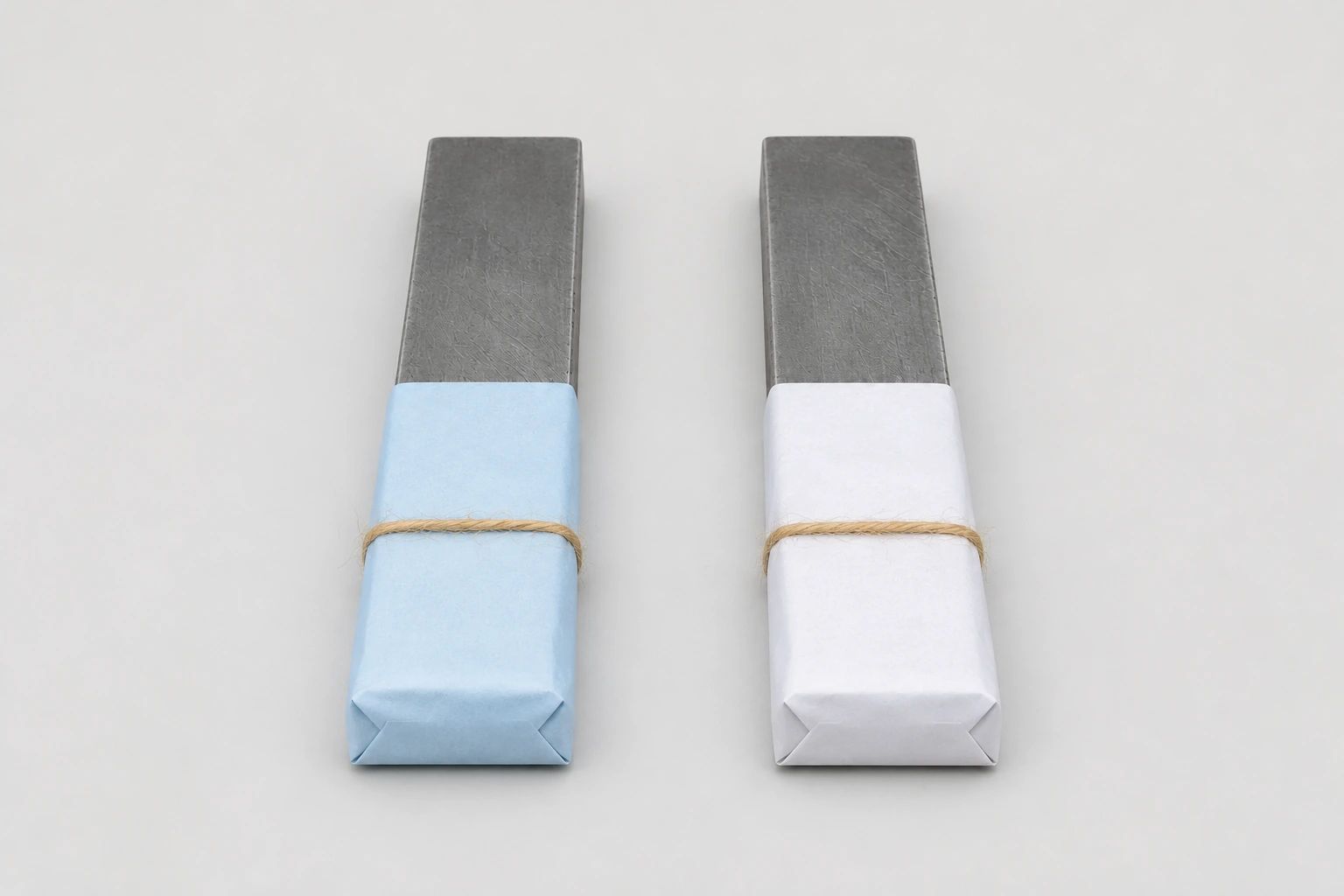
Table of Contents
TL;DR — The 30-Second Answer
Aogami and Shirogami are both carbon steels from Proterial's Yasugi works. Within each family a lower number means more carbon: Shirogami comes in #1, #2 and #3, Aogami in #1, #2 and Super. Both rust without care. The differences:
- Shirogami (White Steel) — Carbon steel with minimum impurities; Proterial lists no chromium or tungsten. Takes a keener edge. Loses that edge faster. Sharpens easier.
- Aogami (Blue Steel) — Same base as Shirogami + tungsten + chromium, which Proterial adds to improve wear resistance. Slightly less ultimate sharpness. Better edge retention. Slightly harder to sharpen.
- If you sharpen weekly: Shirogami #2 — you'll enjoy the maintenance dance.
- If you sharpen monthly: Aogami #2 — better fit for less frequent stones.
- If you want maximum edge life and can sharpen well: Aogami Super (the most carbon and tungsten of the Aogami grades, plus vanadium).
- If you want the rust resistance of stainless with carbon-steel feel: Ginsanko (Silver #3, also from Proterial).
What Are Aogami and Shirogami?
Both Aogami (青紙) and Shirogami (白紙) are high-carbon tool steels made at the Yasugi works of Proterial (called Hitachi Metals until January 2023[9]) in Yasugi, Shimane Prefecture, Japan. The names mean "Blue Paper" and "White Paper" respectively — referring to the color of the paper labels the mill wraps the steel in[11], not the appearance of the finished knife.
The two steels start from the same base recipe: iron, carbon (0.80–1.50% depending on grade, from Shirogami #3 to Aogami Super), silicon 0.10–0.20%, manganese 0.20–0.30%, and very low phosphorus (≤0.025%) and sulfur (≤0.004%)[1][3][7]. Shirogami is this plain formula; Aogami adds tungsten (1.00–2.50%, by grade) and chromium (0.20–0.50%), and Aogami Super also vanadium (0.30–0.50%)[5][6][7]. That alloying is the main chemical difference between the two families.
Shirogami is sold in three numbered grades, Aogami in #1, #2 and Super. Within each family the lower number has more carbon: #1 1.25–1.35%, #2 1.05–1.15%, Shirogami #3 0.80–0.90% — and Proterial rates Shirogami #1 "highest hardness", #2 "high" and #3 "middle"[1][2][3]. Aogami Super has the most carbon (1.40–1.50%) and tungsten (2.00–2.50%) of the Aogami grades, plus vanadium[7]. See our broader steel types guide for the full landscape.
Shirogami (White Steel) — Pure Carbon, Sharpest Edge
Shirogami is the simpler formula: Proterial describes it as a carbon steel with minimum impurities[1]. The lack of alloying elements means the grain structure can be made extraordinarily fine through careful forging and heat treatment — and that fine grain takes a very fine, keen edge.
- Shirogami #1 — Highest carbon of the Shirogami grades (1.25–1.35%); Proterial rates it "highest hardness" and gives a quench hardness of HRC 60 or more[1]. More carbon makes it more brittle — it can chip if mishandled.
- Shirogami #2 — Standard grade (1.05–1.15%), HRC 60 or more (mill minimum)[2]. Slightly less sharp than #1 but more forgiving. The most common Shirogami grade and the right choice for most non-professional buyers.
- Shirogami #3 — Entry grade (0.80–0.90%); Proterial rates it "middle hardness": HRC 60 or more water-quenched, 52 or more oil-quenched[3]. Used in budget carbon-steel knives. Easier to sharpen, holds less of an edge. Rarely seen at premium retail.
Why Shirogami appeals to sharpeners: the steel is responsive on the stones. When you raise the angle by 1 degree on the whetstone, the knife reports that change instantly. Aogami is more forgiving — and that forgiveness is, perversely, a downside if you're trying to develop precise sharpening technique. Shirogami trains your hands.
Trade-off: Shirogami loses its edge faster than Aogami in normal use, because it lacks the tungsten and chromium that Proterial adds to Aogami for wear resistance[6]. How much faster depends on the hardness the maker gives the blade and on how you cut. If you touch up on a finishing stone every day, this matters little. If you sharpen rarely, it's frustrating.
Aogami (Blue Steel) — Tungsten + Chromium, Best Retention
Proterial describes Aogami as an alloy steel with tungsten and chromium added to improve heat-treatment properties and wear resistance[5][6]. The tungsten forms hard carbides in the grain structure that resist abrasion — meaning the cutting edge wears slower against vegetables, fish, and cutting boards.
- Aogami #1 — 1.25–1.35% carbon, 0.30–0.50% chromium and 1.50–2.00% tungsten; HRC 60 or more (mill minimum)[5]. Proterial lists kitchen knives among its uses. Excellent retention with near-Shirogami sharpness.
- Aogami #2 — Standard grade: 1.05–1.15% carbon (as Shirogami #2), 0.20–0.50% chromium and 1.00–1.50% tungsten; HRC 60 or more (mill minimum)[6]. The most common Aogami grade. The right balance for most buyers: better edge retention than Shirogami #2, only slightly less ultimate sharpness.
- Aogami Super — The most carbon (1.40–1.50%) and tungsten (2.00–2.50%) of the Aogami grades, plus 0.30–0.50% vanadium, which Proterial adds with tungsten and chromium for wear resistance[7]. Its published minimum hardness is HRC 60, the same as Aogami #2; the finished figure depends on the maker's heat treatment. Holds an edge longer than Aogami #2, but is markedly harder to sharpen.
The chromium addition (0.20–0.50%) is far too small to make the steel stainless — Aogami is not meaningfully more rust-resistant than Shirogami[11], and both need the same care.
A case for Aogami today: the trade-off math has shifted. Stones with consistent grit progression (synthetic ceramics like Naniwa Chosera, Shapton glass) make Aogami's "harder to sharpen" downside less significant than it was 50 years ago, and Aogami's edge retention advantage becomes more valuable as kitchens use harder cutting boards (polypropylene, hard maple) than the soft hinoki of historical Japan.
Side-by-Side: All Six Grades
The six Shirogami and Aogami grades from Proterial's Yasugi works:
| Steel | Carbon % | HRC (mill min.) | Edge Sharpness | Edge Retention | Sharpenability | Common Knife Types |
|---|---|---|---|---|---|---|
| Shirogami #1 | 1.25-1.35 | 60+ | Best | Low | Easy | Yanagiba, Usuba (traditional) |
| Shirogami #2 | 1.05-1.15 | 60+ | Excellent | Low-Medium | Easy | Gyuto, Petty, Yanagiba |
| Shirogami #3 | 0.80-0.90 | 60+ water / 52+ oil quench | Good | Low | Very Easy | Budget carbon knives |
| Aogami #1 | 1.25-1.35 | 60+ | Excellent | High | Medium | Premium Gyuto, Yanagiba |
| Aogami #2 | 1.05-1.15 | 60+ | Very Good | Medium-High | Medium | Gyuto, Nakiri, Petty |
| Aogami Super | 1.40-1.50 | 60+ | Excellent | Very High | Hard | Premium Gyuto, modern designs |
Carbon and HRC are Proterial's published figures; HRC is the minimum after its standard heat treatment[1][2][3][5][6][7], and a finished knife's hardness is set by the maker's own heat treatment. Note: "Sharpness" here refers to peak achievable sharpness when correctly sharpened, not factory edge. All six steels are extremely sharp from a competent maker; the differences are at the edge of measurable performance.
Which One Should You Buy?
Recommendations by situation:
| Your Situation | Recommendation | Why |
|---|---|---|
| First Japanese carbon knife | Shirogami #2 | Forgiving on stones, fastest learning curve |
| Want best edge retention, sharpen monthly | Aogami #2 | Modern best-balance carbon steel |
| Advanced sharpener, want absolute peak performance | Aogami Super | Most carbon and tungsten of the Aogami grades, plus vanadium — longest retention |
| Traditional yanagiba / usuba for sushi work | Shirogami #1 or #2 | Keen edge, quick to restore — suits daily touch-ups |
| Want carbon-steel feel, less rust risk | Ginsanko (not Aogami) | Stainless from Proterial, which says it has hardness and sharpness comparable to carbon steel[8] |
| Replacement for everyday gyuto, gift | VG-10 stainless instead | Carbon-steel maintenance is wrong for casual use |
| Plan to leave knife on counter wet | Neither — buy stainless | Carbon steel needs the post-use wipe ritual |
| Live in humid climate (Tokyo summer, Florida) | Either, dried at once — or stainless | Aogami's 0.20–0.50% chromium is too little to make a real difference to rust |
Care Notes: Both Will Rust
The non-negotiable carbon-steel routine — same for both Aogami and Shirogami:
- Dry within 60 seconds of every use. Rust on carbon steel starts within minutes of moisture contact. Wipe with a paper towel or cloth immediately after rinsing.
- Oil weekly with food-grade mineral oil or camellia (tsubaki) oil. A few drops on a paper towel, wiped along the entire blade. This prevents active rust between uses.
- Embrace patina, not rust. Patina is the stable gray-blue oxide that forms after weeks of use. It's protective. Active rust is the orange flaky stuff — that's bad and needs removal with a #1000 stone or rust eraser. See our rust care guide.
- Never dishwasher. Hot water + strong detergent + steam = rust within hours.
- Store dry. Magnetic strip, saya, or a knife block in a dry kitchen. Not a wet drawer.
- Sharpen with whetstones, not pull-throughs. A pull-through removes too much steel and exposes fresh metal to oxidation in unhelpful ways. Use #1000/#3000/#6000 progression. See sharpening guide.
Price Implications
Steel grade is a small fraction of total knife price — the smith's labor and shop reputation matter far more. Rough 2026 retail bands for 210mm gyutos from mid-tier Sakai makers:
- Shirogami #2 gyuto: ¥18,000-30,000 / $130-220 — the entry to traditional carbon-steel construction.
- Aogami #2 gyuto: ¥20,000-35,000 / $150-260 — a small premium over Shirogami #2.
- Shirogami #1 gyuto: ¥25,000-50,000 / $180-360 — typically from named smiths.
- Aogami #1 gyuto: ¥30,000-60,000 / $220-440 — premium professional tier.
- Aogami Super gyuto: ¥35,000-80,000 / $260-580 — top-of-line carbon.
The price gap between #1 and #2 grades often has more to do with the smith than with the steel. A "Shirogami #2" from a master smith can outperform a "Shirogami #1" from a budget maker. For shopping, see our under $200 guide for Aogami picks and our yearly best-of for premium carbon options.
Frequently Asked Questions
What is the practical difference between Aogami and Shirogami in the kitchen?
Is Aogami Super really worth the extra money over regular Aogami #2?
Will an Aogami or Shirogami knife rust if I dry it after every use?
Can I tell which steel a knife is made of just by looking at it?
Why is Aogami called 'blue' steel and Shirogami 'white' steel — is it the color?
Is Aogami or Shirogami a good choice for my first Japanese knife?
What about Ginsanko, AUS-10, or VG-10 — how do those compare to Aogami and Shirogami?
Sources
- [1] Shirogami 1 — chemical composition and heat treatment , Proterial, Yasugi Specialty Steel
- [2] Shirogami 2 — chemical composition and heat treatment , Proterial, Yasugi Specialty Steel
- [3] Shirogami 3 — chemical composition and heat treatment , Proterial, Yasugi Specialty Steel
- [4] Kigami 2 — chemical composition and heat treatment , Proterial, Yasugi Specialty Steel
- [5] Aogami 1 — chemical composition and heat treatment , Proterial, Yasugi Specialty Steel
- [6] Aogami 2 — chemical composition and heat treatment , Proterial, Yasugi Specialty Steel
- [7] Aogami Super — chemical composition and heat treatment , Proterial, Yasugi Specialty Steel
- [8] GIN 3 — chemical composition and heat treatment , Proterial, Yasugi Specialty Steel
- [9] Corporate History (Detailed) , Proterial, Ltd.
- [10] VG10 , Takefu Special Steel Co., Ltd.
- [11] White vs Blue Steel: Shirogami vs Aogami, Honestly , Knives and Stones (retailer)