Gyuto vs Santoku vs Bunka: Which Japanese All-Rounder to Buy
QUICK ANSWER
Buy the gyuto if you want one knife that does everything — it is the longest, has a curved belly, and handles meat, fish, and big vegetable loads with room to spare. Choose the santoku if you want a shorter, lighter, flatter blade that feels compact on a home board and leans toward vegetables. Pick the bunka only if you specifically want that santoku-class size with an angled k-tip for fine tip work. The differences are real but modest; all three are capable daily drivers.
Most versatile
Gyuto
Most compact
Santoku
Best tip precision
Bunka
Safe default
Gyuto 210mm
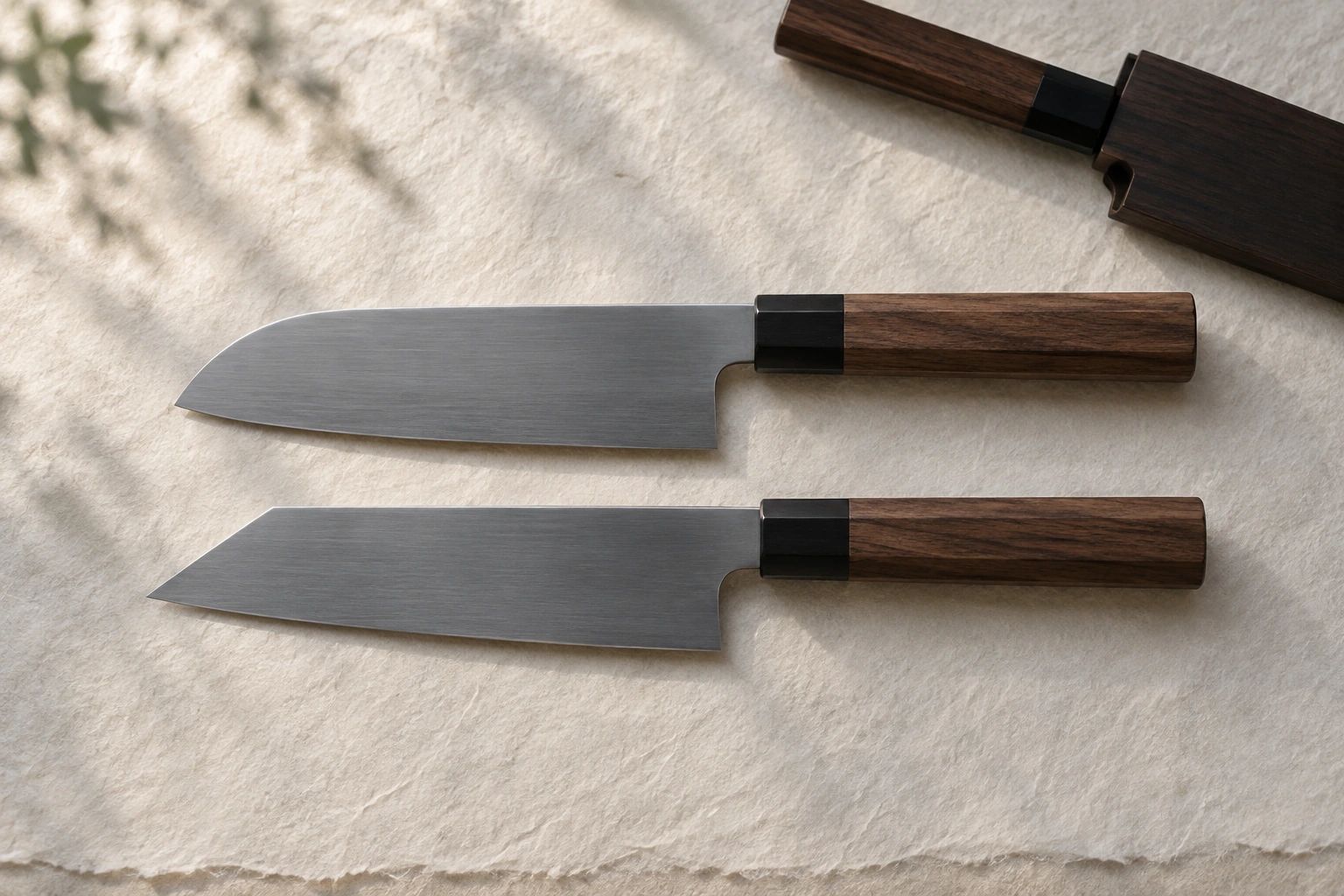
Table of Contents
30-second verdict
Gyuto = the do-everything knife. Longest of the three (usually 210–240mm), with a curved belly that lets you rock-chop as well as push-cut. It is the natural pick if you want a single knife that handles meat, fish, and large vegetable loads without feeling cramped. Think "Japanese chef knife."
Santoku = the compact all-rounder. Shorter (165–180mm), lighter, with a flat profile and a rounded, dropped tip. It feels manageable on a home board, leans toward vegetables and everyday prep, and is the friendliest for smaller kitchens and smaller hands. Less reach for big proteins, more control for quick jobs.
Bunka = a santoku with a point. Same compact size and flat-ish profile as a santoku, but it swaps the rounded nose for an angled, reverse-tanto k-tip. That sharp tip buys you precision for scoring, fine detail, and tight cuts — a small but genuine edge over the santoku for tip work, at a slight cost in rounded-tip safety.
Short version: want one knife that does it all → gyuto 210mm. Want a compact, vegetable-leaning daily driver → santoku. Want that compact size but with a precise tip → bunka.
Side-by-side: the real differences
Five dimensions actually separate these three. Everything else — steel, handle, price — is available across all of them and is a brand choice, not a blade-style choice.
- Length & reach. Gyuto is the long one (210–240mm, with 210mm the home standard). Santoku and bunka are both short and close in size (165–180mm). More length means more reach for big ingredients and longer slicing strokes; less length means more nimbleness and less board space needed.
- Blade profile. The gyuto has a pronounced curved belly. The santoku and bunka are comparatively flat with a gentle curve near the tip. Profile is what dictates cutting motion (more on that below).
- Tip shape. This is where santoku and bunka part ways. Gyuto: a fine, raised pointed tip. Santoku: a rounded, dropped sheepsfoot tip. Bunka: an angled, reverse-tanto k-tip that comes to a sharp point — the most precise tip of the three for detail work.
- Cutting motion. Gyuto favors rocking (curved belly) but push-cuts fine too. Santoku and bunka are built for push cutting and tap-chopping (flat profile lifts and presses straight down). All three can do all motions; each just has a sweet spot.
- Best-for. Gyuto: the widest range, including meat and large-volume prep. Santoku: vegetable-forward everyday cooking in a compact package. Bunka: the same everyday range as a santoku, plus better fine-tip precision.
Notice what is not on this list: there is no "better steel" or "sharper" category. A premium gyuto, santoku, and bunka from the same maker share the same steel and the same edge. The choice is purely about size, profile, and tip — how the knife fits your hands, your board, and the way you like to cut.
Profile, tip & cutting motion
Why the curve matters. A curved belly (the gyuto) keeps part of the edge on the board throughout a cut, so you can roll the knife forward and back — the classic rocking mince used for garlic, herbs, and shallots. A flat profile (santoku and bunka) keeps almost the entire edge in contact at once, which rewards a clean up-and-down push: lift the blade, press straight down, slide the food along. Neither is superior; they suit different muscle memories. If you trained on a Western chef knife and rock instinctively, the gyuto will feel like home. If you prefer decisive straight chops, the flatter santoku or bunka will click faster.
Why the tip matters. The gyuto's raised pointed tip is great for separating segments, trimming, and getting under sinew. The santoku's dropped, rounded tip trades that precision for a safer, more forgiving nose — pleasant for cooks who find a sharp point intimidating, and well suited to scooping prep off the board. The bunka's k-tip is the precision specialist: an angled reverse-tanto point that excels at scoring, fine slicing, and detailed work, essentially giving you santoku ergonomics with a tip that behaves more like a gyuto's. That is the entire reason to choose a bunka over a santoku — if tip precision does not matter to you, the santoku's rounded tip is the safer, equally capable choice.
How the differences feel in practice. Honestly, modest. Swap between a good santoku and a good bunka and most cooks notice the tip and little else. Swap from either to a gyuto and you mainly feel the extra length and the rocking ability. These are refinements within one family of all-rounders, not categorical leaps. Any of the three will breeze through 90% of home prep; the remaining 10% is where size and tip start to nudge you toward one over the others. For the deep two-blade breakdown of the long-vs-short decision, our santoku vs gyuto guide goes further.
Who picks which
Pick the gyuto if you want one knife to rule the kitchen, you cook meat and fish regularly, you have a board at least ~40cm wide, you like longer slicing strokes, or you rock-chop herbs by habit. It is the most versatile of the three and the answer we give most often to "I just want one good knife." Explore options in our best gyuto knife roundup, and right-size it with the gyuto size guide. For the full anatomy of the blade, see the gyuto knife guide.
Pick the santoku if your kitchen or board is small, you have smaller hands, you cook mostly vegetables, you want the lightest and most manageable of the three, or a sharp pointed tip makes you nervous. It is the most beginner-friendly all-rounder. See our tested picks in the best santoku knife guide.
Pick the bunka if you love the compact santoku size and weight but want a precise tip for scoring, detail cuts, and getting into tight spots — and you like the look of the angled k-tip. It is the enthusiast's compact all-rounder. Browse our best bunka knife picks.
Pick two if you want full coverage without redundancy: a gyuto (210mm) for big jobs and proteins, plus a santoku or bunka (165–180mm) for fast everyday prep and fine work. That pairing covers nearly every home task. For the wider lineup beyond all-rounders, see best Japanese knives 2026.
Full comparison table
| Attribute | Gyuto | Santoku | Bunka |
|---|---|---|---|
| Typical length | 210–240mm | 165–180mm | 165–180mm |
| Blade profile | Curved belly | Flat, gentle curve | Flat, gentle curve |
| Tip | Raised fine point | Rounded sheepsfoot | Angled k-tip (sharp point) |
| Best cutting motion | Rock & push | Push & tap-chop | Push & tap-chop |
| Weight feel | Longest, most reach | Light, compact | Light, compact |
| Leans toward | Everything incl. meat | Vegetables, everyday | Vegetables + tip precision |
| Board space needed | Larger (~40cm+) | Standard board OK | Standard board OK |
| Best for | One do-it-all knife | Compact daily driver | Compact + detail work |
Read the table as three points on a spectrum, not three different tools. Gyuto and santoku sit at opposite ends — long-and-curved vs short-and-flat — and the bunka sits right beside the santoku, distinguished almost entirely by its tip.
Final pick by cook type
- The "I just want one good knife" cook → gyuto 210mm. Widest range, handles proteins, familiar to anyone who has used a chef knife. The safest single-knife answer.
- The vegetable-forward home cook with a small board → santoku. Light, compact, push-cuts beautifully, forgiving rounded tip. The friendliest everyday all-rounder.
- The detail-oriented enthusiast → bunka. Santoku ergonomics plus a precise k-tip for scoring and fine work. The compact all-rounder with a sharper personality.
- The Western-trained, rock-chopping cook → gyuto. The curved belly matches your existing technique; santoku and bunka will fight your muscle memory a little.
- The cook who wants two knives → gyuto + santoku (or bunka). One long, one short. Covers nearly everything with no redundant overlap.
- The smaller-handed cook → santoku or bunka. The compact length is more controllable; a 210mm gyuto can feel like a lot of knife at first.
Still undecided? Default to the gyuto 210mm — it is the most versatile and the least likely to leave you wishing you had bought the other one. If you know your cooking skews to small-batch vegetable prep on a compact board, the santoku (or a bunka if you value a fine tip) is the more comfortable companion. Whichever way you lean, none of these is a mistake. If you are buying in Japan, hold all three in hand first — Tokyo's Kappabashi knife district is the place to do exactly that.