Japanese Knife Care: Complete Daily, Weekly, Monthly Routine (2026)
QUICK ANSWER
Hand-wash with mild soap immediately after use, dry with cloth in 60 seconds, store on magnetic strip or in saya — never dishwasher.
Wash
Hand only
Dry
60 sec post-wash
Store
Magnetic strip / saya
Never
Dishwasher
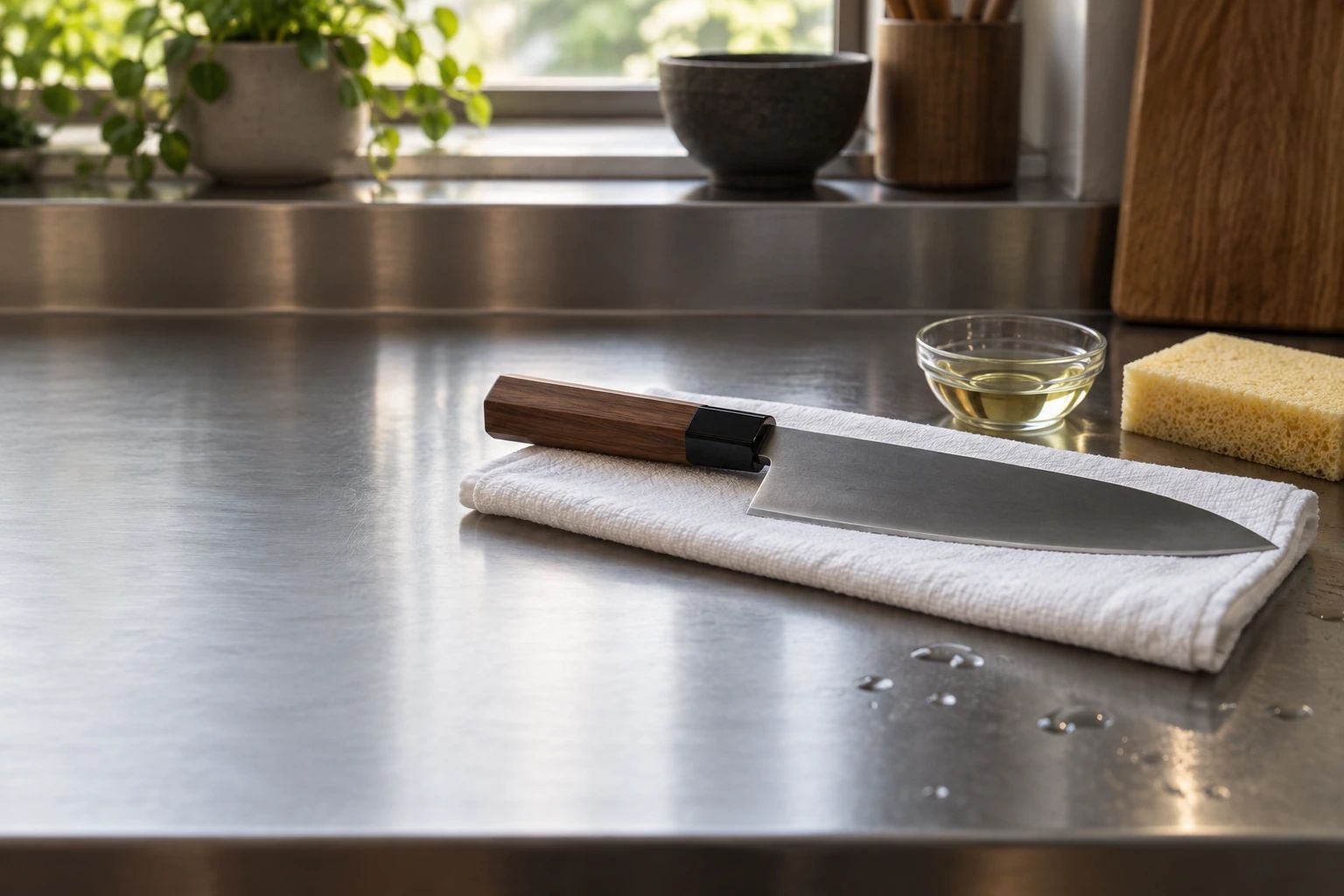
Table of Contents
TL;DR — The Care Schedule at a Glance
Five timeframes, five actions. The whole care system in one table:
| Frequency | Action | Tool | Time |
|---|---|---|---|
| After every use | Wash, dry, (oil if carbon) | Soft sponge, towel, oil | 1 min |
| Weekly | Hone the edge | Ceramic rod or strop | 2 min |
| Monthly | Whetstone touch-up | #3000-6000 stone | 10-15 min |
| Quarterly | Full whetstone progression | #1000, #3000, #6000 stones | 20-30 min |
| Annual (optional) | Pro sharpening + inspection | Professional sharpener | Drop off / mail |
The breakthrough insight: frequency matters more than perfection. A 2-minute weekly hone done consistently beats a 30-minute monthly sharpening done sloppily. Set a calendar reminder and don't skip it.
Daily — Wash, Dry, (Oil)
The daily routine is the foundation. Skip it and everything else falls apart. Three steps:
- Wash by hand immediately after use. Use mild dish soap and a soft sponge — not a scouring pad, not steel wool. The cutting edge is the most delicate part; sponge along the spine first, then the flat sides, gently across the edge in the direction away from your hand. Total time: 30 seconds.
- Dry within 60 seconds of rinsing. Use a clean cloth or paper towel. For stainless knives, drying is recommended; for carbon knives, drying is non-negotiable — rust starts forming within minutes of water contact. Wipe the entire blade including the spine and tang. Total time: 15 seconds.
- Oil if carbon steel. For Aogami, Shirogami, or any carbon-steel knife, apply a thin film of food-grade mineral oil or tsubaki (camellia) oil to both sides of the blade. A few drops on a paper towel, wiped along the blade. Total: 15 seconds. For stainless knives, this step is unnecessary.
Critical things to avoid in daily use:
- Never the dishwasher. Heat + detergent + impacts = certain damage. See FAQ.
- Never glass, marble, or ceramic cutting boards. These destroy the edge in weeks. Use wood (hinoki, maple) or soft plastic. See cutting board guide.
- Never leave wet in the sink. Wash and dry immediately, even if you're in a rush.
- Never cut bones, frozen food, or hard squash with thin Japanese knives. Use a Western cleaver or deba for those.
Weekly — Hone the Edge
Honing is the most under-used maintenance technique in home kitchens. It takes 2 minutes, requires no skill development, and triples the time between major sharpenings. The mechanism: the edge of a knife is microscopically rolled over from use; honing pushes it back into straight alignment.
How to hone with a ceramic rod (the only kind suitable for Japanese knives):
- Hold the rod vertically, tip down, on a non-slip surface or in your weak hand.
- Place the heel of the blade against the top of the rod at a 15-degree angle (about half the angle of a standard chef knife). This is the same angle your knife is sharpened at.
- Pull the knife down and toward you with light pressure — just the weight of the knife — letting the blade trace from heel to tip down the rod.
- Repeat on the opposite side, alternating 5-8 strokes per side. Total: 10-16 strokes.
- Test the edge: slice a tomato. If it cuts cleanly without pressure, you're done. If it slides on the skin, do another 5 strokes per side.
Alternative for advanced users: a strop (leather strip charged with fine polishing compound) achieves the same effect with even finer realignment. Strops are common in single-bevel yanagiba care.
Monthly — Whetstone Touch-Up
Once a month — set a calendar reminder — spend 10-15 minutes on a fine whetstone (#3000-6000 grit) to refresh the edge. This is not a full sharpening; it's a touch-up that maintains the existing edge geometry.
Process:
- Soak the stone in water for 10-15 minutes (or longer for splash-and-go stones — check the manufacturer's instructions). Place on a wet towel for stability.
- Find the angle. Place the knife on the stone with the edge pointing away. Lift the spine until the edge contacts the stone — for most Japanese knives, this is about 15 degrees. A good cheat: stack two pennies under the spine; that's roughly 15°.
- Pull from heel to tip in long strokes, applying light pressure (just enough to feel the steel grip the stone). 10-15 strokes per side.
- Feel for a burr by running your thumb across the spine (not across the edge) on the opposite side. A slight rough catch means you've raised a burr — flip and work the other side.
- Finish with 5 strokes per side at lighter pressure to remove the burr.
- Wipe clean, dry, and test on a tomato or a sheet of newspaper (a sharp knife slices newspaper without tearing).
The full technique with photos is in our sharpening guide. The monthly touch-up takes 10-15 minutes once you have the rhythm; the first 2-3 sessions will take longer as you find your angle.
Quarterly — Deep Sharpen and Inspection
Every three months, do a full whetstone progression that fully resharpens the edge and visually inspects the blade:
- Start on #1000 (medium grit) to actually reshape the edge. 15-20 strokes per side, then check for a burr along the entire length.
- Progress to #3000 (fine grit). 10-15 strokes per side. The edge is now sharp but slightly toothy.
- Finish on #6000-8000 (extra fine). 8-10 strokes per side with very light pressure. The edge is now polished and razor-sharp.
- Inspect for chips. Hold the blade under bright light and run your fingernail gently along the edge. Tiny catches indicate chips that need addressing with a coarser stone first.
- Check the handle. If pakkawood, check for cracks or loose rivets. If wa-handle (octagonal magnolia), check for splitting or moisture damage. Replace the handle if loose — for traditional smiths, this is a $30-80 service.
- Inspect the spine and tang. Look for hairline cracks. These are rare but indicate the knife needs professional attention.
A quarterly session is the perfect time to also clean the knife block, replace the cutting board if worn, and check that your storage method is still appropriate. See storage guide.
Annual — Professional Service (Optional)
Once a year, send the knife to a professional sharpener for a service-and-inspect cycle. The benefits over home sharpening:
- Reground edge geometry. Years of home sharpening slowly thin and shift the edge; a pro can re-grind to factory geometry.
- Inspection for issues you can't see. Smiths see structural problems that home users miss.
- Coarse-stone correction. If chips have appeared, pros have the #220-400 stones to fix them quickly.
- Handle and saya service. Replace loose handles, refit saya, polish bolsters.
Costs: $20-40 per knife for most professionals; $50-100 for premium services on hand-forged knives. In Japan, drop off at any specialty shop in Kappabashi (map) or send by mail to named smiths' shops. In North America, Korin (NYC), Japanese Knife Imports (San Diego), and Knifewear (Canada) all offer professional sharpening with shipping included.
For home cooks who keep up with the weekly hone and monthly touch-up, annual professional service is optional — you can extend to every 18-24 months. For owners of hand-forged knives over $300, we recommend annual service regardless of home routine, just to catch issues early.
Stainless vs Carbon: Where Routines Differ
The major routine differences between the two steel types:
| Step | Stainless (VG-10, SG2, AUS-10) | Carbon (Aogami, Shirogami) |
|---|---|---|
| Daily dry | Recommended (5-15 min OK) | Required within 60 seconds |
| Daily oil | Not needed | Required (mineral or tsubaki oil) |
| Patina expected | No | Yes, within days — desirable |
| Acidic food contact (tomato, lemon) | No special action | Wash and oil immediately after |
| Storage humidity | Standard kitchen OK | Avoid damp areas; use saya in humid climates |
| Active rust intervention | Rare — wipe with stone if needed | Use rust eraser or #1000 stone immediately |
| Weekly hone | Ceramic rod or strop | Strop preferred; ceramic rod OK |
| Monthly stone | #3000-6000 | #3000-6000 (carbon is more responsive) |
Both routines share the core actions; carbon requires more vigilance about moisture. For deeper detail on carbon steel maintenance, see rust care guide and Aogami vs Shirogami.
The Tools You Need
The complete tool kit for proper Japanese knife maintenance:
- Soft sponge and dish soap — daily washing. Avoid scouring pads.
- Microfiber or cotton drying towel — dedicated to knives (not the regular dish towel).
- Mineral oil or tsubaki oil — for carbon knives, ~$10-15 for a year's supply.
- Ceramic honing rod (fine grit) — Idahone, MAC, or similar. ~$30. Lasts decades.
- Combination whetstone #1000/#3000 — Naniwa, Shapton, or King brands. ~$45-60.
- Finishing stone #6000 or higher — optional for the truly committed. ~$60-100.
- Stone holder or non-slip mat — keeps the stone stable while sharpening. ~$15.
- Magnetic strip or saya — storage. ~$20-60. See storage methods comparison.
Total one-time investment: $150-250 for a complete kit. Annual replacement costs (stones, oil): $20-30/year. For someone who owns even a single $200 Japanese knife, this tool kit pays for itself within 2 years compared to professional sharpening at $30/knife/year for multiple knives.
For more on stones specifically, see our sharpening stones guide.
Storage: Where the Knife Lives Between Uses
Storage is daily maintenance — bad storage undoes good daily routine. Three good options and three bad ones:
Good:
- Magnetic strip on the wall — best option. Visible, dry, ergonomic. Place 30cm above the counter, well clear of grease zones.
- Saya (wooden sheath) — traditional Japanese option. Especially recommended for carbon-steel knives and for travel.
- Knife block (with vertical slots only, ideally magnetic) — acceptable. Wash the block monthly; it traps moisture and food residue.
Bad:
- Loose in a drawer — the knife bangs against other utensils, chipping the edge. Even with a tray separator, this damages over time.
- Wet sink hanging — leaves the blade wet and tilted. Rust within days for carbon, dulling for stainless.
- Standing tip-down in a jar — the tip takes constant pressure and chips. The most common dollar-store storage mistake.
For specifics, see storage guide and block vs magnetic comparison.
Top 10 Care Mistakes That Kill Japanese Knives
- Dishwasher. Number-one killer. Even one cycle does measurable damage. See FAQ.
- Glass or stone cutting board. Destroys the edge in weeks of use.
- Leaving wet in the sink overnight. Especially deadly to carbon, also damages stainless over time.
- Using a Western steel rod. The grooves chip the harder Japanese edge instead of realigning it.
- Cutting bones or frozen food. The thin geometry chips on impact with bone or hard contact.
- Storing loose in a drawer. Banging against other utensils damages the edge gradually.
- Sharpening on a pull-through device. Removes too much steel, ruins the angle.
- Acidic food residue left on the blade. Tomato, lemon, onion juice on carbon = pitting rust within hours.
- Storing in a damp environment. Bathroom-adjacent kitchens, basement kitchens — high humidity attacks even stainless.
- Ignoring small chips. A 1mm chip becomes a 3mm chip in two months of use; deal with it early.
Eight of these ten are easily avoided with five seconds of attention after each use. The discipline isn't hard; it just needs to be consistent.