Kappabashi Kitchen Town Guide (2026): Getting There, What to Buy, When to Go
QUICK ANSWER
Kappabashi Kitchen Town (Kappabashi Dougu-gai) is one Tokyo street, about 800 metres long, with some 170 shops selling tableware, lacquerware, food samples, cookware, packaging, noren and knives to restaurants and to ordinary visitors; it is five minutes on foot from Tawaramachi Station on the Ginza Line, and it is best visited Monday to Saturday, because the shopping-street association says about 70% of its shops close on Sundays and public holidays.
All of those figures are the association’s own. Opening hours are roughly 10:00 to 17:00 but differ from shop to shop, so check each one before you go. Tax-free shopping changes on 1 November 2026: from that date you pay the tax at the till and get it back after customs confirms, when you leave Japan, that you are taking the goods with you.
- Length and shops
- About 800 m north to south; about 170 shops (association figures)
- Nearest stations
- Tawaramachi (Ginza Line) 5 min; Iriya (Hibiya Line) 6 min; Asakusa (Tsukuba Express) 5 min
- Closed days
- About 70% of shops close on Sundays and public holidays; check each shop
- Tax-free
- Not every shop; refund method from 1 November 2026
Table of Contents
Kappabashi Kitchen Town — Kappabashi Dougu-gai, “tool street” — is a single street in Tokyo’s Taito City, about 800 metres from end to end, lined with some 170 shops that supply restaurants with everything from rice bowls to shop signs, and almost all of them sell to ordinary visitors too.[1][2][3] The quickest way in is Tawaramachi Station on the Ginza Line, five minutes on foot, and the best days are Monday to Saturday: the shopping-street association says about seven in ten shops close on Sundays and public holidays.[4][5]
Most English-language writing about Kappabashi is about knives. This page covers the rest of the street — access, closing days, what to buy, tax-free changes and shipping — with one section that points knife buyers to the right pages.
What Kappabashi is
The street’s merchants’ association, the Kappabashi Dougugai Promotion Association, describes it as 800 metres long with more than 170 shops, midway between Ueno and Asakusa, and calls it Japan’s largest shopping street devoted to kitchen implements.[1] Dealers in old tools began gathering here around 1912, along the banks of the Shinhorikawa canal; the canal was covered over after the 1923 Great Kanto Earthquake, and its two bridges, Kappabashi and Kikuyabashi, survive only as the names of road crossings.[1][2]
The name has two stories, and the association tells both: raincoats (kappa) hung out to dry on a bridge by low-ranking samurai, or river creatures (kappa) that helped a local merchant dig a drainage canal in the early 19th century.[6] It is a trade street first, stocked for restaurants, hotels and bakeries, but the association says almost every shop sells to individuals and that individual customers are welcome.[3]
Getting there
Walking times as given by the association:[4]
| Station | Line | On foot |
|---|---|---|
| Tawaramachi | Tokyo Metro Ginza Line | 5 min |
| Asakusa | Tsukuba Express | 5 min |
| Iriya | Tokyo Metro Hibiya Line | 6 min |
| Asakusa | Toei Asakusa Line, Tobu line | 13 min |
| Ueno, Uguisudani | JR Yamanote and Keihin-Tohoku lines | 15 min |
| Asakusabashi | JR Sobu Line | 25 min |
Note that there are two “Asakusa” times: the Tsukuba Express station is much closer to the street than the Toei and Tobu stations of the same name. The street runs north to south between Kototoi-dori and Asakusa-dori; the association’s 2026 map puts Tawaramachi east of the southern end and Iriya west of the northern end.[7] Do not plan to drive: the street has parking meters, and they take only 60 minutes, paid in advance.[4]
Opening days and when to go
The association says most shops open from about 10:00 to 17:00, with exceptions, and publishes each month which shops open on Sundays and public holidays.[8] Most shops are open on Saturdays; on Sundays and public holidays about 70% are closed.[5][3] For the autumn and winter season, the public holidays to plan around are 3 and 23 November 2026 and 1 and 11 January, 11 and 23 February and 22 March 2027 (21 March 2027 is itself a Sunday).[9]
There are exceptions in both directions. The two food-sample shops named below list Sunday hours (one of them closes on Fridays instead), and the shared tax-free counter lists opening hours for every day of the week.[10][11][12] Several directory listings, on the other hand, give the year-end and New Year period as a closing time.[13][14] Check each shop before you go; its page in the association’s directory lists hours and closing days.
What to buy besides knives
The association’s own list runs from bakery equipment and Japanese, Western and Chinese tableware to lacquerware, packaging, plastic food samples, chef’s coats, signs, noren curtains, bamboo ware, furniture and refrigerated showcases.[1] The shops named below are examples from the association’s directory, described as each shop describes itself there. They are not a ranking, and we have not reviewed them.
Tableware and ceramics
Niimi, whose giant chef statue on the roof marks the southern entrance, has traded since 1907 and stocks more than 20,000 items for restaurants and hotels.[15] Dengama sells Japanese tableware from across the country — Mino, Arita, Kutani, Mashiko and Kyoto wares — from one-off pieces by named potters to everyday bowls.[16]
Lacquerware and chopsticks
Tanaka Shikki-ten sells lacquerware for professional and home use, takes special orders with a business name, and sells Edo wooden chopsticks planed by hand.[17] Hashitou Honten specialises in chopsticks made from Japanese wood, including more than 60 kinds of disposable chopsticks and lacquered ones by traditional craftsmen.[18]
Food samples
Ganso Shokuhin Sample-ya, the consumer brand of the maker Iwasaki, sells replicas, magnets, key rings and a make-it-yourself kit, and runs replica-making classes upstairs for up to 20 people, by reservation.[10] Sato Food Samples, founded in 1925, sells miniature replicas made with professional materials as souvenirs.[11]
Cookware and tools
Iidaya says it stocks more than 8,500 cooking tools.[13] Dougen Saito has sold cookware since 1930 and specialises in copper.[19] Kanaya Brush makes about 60 kinds of cooking brush,[14] and Majimaya, which began by carving wooden moulds for Japanese sweets, displays more than 1,700 cookie cutters in a tower four floors high.[20]
Packaging, noren, uniforms and signs
Shimojima sells food packaging, paper bags and delivery containers.[21] Saito sells chef’s whites alongside ready-made noren and noren made to order with a shop’s name.[22] Shimura Seisakusho, on the street since 1952, sells glass showcases, store fixtures and display items.[23]

Knives: where to go next
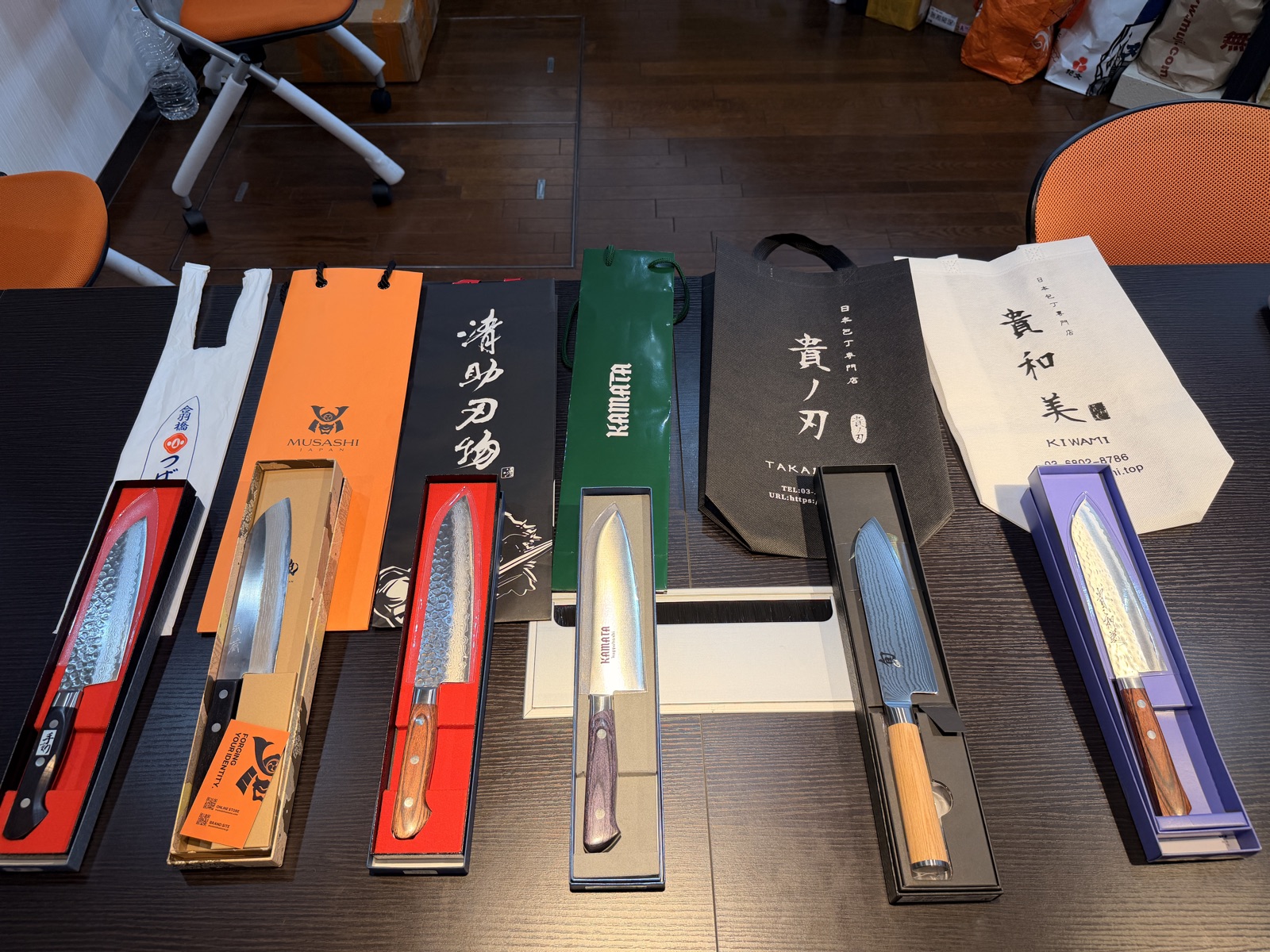
We cover the knife shops on their own pages. Our Kappabashi knife shop map lists 16 knife specialists with addresses and maps. Our Kappabashi knife shopping guide covers budgets, what to ask, engraving and the order in which to visit. And in April 2026 our editors bought one santoku of around $150 at each of six Kappabashi knife shops and cut the same tomato, onion and daikon with all of them; the results, with photos and video, are in our $150 Kappabashi field test. It compares those six knives on one day, not the shops’ full ranges.
If you are flying home with a knife, it has to go in checked baggage; our guide to flying with Japanese knives has the details.
Make one yourself
Kappabashi sells the finished blade. To watch one being made — or make one — the nearest forge is outside the city; in Tokyo itself, two katana polishers take visitors into their workshops.
Tokyo outskirts · 180 min
A sword smith's workshop. Tamahagane is the steel used for katana, which is where the price comes from.
from ¥260,500 per person
Details & bookingAsakusabashi, Tokyo · 140 min
Watch rather than shop: the Japanese Sword Museum, then master polisher Yasumasa Nagaoka at work; trying it yourself is optional and must be requested when you book.
from ¥52,500 per person
Details & bookingSetagaya, Tokyo · 120 min
A step beyond buying whetstones on this street: you polish a real katana yourself with Masaru Nemoto, whom the listing describes as one of about 100 professional katana polishers in Japan.
from ¥34,625 per person
Details & bookingCompare all nine knife-making workshops in Japan
Most of these are booked by request: you propose a date, the workshop confirms it afterwards. Only a handful confirm on the spot — the operator filters those here. Prices as listed by the operator on 14 September 2026. The operator sets them and may change them at any time. Affiliate links: if you book, we may receive a commission at no extra cost to you. These are the operator's listings, not editorial picks. We are an independent publisher, not connected to the operator.
Tax-free shopping in autumn 2026
Japan’s tax-free system changes on 1 November 2026, and there is no transition period: sales up to 31 October follow the old rules, and sales from 1 November follow the new ones.[24][25] According to the National Tax Agency, under the new refund method:[25][26]
- You pay the tax-inclusive price at the shop.
- When you leave Japan, within 90 days of the purchase, you show your passport and have customs confirm that you are taking the goods out, at a kiosk or terminal in the departure lobby — before you check in your bags.
- After that confirmation, the shop refunds the tax. The law does not fix how; the agency gives bank transfer, credit card, an app or cash at the port as examples.
- The minimum is ¥5,000 excluding tax, the old split between general and consumable goods ends, sealed packaging is no longer required, and you may buy only what you can take out of Japan yourself.
At Kappabashi, two things matter. First, not every shop is a tax-free shop: a shop’s page in the association’s directory has a “Tax-Free Sales Status” line saying, for example, whether tax-free sales are handled in the shop or at a tax-free counter, and many pages have no such line. Second, the street has a shared counter, Smart Refund Kappa-bashi, which handles the paperwork for purchases at its member shops.[12] Its listing describes refunds paid on the spot, which is how the old system works; ask how it handles refunds from 1 November. Under the new rules, a counter procedure must be done on the same day as the purchase.[25]
For knife buyers the order at the airport matters: knives travel in checked baggage, but customs confirmation cannot be done after you have checked your bags, so go to the kiosk first.[26] The full rules are in our guide to tax-free shopping in Japan from 2026.
Shipping purchases home
Ceramics and cast iron fill a suitcase quickly. Some shops ship abroad themselves — Hashitou Honten, for example, lists gift wrapping and overseas shipping.[18] The Smart Refund counter lists luggage storage, same-day delivery to hotels, airports, major stations and Tokyo Skytree, and domestic and overseas delivery without you having to pack anything.[12]
Shipping and tax interact. The National Tax Agency says that when you sign a shipping contract at the shop and the goods go to the carrier there and then, the sale counts as an export. The older option of buying tax-free and sending the goods home separately later ended on 31 March 2025.[25] In practice, decide at the till whether something goes in your suitcase or in a box. If you are shipping knives, ask the shop or carrier what your destination country accepts.

A half-day route
Allow three to four hours. This route follows the association’s 2026 map from south to north.[7]
- Start at Tawaramachi and walk west along Asakusa-dori to the Kikuyabashi crossing. Niimi’s giant chef marks the southern entrance.[15]
- Walk the southern half towards the Kappabashi crossing, looking at both sides of the street. Dougen Saito describes itself as the fourth shop on the left as you enter from Asakusa-dori.[19]
- Pause at the midpoint. The map marks a small park with the golden Kappa Kawataro statue just south of the Kappabashi crossing, and the way to Tsukuba Express Asakusa Station runs east from that crossing.[7][2]
- Walk the northern half to Kototoi-dori. The tax-free counter is in this half, and the map shows public toilets at the Taito City Lifelong Learning Center and Kinryu Park; Matsuba Park in the southern half has one too.[7]
- Leave from Iriya by walking west along Kototoi-dori, or turn back and buy on the return leg.
Walk the whole street once before buying anything heavy or fragile, and buy those things last. If you are ordering engraving on a knife, place the order first and collect it on the way back.
The Kappabashi Dougu Matsuri
The Kappabashi Dougu Matsuri is the street’s largest annual event, held each year around 9 October, which the street calls Tools Day (Dougu no Hi).[2] It was first held in 1983.[6] The 41st festival was scheduled for 6 to 12 October 2026, with a prize draw throughout and the street closed to traffic on 12 October from 10:00 to 17:00.[27][28] If you are reading this later in the season, the 2026 festival is over; the association posts the next dates on its website.
Frequently Asked Questions
Is Kappabashi only for knives?
What is the nearest station to Kappabashi?
Are Kappabashi shops open on Sundays?
Can tourists buy at Kappabashi, or is it wholesale only?
How does tax-free shopping work at Kappabashi from 1 November 2026?
Can I ship things home from Kappabashi?
How long do I need at Kappabashi?
When is the Kappabashi Dougu Matsuri?
Sources
- [1] Overview | Kappabashi Dougu Street , Kappabashi Dougugai Promotion Association (2026)
- [2] ごあいさつ | かっぱ橋道具街 , 東京合羽橋商店街振興組合 (2026)
- [3] FAQ | Kappabashi Dougu Street , Kappabashi Dougugai Promotion Association (2026)
- [4] Access | Kappabashi Dougu Street , Kappabashi Dougugai Promotion Association (2026)
- [5] よくあるご質問・お問い合わせ | かっぱ橋道具街 , 東京合羽橋商店街振興組合 (2026)
- [6] かっぱ橋の歴史 | かっぱ橋道具街 , 東京合羽橋商店街振興組合 (2026)
- [7] Handy Shop Guide 2026.9 — Kappabashi Dougugai Street (PDF map) , Kappabashi Dougugai Promotion Association (2026-09)
- [8] 【商店街加盟店舗営業状況】 | かっぱ橋道具街 , 東京合羽橋商店街振興組合 (2026-09-01)
- [9] 「国民の祝日」について(令和8年・令和9年の国民の祝日) , Cabinet Office, Government of Japan(内閣府) (2026)
- [10] Ganso Shokuhin Sample-ya Kappabashi store | Kappabashi Dougu Street , Kappabashi Dougugai Promotion Association (shop directory) (2026)
- [11] Sato Food Samples | Kappabashi Dougu Street , Kappabashi Dougugai Promotion Association (shop directory) (2026)
- [12] TAX-REFUND COUNTER Smart Refund Kappa-bashi | Kappabashi Dougu Street , Kappabashi Dougugai Promotion Association (shop directory) (2026)
- [13] Iidaya (ALL for your kitchen goods) | Kappabashi Dougu Street , Kappabashi Dougugai Promotion Association (shop directory) (2026)
- [14] KANAYA BRUSH (Store specializing in brushes) | Kappabashi Dougu Street , Kappabashi Dougugai Promotion Association (shop directory) (2026)
- [15] Niimi Co.Ltd. (Table & Cooking-Ware) | Kappabashi Dougu Street , Kappabashi Dougugai Promotion Association (shop directory) (2026)
- [16] Dengama (Japanese Pottery, Arita, Mino etc) | Kappabashi Dougu Street , Kappabashi Dougugai Promotion Association (shop directory) (2026)
- [17] TANAKA SHIKKI-TEN | Kappabashi Dougu Street , Kappabashi Dougugai Promotion Association (shop directory) (2026)
- [18] -Japanese forest's gift- Hashitou Honten | Kappabashi Dougu Street , Kappabashi Dougugai Promotion Association (shop directory) (2026)
- [19] Dougen Saito (Kitchen Goods) | Kappabashi Dougu Street , Kappabashi Dougugai Promotion Association (shop directory) (2026)
- [20] Majimaya Confectionery Tool & Gear Shop | Kappabashi Dougu Street , Kappabashi Dougugai Promotion Association (shop directory) (2026)
- [21] Shimojima Kappabashiten (Food & Package) | Kappabashi Dougu Street , Kappabashi Dougugai Promotion Association (shop directory) (2026)
- [22] Saito – White coats (Hakui, Noren, Nobori) | Kappabashi Dougu Street , Kappabashi Dougugai Promotion Association (shop directory) (2026)
- [23] Shimura Seisakusho | Kappabashi Dougu Street , Kappabashi Dougugai Promotion Association (shop directory) (2026)
- [24] 輸出物品販売場制度のリファンド方式への見直し , National Tax Agency Japan(国税庁) (2026-07-08)
- [25] Tax-Free Shopping System will be shifted to the Refund Method from November 2026 (PDF) , National Tax Agency Japan (2025-04)
- [26] Notice to Foreign Travelers Who Purchase Tax-Free Goods (From November 2026) (PDF) , National Tax Agency Japan / Japan Customs (2026)
- [27] 2026 10/6~12「第41回かっぱ橋道具まつり」開催のお知らせ , 東京合羽橋商店街振興組合 (2026-09-15)
- [28] かっぱ橋道具街まつり(特設ページ) , 東京合羽橋商店街振興組合 (2026)