What Is Honyaki? Honyaki vs Kasumi Knives Explained
QUICK ANSWER
Honyaki (本焼) is a knife forged from a single piece of high-carbon steel, often differentially hardened to leave a hamon line; kasumi (霞) is the far more common — and far more practical — two-piece construction where a hard steel edge is clad to a softer iron body.
Honyaki holds the finest, longest edge but is brittle, very hard to sharpen, and several times more expensive. For nearly every home cook, a good kasumi knife is the right answer.
- Honyaki (本焼)
- One single steel, often differentially hardened
- Kasumi (霞)
- Hard edge steel clad to a soft iron body
- Hamon
- The wavy temper line on honyaki blades
- Who needs honyaki
- Sushi pros & collectors — rarely home cooks
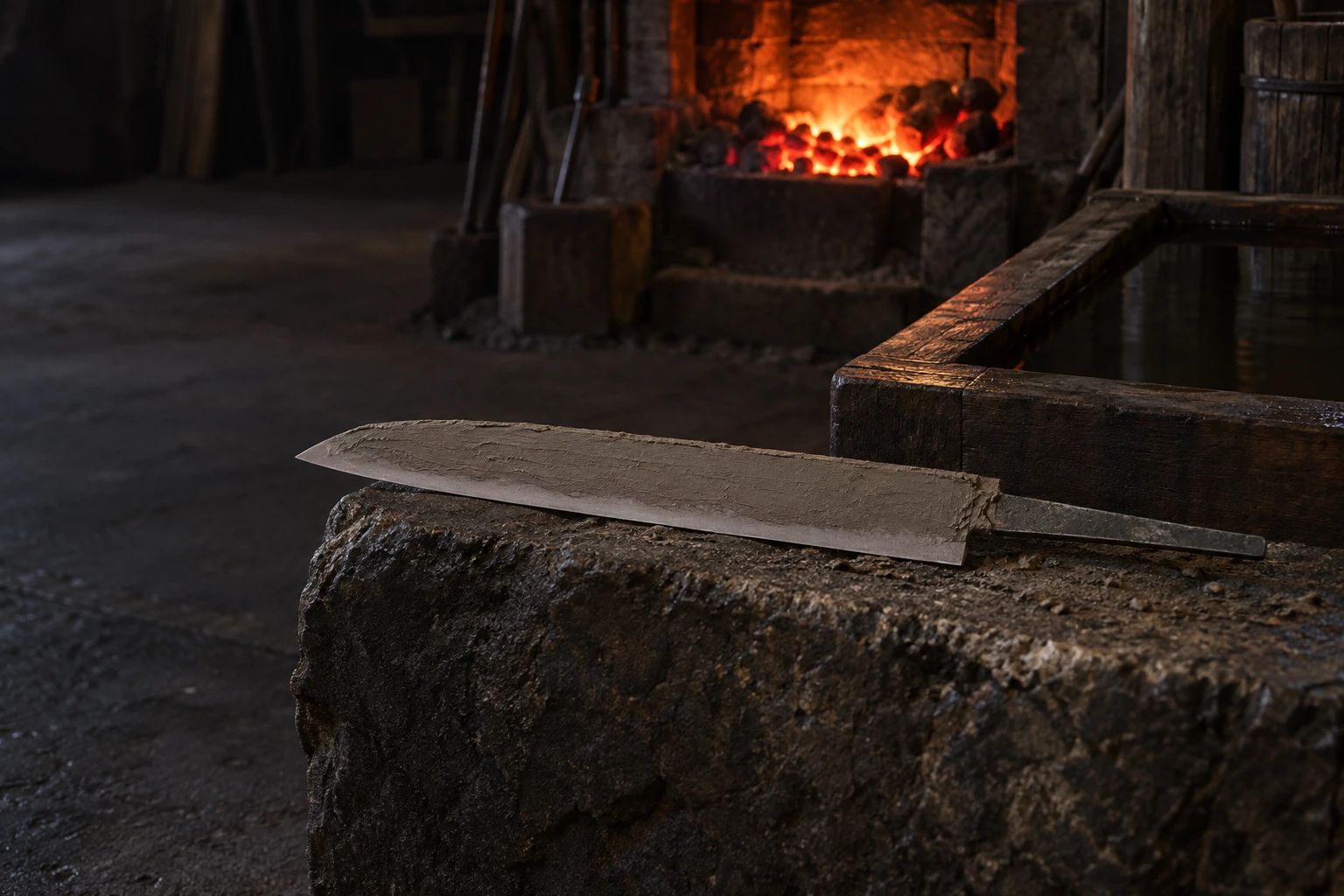
Table of Contents
TL;DR — honyaki vs kasumi in 30 seconds
- Honyaki (本焼) — forged from a single piece of high-carbon steel, usually a white (Shirogami) or blue (Aogami) steel. Often differentially hardened, which can leave a visible hamon temper line, much like a traditional Japanese sword.
- Kasumi (霞) — a two-material blade: a hard high-carbon steel edge forge-welded (clad) to a softer iron or low-carbon steel body (jigane). This is the standard, far more common way Japanese knives are made.
- Honyaki is harder, can hold the finest and longest edge, and is prized by specialists — but it is also more brittle, much harder to sharpen, and several times more expensive.
- Kasumi is easier to make, sharpen, and live with, and forgives the kind of mistakes everyone makes in a real kitchen.
- The honest bottom line: for nearly all home cooks, a good kasumi knife is the right choice. Honyaki is overkill — beautiful, but overkill.
If you only remember one thing: honyaki = one steel, kasumi = two. Almost everything else follows from that single fact.
What is honyaki?
Honyaki (本焼, roughly "true-forged" or "true-hardened") is a knife made from a single, uniform piece of high-carbon steel. There is no separate softer body welded on — the whole blade is the same hard steel, shaped, ground, and heat-treated as one. This puts honyaki in the same conceptual family as the traditional Japanese sword (katana), which is also forged and hardened from carbon steel using related techniques.
The signature move in classic honyaki is differential hardening. The smith coats the blade with clay — thin along the cutting edge, thick over the spine — and then heats and quenches it in water or oil. The exposed edge cools quickly and transforms into very hard steel; the clay-insulated spine cools more slowly and stays comparatively soft and tough. The result is a single blade with two personalities: a hard edge that takes and holds a fine apex, and a softer back that absorbs shock so the whole thing is less likely to snap.
That hard-soft boundary is what produces the hamon — the wavy temper line you see on a well-made, properly polished honyaki. We come back to the hamon in detail below, because it is both the most beautiful and the most misunderstood part of the whole subject.
The steels involved are usually traditional Japanese carbon steels — most often a white steel (Shirogami) or blue steel (Aogami). These take an extremely keen edge and respond well to hardening, which is exactly why they are chosen here. They are also reactive and will rust if neglected, which is part of what makes honyaki a high-commitment object. For how those carbon steels compare to stainless, see our carbon vs stainless knife guide; for the steel families themselves, see the steel types guide.
What is kasumi?
Kasumi (霞, "mist" or "haze") is the construction you'll actually meet in almost every Japanese knife shop. Instead of one steel, a kasumi blade is built from two materials forge-welded together:
- Hagane — a thin layer of hard, high-carbon cutting steel that forms the edge.
- Jigane — a softer iron or low-carbon steel body that makes up most of the blade and supports the hard edge.
The hard steel does the cutting; the soft body makes the knife easier to forge, easier to sharpen, and much more forgiving. The name "kasumi" refers to the soft, hazy, slightly cloudy finish that the softer jigane takes on when the blade is polished — a different look from the bright, hard, mirror-prone surface of honyaki.
This two-part approach is genuinely clever engineering, not a compromise. You get most of the edge performance of a hard carbon steel without making the entire blade hard and brittle, and you can sharpen the knife on a stone without fighting the steel the whole way. The vast majority of single-bevel traditional knives — the yanagiba sushi slicer being the classic example — are kasumi, and so are countless excellent double-bevel knives.
In short: kasumi is not "honyaki's cheaper cousin." It is the mainstream, time-tested, practical standard, and a fine kasumi knife from a good maker is a serious tool that will outlast you.
How each one is made
Making a kasumi knife
The maker forge-welds a piece of hard cutting steel to a piece of softer iron, then forges the laminated billet out into a blade shape. Because the body is soft, the steel moves predictably under the hammer and grinds and sharpens cooperatively later. Hardening only really needs to take hold in the thin hard layer at the edge. The process is demanding and skilled, but it is comparatively forgiving — and that forgiveness is exactly why kasumi can be made in greater numbers and at more accessible prices.
Making a honyaki knife
Honyaki has no soft body to hide behind. The entire blade is one hard carbon steel, so every step is less forgiving and the hardening step is genuinely high-stakes:
- Clay coating — the smith applies clay in a carefully judged pattern, thin at the edge and thick at the spine, to control how fast each part of the blade will cool.
- The quench — the blade is heated and then plunged into water or oil. This is the moment of truth. The violent, uneven cooling can warp the blade or crack it outright, and a single piece of hard steel has nowhere to absorb that stress.
- Failure is normal — because of that, a meaningful share of honyaki attempts are lost at the quench or in finishing. Those failures are real costs that get folded into the price of the knives that survive.
- Finishing and polishing — straightening, grinding, and a long, patient polish that ultimately reveals the hamon.
This is why honyaki is associated with master smiths and why so few makers produce it. It demands control over heat, steel, and timing that takes years to develop and still doesn't guarantee a perfect result on any given blade.
The hamon — what it is and isn't
The hamon is the wavy, cloudy line that marks the border between the hard edge and the softer spine of a differentially hardened blade. It is not painted on and it is not decoration applied for its own sake — on a true honyaki it is the visible fingerprint of the heat treatment, the place where the fast-cooled hard steel meets the slow-cooled soft steel. Polishing and etching bring it out so the eye can read what the quench did.
A few honest caveats worth knowing:
- A hamon does not automatically mean honyaki. A visible temper-line look can be created or enhanced cosmetically on some knives, and laminated (kasumi) blades can show lines too. The hamon is suggestive, not proof. If authenticity matters to you, buy from a maker or shop that states clearly how the blade was made.
- The hamon doesn't make the knife cut better. It is the consequence of the hardening, not a performance feature in itself. The edge does the cutting; the hamon just lets you see the story of how the blade was hardened.
- It rewards maintenance. Because honyaki is reactive carbon steel, the polished surface that shows off a hamon will patina and can rust if you neglect it. The beauty and the upkeep are a package deal.
Honyaki vs kasumi: side by side
| Aspect | Honyaki (本焼) | Kasumi (霞) |
|---|---|---|
| Construction | Single piece of high-carbon steel | Hard steel edge clad to soft iron/steel body |
| Typical steel | Shirogami (white) or Aogami (blue) carbon | Hard carbon edge + soft jigane body |
| Hardening | Often differentially hardened (clay + quench) | Hardening concentrated in the edge layer |
| Hamon | Can show a genuine hamon temper line | Hazy "kasumi" finish; no true hamon |
| Edge potential | Very fine, very long-lasting | Excellent — slightly behind the best honyaki |
| Toughness | More brittle; less forgiving of abuse | More forgiving; soft body absorbs shock |
| Sharpening | Hard and demanding; pro work common | Cooperative on stones; beginner-friendlier |
| Availability | Rare; made by relatively few smiths | Mainstream; widely available |
| Price (broad ranges) | Often ~$600 to $3,000+ | Roughly ~$80 to $300 for good knives |
| Best for | Specialists, collectors, devoted owners | Home cooks and most professionals |
Prices are broad, illustrative ranges only — actual prices vary widely by maker, steel, size, and finish.
Honest pros and cons
Honyaki — the case for and against
- Pro — peak edge. A well-made honyaki can take an exceptionally keen edge and hold it for a long time.
- Pro — craft and beauty. The hamon, the polish, the single-steel construction, and the maker's mark add up to an object many people genuinely treasure.
- Con — brittleness. The same hardness that holds the edge makes it less tolerant of twisting, bones, hard contact, and accidental drops. Chips happen, and they're painful to fix.
- Con — hard to sharpen. Honyaki is demanding on the stones; many owners rely on professional sharpening rather than doing it themselves.
- Con — cost and care. Several times the price of a comparable kasumi knife, plus the rust-prone upkeep of reactive carbon steel.
Kasumi — the case for and against
- Pro — practical performance. Cuts beautifully and gets genuinely sharp; the gap to honyaki is small in everyday use.
- Pro — forgiving and serviceable. The soft body absorbs shock and makes the knife far easier to sharpen and maintain.
- Pro — accessible. Excellent kasumi knives exist at sane prices and are easy to find.
- Con — slightly behind the very best. At the extreme top end of edge fineness and retention, the best honyaki has an edge — one most cooks will never notice.
- Con — carbon care (if carbon-clad). Many traditional kasumi knives still use reactive carbon steel and need drying and a little oil, though stainless-clad versions exist.
Who honyaki is actually for
Honyaki is a specialist's and a collector's object. It makes the most sense for:
- Sushi and traditional Japanese professionals who slice all day, value the very finest edge, push their tools to the limit, and already have the sharpening skill (or a trusted sharpener) to keep a hard blade in shape. A honyaki yanagiba is the classic example of this — the single-bevel slicer where edge refinement matters most.
- Collectors and enthusiasts who appreciate the craft, the rarity, the hamon, and the connection to swordmaking traditions, and who want to own a piece that represents the top of a smith's skill.
- Devoted home cooks who go in with eyes open — people who genuinely enjoy maintenance, want the experience, and accept the cost and fragility as part of the deal.
Notice who isn't on that list: the ordinary home cook who wants one excellent knife to chop vegetables, break down a chicken, and slice fish on weekends. For that person, honyaki is the wrong tool — not because it's bad, but because its advantages don't show up in that kitchen while its drawbacks very much do.
Price reality
Treat these as broad ranges, not quotes — actual prices swing widely with the maker, the steel, the size, the finish, and the shop.
- Good kasumi knives — roughly $80 to $300 for a wide range of well-made everyday and traditional knives. This is where the value lives.
- Honyaki — frequently $600 to $3,000 and up, sometimes far higher for renowned makers, large single-bevel blades, or elaborate finishes.
The premium is not arbitrary. You are paying for the difficulty of single-steel construction, the real failure rate at the quench, the skill required, and the scarcity of smiths who do this work at all. That is a legitimate price for craft and rarity — it just isn't a price most people need to pay to get a knife that cuts wonderfully. If you're shopping in Japan, both kasumi and honyaki knives are easiest to compare in person in places like Tokyo's Kappabashi kitchenware district, where you can see the construction and finish for yourself before committing.
Do you actually need honyaki?
Almost certainly not — and that's not a knock on honyaki, it's just honest advice. Here's the simple decision:
- Buy kasumi if you want one or two great knives that perform beautifully, sharpen cooperatively, forgive real-kitchen mistakes, and don't cost a small fortune. That describes the overwhelming majority of cooks, home and professional.
- Consider honyaki only if you are a slicing specialist or a committed enthusiast/collector, you already sharpen well (or pay someone who does), and you specifically want the craft, the hamon, and the peak edge — and you accept the fragility, the upkeep, and the cost.
A great kasumi knife will get you 95% of the way to "the best cutting experience of your life" for a fraction of the price and a fraction of the worry. Spend the difference on a good whetstone and the time to learn to sharpen — that will improve your cutting far more than upgrading from kasumi to honyaki ever would.
Where to go next: read the carbon vs stainless knife guide to decide how much maintenance you actually want, the steel types guide to understand white vs blue carbon steels, and our best Japanese knives roundup for concrete picks. If single-bevel slicers are what drew you here in the first place, see the best yanagiba knife guide and the yanagiba knife type overview.